How to Compare Wheel Hub Unit Quality: OEM vs Aftermarket
What Determines the Quality of a Wheel Hub Bearing Unit?
Quality in a wheel hub bearing unit is set by five controllable variables: raceway steel and heat treatment, grinding and superfinishing tolerance, internal clearance or preload, the seal and grease package, and the rigidity of the flange or housing the bearing sits in. Two units with identical boundary dimensions can differ on every one of them, which is why a euro-quoted offer cannot be ranked by part number alone. German buyers often phrase the same question as “wie lässt sich die Qualität von Radnaben- und Radlager-Einheiten in €-Angeboten vergleichen”; the method is language-independent — compare specification and batch documents first, freight second, unit price last.
What Is Inside a Hub Bearing Unit?
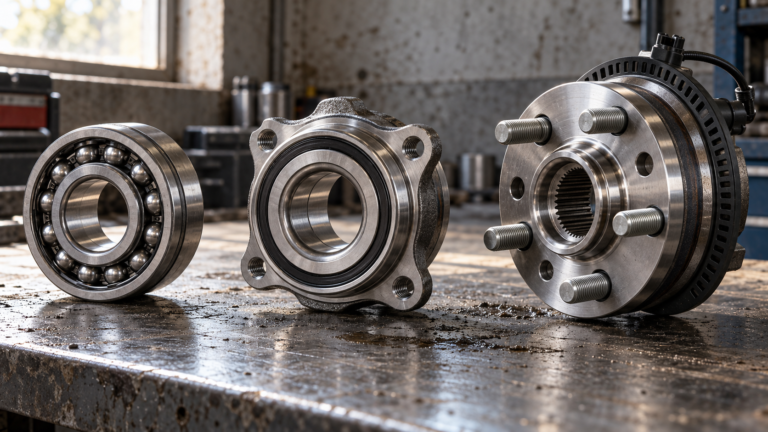
A hub bearing unit is a double-row angular contact ball bearing, greased for life and sealed on both sides, that carries the combined radial and axial loads produced by cornering, braking and drive torque. Its components are two inner rings (often joined by the flange), one outer ring, two ball sets, a cage per row, contact lip or cassette seals, a measured grease fill, and — on second- and third-generation units — a magnetic encoder ring or toothed ring for the ABS sensor. In a third-generation unit the wheel flange, disc pilot and studs are integrated, so the part is replaced as a complete assembly rather than re-greased or adjusted.
One-, Two- and Three-Generation Units: What Changes?
The generation number describes how far the bearing is integrated into the corner assembly; it is not a quality grade. A first-generation unit is a bearing only, pressed into a separate hub and knuckle. A second-generation unit carries an outer-ring flange that bolts to the knuckle but still uses a separate hub. A third-generation unit is a sealed cartridge with the hub flange and ABS interface built in. Each step removes an interface a fitter can assemble wrongly, and adds inspection points on the supplier’s side.
| Unit generation | Bearing arrangement | Mounting interface | ABS interface | What to verify in the offer |
|---|---|---|---|---|
| Generation 1 | Double-row angular contact ball, sealed for life | Pressed into hub and knuckle; separate hub | None, or a separate sensor ring | Bore and width tolerance, seal type, clearance |
| Generation 2 | Double-row angular contact ball with outer-ring flange | Bolted to knuckle; separate hub | Encoder on the bearing or on the hub | Flange PCD, bolt grade, encoder presence |
| Generation 3 | Unitized double-row, flange integrated | Bolts directly to knuckle; wheel mounts on the flange | Magnetic encoder integrated | Flange offset, stud pattern, encoder signal, seal design |
How Do Material and Heat Treatment Change Service Life?
Raceway life depends on through-hardened bearing steel of the 100Cr6 / AISI 52100 type, held at the specified hardness with controlled retained austenite, or on case-hardened steel where shock loads dominate. Two suppliers can both write “bearing steel” while differing in carbide distribution, tempering temperature and hardenability. Raceway roughness and roundness matter as much as hardness: a superfinished raceway runs cooler, generates less noise and resists contamination-driven spalling for longer. At the wheel end, clearance and preload are application parameters rather than quality grades — a P6-class unit is not automatically better than a normal-class unit if the clearance does not suit the knuckle and the duty cycle.
Which Hub Unit, Tapered or Cylindrical Roller Bearing Fits the Load Case?
Match the bearing to the direction and size of the load, not to the price band. Combined radial and axial loads at a car corner belong to double-row angular contact ball hub units; heavy radial loads with shaft deflection belong to tapered roller bearings mounted in adjusted pairs; high-stiffness radial duties with negligible axial load belong to cylindrical roller bearings.
Where Do These Bearings Sit on a Vehicle?
Hub units sit at all four corners and carry the vertical wheel load plus cornering and braking forces. Tensioner and idler bearings sit on the accessory drive, where they carry a light radial load at high speed for the life of the belt. Constant-velocity joint assemblies sit on the driveshafts and transmit torque while articulating through steering and suspension travel. Clutch release bearings sit at the gearbox input and take an axial load each time the clutch is operated. HJDP, the brand of Jinan Huayuan Auto Bearing Co., Ltd. (jnhjdp.com), builds its range around these positions: first-, second- and third-generation hub units and hub assemblies, tensioner and idler bearings, CV joint assemblies, clutch release bearings, and tapered and cylindrical roller bearings for automotive use.
Tapered or Cylindrical: Which One for Which Duty?
| Criterion | Tapered roller bearing | Cylindrical roller bearing |
|---|---|---|
| Load direction | Combined radial and axial, one axial direction per row | Radial only, with high radial capacity |
| Stiffness | High; set by preload or end play | Very high radially; no axial location |
| Mounting | In adjusted pairs; the setting must be measured | One ring floats axially in the housing |
| Alignment sensitivity | Low tolerance of misalignment; edge loading if offset | Sensitive to angular error between housing and shaft |
| Typical automotive position | Wheel ends, differentials, trailer axles | Gearbox shafts, some idler and pulley arrangements |
| What to check in a quote | Cup and cone matching, contact pattern, setting instruction | Roller profile, cage and rib design, clearance class |
Two practical consequences follow. Tapered bearings are set by adjustment — preload or end play — so the drawing must state the setting and the mounting must reproduce it; a pair installed without measuring will fail early at one row. Cylindrical roller bearings need one ring free to float axially, so a housing that clamps both rings converts thermal growth into axial loading.
How Do Tensioner Bearings and CV Joints Differ in Duty?
A tensioner bearing fails from grease starvation and seal wear rather than raceway fatigue, because its load is small and its speed high; pulley concentricity, belt alignment and seal quality decide life more than load rating. A CV joint works at articulation angles and transmits torque through ball tracks and a cage, so track geometry, cage window clearance, boot material and grease type decide durability — a joint that loses its boot fails within a short distance regardless of the steel underneath. A clutch release bearing carries an intermittent axial load and must stay quiet under preload, which makes grease distribution and seal friction audible defects rather than theoretical ones.
How Do OEM and Aftermarket Wheel Bearing Units Actually Differ?
OEM and aftermarket describe the route a part takes to market and the documents that travel with it, not a tolerance class. The same production line can supply both, and an aftermarket unit built to a well-controlled drawing can be dimensionally tighter than a low-cost part sold as “OEM”. The label tells you who owns the drawing and the approval process; the drawing and the batch documents tell you what the part actually is.
What Do the Two Labels Mean in a Bearing Offer?
An OEM part is produced against a vehicle manufacturer’s drawing and part number, normally marked under that manufacturer’s approval and delivered with the documentation the programme requires. An aftermarket part is produced to the bearing maker’s own drawing or to the buyer’s drawing, sold under a brand name and cross-referenced to OE numbers through catalogues. Phrases such as “OEM quality” or “OEM standard” have no agreed definition and no test behind them, so they should carry no weight in a comparison. What can be compared is the drawing revision, the measured values and the traceability of the batch.
Where Do Aftermarket Parts Legitimately Differ?
Seal compound (NBR, HNBR or a PTFE lip), grease supplier and fill percentage, encoder magnet grade, cage material, coating, marking, packaging and the depth of documentation are all places where an aftermarket offer may differ from an OEM release without being defective. Some differences are cost-driven and harmless; others change life. A lower-grade encoder can lose signal at low wheel speed and trigger an ABS fault that looks like a sensor failure, and a cheaper lip seal is where water ingress starts. The trade-off is examined in more detail in this comparison of aftermarket versus OEM wheel bearings.
Which Risks Should the Price Difference Cover?
A lower euro price is only a saving if it does not buy one of five risks: relabelled or mixed-batch parts without a traceability code; an encoder that does not match the vehicle’s sensor; clearance chosen for a different application; seal and grease that suit a dry climate but not a wet one; and packaging that lets units move inside the carton. Each of these appears later as a return, a workshop comeback or a warranty claim, and each is cheaper to check before the order than after it.
Which Drawing and Sample Details Should You Confirm Before Ordering?
Confirm eight parameters on a revision-controlled drawing and match them to a physical sample before you discuss price. These are the items that decide fit and life; packaging, marking and payment terms are negotiable, dimensions and materials are not. Where a model or OE number is involved, treat catalogue cross-references as a starting point only — fitment is confirmed against the drawing and a physical sample, not against a list.
| Parameter | Where it appears | Why it decides fit or life |
|---|---|---|
| Boundary dimensions (bore, outside diameter, width) | Dimension lines on the main view | Controls seating in the knuckle or hub bore |
| Flange PCD, pilot diameter, offset | Flange view on generation 2 and 3 units | Centres the brake disc and wheel; wrong offset changes track and load |
| Internal clearance or preload | Note or table on the drawing | Drives noise, heat and fatigue life |
| Seal type and material | Section view and parts list | Determines water and dust resistance |
| Grease type and fill quantity | Note on the drawing | Sets grease life at operating temperature |
| Encoder type and pole count | Detail view or separate specification | ABS signal quality at low speed |
| Material and heat treatment | Title block and notes | Fatigue and wear resistance |
| Marking and packaging | Separate packaging specification | Traceability and private-label compliance |
How Should the Sample Be Approved?
- Request the drawing with revision number and date, not a catalogue image or a photo of a part.
- Compare the drawing with the part removed from the vehicle and the number it carries; note any difference rather than assuming the catalogue is right.
- Ask for a sample taken from a production batch, not a hand-built pilot piece.
- Measure boundary dimensions, flange geometry and clearance, and check radial and axial runout.
- Inspect the seal lips and the encoder ring, then spin the unit and listen for noise and roughness.
- Trial-fit on a knuckle or hub in your own workshop, including bolt torque and sensor gap.
- Sign and retain the approved sample as a golden sample, and quote its revision number on the purchase order.
- Fix marking, packaging and private-label artwork in the same document set, so a later reorder cannot drift.
HJDP supports this sequence for its own range with drawing review, sample confirmation, custom packaging and private-label marking, so that the approved sample and the shipped batch are described by one document.
What Do Certifications and Quality Documents Prove?
A certificate proves that a management system or a batch was audited within a stated scope on a stated date; it does not prove the clearance, grease fill or seal quality of the unit in the carton. Certificates are useful for shortlisting a supplier. Batch documents are what allow you to accept a part, and they are the only thing that lets you trace a failure back to a heat number and a production date.
Which Documents Attach to a Batch?
Ask for the dimensional inspection report with measured values rather than a pass stamp, the material certificate with heat number, the heat-treatment record, the grease specification, the seal and encoder specification, and a packing list carrying a traceability code that also appears on the unit or its box. A first-article report for a new part number is worth more than a brochure, because it names the part, the drawing revision and the instruments used.
How Should a Certificate Be Read?
Read four things: the scope statement, to see whether wheel hub bearings are actually inside the certified scope or only other product families; the standard the system is certified to; the accreditation and name of the issuing body; and the site address, which must be the site that produces or at least controls the part. A certificate issued to a trading office does not describe a production line, and an expired certificate is a historical document.
How Do You Judge a Test Report?
Check the sample size, the standard or internal procedure referenced, who ran the test and when, the pass or fail criteria, and whether the tested part number and revision match the part you are buying. One endurance run on one sample is a data point; a dimensional report on a production batch is evidence. A report that omits the criteria is a statement, not a result.
How Do You Compare Freight and Landed Cost in Euro-Quoted Offers?
Convert every offer to landed cost per bearing at one Incoterm before comparing unit prices. Bearings are dense, but flanged hub units and CV joint assemblies are bulky, and once chargeable weight, packing and destination charges are added, a lower unit price frequently stops being the cheaper part. The same rule applies whether the offer arrives in euros, dollars or yuan.
| Cost element | Basis of calculation | What to verify |
|---|---|---|
| Goods value | Per piece and per carton | Currency, and the date of the exchange rate used |
| Export packing | Carton, pallet, marking | Pieces per carton, pallet height, whether packing is charged |
| Main freight | Chargeable weight, actual or volumetric | Incoterm point, port or airport pair, carrier |
| Insurance | Percentage of the insured value | Whether it is included in the quoted figure |
| Duty and import tax | Customs code and destination rate | Who declares, and on which valuation |
| Destination charges | Per shipment | Fixed cost that shrinks per unit as volume grows |
| Quality cost | Inspection, returns, downtime | Defect allowance and inspection scope in the contract |
Why Do Incoterms and Packing Density Decide the Ranking?
An EXW price stops at the factory gate and leaves export clearance, main freight, insurance and destination handling to the buyer; a CIF price includes freight and insurance to a named port but not the charges after arrival; a delivered price includes them. Comparing an EXW figure with a delivered figure is the most common error in a euro-quoted enquiry. Packing density is the second: hub units shipped in oversized cartons are charged on volume rather than weight, so a carton redesign that removes void space can cut cost per piece without any change in unit price.
How Do You Keep the Comparison Fair?
- Same Incoterm, same quantity break, same packing specification and same payment terms for every offer.
- Ask for freight as a separate line so you can re-quote with your own forwarder and compare the goods value alone.
- Record the exchange rate and its date, and keep it on the comparison sheet.
- Include the inspection scope, because a cheaper offer that needs full incoming inspection is not cheaper.
What Should Incoming Inspection and Installation Cover?
At goods-in, verify identity and traceability first, then dimensions and rotation, then seals and encoders; at installation, press only on the ring that carries the interference fit. Most early wheel bearing failures in the aftermarket are installation and handling failures rather than manufacturing failures, and both are visible if the checks are defined before the parts arrive.
Which Failure Modes Point to a Quality Problem?
- Rust or water marks under the seal lip: seal lip geometry, grease type, or storage damage before fitting.
- Spalling on a raceway with clean grease: contamination at assembly, or a heat-treatment and film problem.
- Evenly spaced marks across the raceway (false brinelling): vibration during transport or long storage without rotation.
- Cage fracture or roller marks in the cage pockets: cage material, misassembly, or shock loading during fitting.
- ABS fault immediately after fitting: encoder damaged by pressing through the inner ring, or metal particles on the encoder face.
- Grease leakage from the seal: overfill, a rolled lip during assembly, or a seal fitted in the wrong orientation.
How Should a Hub Unit Be Installed?
- Clean the knuckle bore, remove burrs and corrosion, and check that the bore is round.
- Support the ring that carries the press fit; never transmit press force through the balls, rollers or cage.
- Press the unit in square with the correct driver — a hammer transfers load through the raceways.
- Tighten flange bolts to the vehicle maker’s torque and in the specified sequence.
- Clean the encoder face and check the sensor gap before the final torque.
- Rotate the wheel and re-check for noise, end play and brake drag.
What Belongs on a Goods-In Checklist?
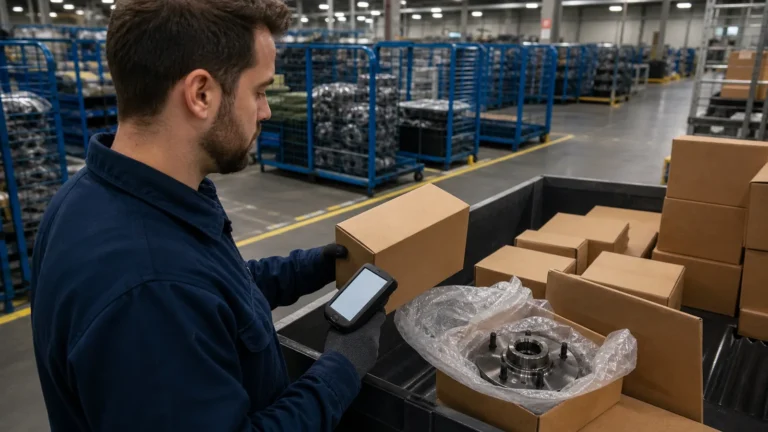
Record the traceability code against the purchase order, count and check carton condition, look for rust or oil staining on the seals, confirm that the marking on the part matches the drawing, measure one unit per batch against the boundary dimensions, spin it for noise, and file the document set with the batch. If a batch fails one of these, the decision to accept, sort or reject should be taken before the cartons are put away, because traceability is lost once units are mixed on a shelf.
Frequently Asked Questions
Is an OEM wheel bearing always better than an aftermarket one?
No. The label describes the supply route and the approval process, not the tolerance of the part. An aftermarket unit produced to a controlled drawing, with batch dimensional reports and a matching encoder, can equal or exceed a low-cost part sold as OEM. Compare drawing parameters, clearance, sealing and documents rather than the word printed on the box.
How do I compare two hub unit offers quoted in euros?
Put both on one sheet at the same Incoterm and quantity: drawing revision, clearance, seal and encoder specification, batch documents, pieces per carton, chargeable weight and duty. Then divide total landed cost by the number of pieces. The lower unit price often loses once packing and freight are expressed as cost per bearing.
Do certificates guarantee bearing quality?
No. A management-system certificate shows that a process was audited within a stated scope on a stated date; it does not certify the clearance or grease fill of the unit in the carton. Use certificates to shortlist suppliers, then accept parts on batch dimensional reports, material certificates and an approved sample.
Why can freight change which offer is cheaper?
Because flanged hub units are bulky relative to their weight, and air or courier freight is charged on volumetric weight. A carton that wastes space, an over-tall pallet or a partial container can add more per piece than the gap in unit price. Ask for chargeable weight and carton dimensions before ranking offers.