Aftermarket vs OEM Wheel Bearings: A Buyer’s Evidence Guide
The useful answer to aftermarket versus OEM wheel bearings is not that one label always wins. The right choice is the exact part whose fitment, manufacturing evidence, traceability, validation, warranty and total acquisition cost meet the vehicle and the buyer’s program. This guide shows how to make that comparison without relying on packaging or slogans.
Are OEM wheel bearings always better than aftermarket bearings?
No universal rule makes every OEM-channel part better or every aftermarket part lower quality. OEM-channel parts may offer strong catalog integration and vehicle-program support; aftermarket parts range from well-controlled application-specific products to unverified copies. Confirm the OE relationship, vehicle qualifiers, mechanical and sensor interfaces, product-specific evidence, manufacturer identity, lot traceability and commercial terms before deciding.
Define OEM, OE and aftermarket before comparing parts
“OEM” is used loosely in the parts trade. It can mean the vehicle manufacturer, a supplier that made an original-equipment part, a service part sold through the vehicle brand, or simply a product presented as equivalent. Those are not the same claim. An aftermarket bearing is a part sold outside the vehicle maker’s branded service channel; its quality can range from well-controlled, application-specific production to an unverified visual copy. The label alone predicts neither fitment nor service life.
For a useful comparison, identify the exact service part number, OE reference, manufacturer and product revision. Then compare functional interfaces, material and process evidence, validation, warranty and traceability. A premium aftermarket supplier may provide clearer batch records than an anonymous part in OEM-style packaging. Conversely, a familiar name does not correct a mismatched axle, encoder or connector.
Decision principle: choose the product whose application and conformity can be demonstrated for the specific vehicle and duty. Do not rank two bearings only by package, country of origin, price or the words OEM quality.
Start with exact vehicle and wheel-end fitment
The safest comparison begins with VIN-supported or otherwise controlled application data. Record vehicle make, model, platform, model year, market, engine or drive configuration where relevant, front or rear axle, left or right if differentiated, and driven or non-driven position. An OE number should be normalized carefully—spaces, hyphens and supersessions can matter—and every interchange should retain its source and qualifiers.
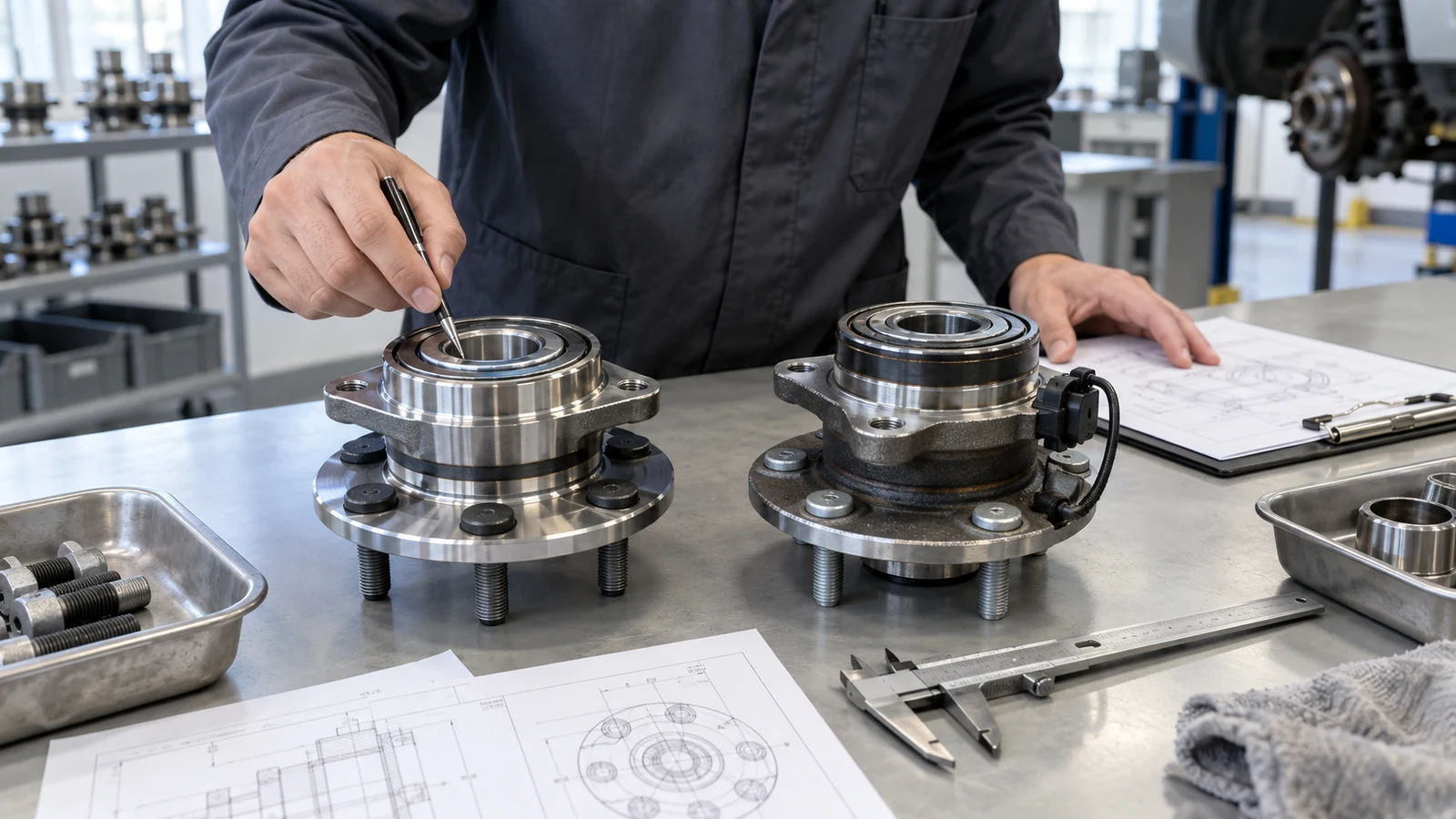
Next compare the physical and electrical interfaces: bearing or hub-unit generation, bore or spline, flange pilots and offsets, mounting-hole and wheel-stud pattern, thread form, ABS encoder or tone ring, sensor type, connector, cable length, bracket positions and supplied fasteners. Two units can share an outer silhouette and still differ in offset, spline count or speed-signal design. Product photos are good for rejecting obvious conflicts but weak evidence for approving a fit.
If the listing and the vehicle record conflict, stop. Ask for a drawing, a controlled catalog reference or an approved sample comparison. Do not use installation force to resolve uncertainty. A hub that must be modified, rewired or “made to fit” is not an acceptable interchange unless the vehicle maker has an authorized procedure.
Compare like-for-like bearing architecture
Generation 1 bearings, Generation 2 flanged units and Generation 3 integrated hub assemblies have different installation and interface requirements. Some applications use a separate bearing pressed into a knuckle; others integrate one or both flanges, wheel studs, an encoder or a complete sensor. Price comparisons become misleading when one quote includes a hub, studs, nut and sensor while another includes only the rolling bearing.
Capture the supplied scope as a bill of contents. Confirm whether retaining rings, axle nuts, bolts, dust caps or sensor clips are included and whether they are single-use. A lower unit price can create a higher installed cost if additional hardware, labor or return handling is required. For distributor programs, packaging, label data and kit consistency are part of the product because missing hardware creates service-bay delays and warranty disputes.
Architecture also changes the correct inspection and installation method. Never transfer a torque, press direction or preload procedure from a similar-looking unit. The current vehicle service information controls installation, and a bearing supplier’s general guide is supporting information only.
Understand what performance evidence can support
ISO 281 describes methods for dynamic load rating and rating life under stated assumptions and explains that modified life can account for factors such as reliability, lubrication and contamination. It does not predict the exact road life of a hub bearing in every vehicle. Impact loads, water ingress, electrical erosion, installation damage, wheel offset, mating-part condition and duty cycle can dominate field performance.
When a supplier presents a life test, ask for the tested part number and revision, sample count, load, speed, temperature, lubricant, contamination control, failure definition and comparison baseline. Results from a different design family are useful engineering context but not proof for the offered SKU. The same applies to running torque, seal endurance, corrosion, flange fatigue, stud retention and sensor-signal tests.
Dimensional conformance should reference an agreed drawing. ISO 492:2023 provides geometrical characteristics and tolerance values for radial rolling bearings, but an integrated automotive hub includes additional features that the product drawing must define. A complete report shows units, datums, method and actual readings rather than a row of “OK” marks.
Evaluate the supplier’s quality and traceability system
Ask who manufactures the part, where it is made and which operations are outsourced. If certification is relevant, verify the legal entity, site and scope with the issuing or oversight system. IATF 16949 is an automotive quality-management standard with customer-specific requirements; it is not a brand tier. Product approval still needs drawing, process and lot evidence.
A distributor-ready traceability record should connect the part or carton label to production date or lot, critical component and material batches where agreed, inspection results and shipment. Ask the supplier to demonstrate a mock containment: starting from one label, can it identify the potentially affected scope and produce the linked records? A vague claim of full traceability is less useful than a five-minute demonstration.
Review change-control rules before the first order. Material, grease, seal, encoder, sensor, component source, manufacturing site, tooling, test method and packaging can all affect conformity. Define which changes require notification, samples, revalidation or buyer approval. A warranty cannot compensate for an uncontrolled change that creates widespread catalog errors.
Compare total acquisition cost, not unit price alone
The purchase price is only one line. Add freight, duty, inspection, packaging, inventory carrying cost, installation labor, missing hardware, return freight, technician time, customer credits and brand damage. Use actual program data where available rather than a universal failure-cost multiplier. A more expensive part is not automatically a better value; it must reduce a documented risk or deliver a measurable service benefit.
MOQ and lead time also influence the decision. A supplier may offer excellent technical evidence but require an uneconomic quantity for a slow-moving application. Consider mixed-SKU consolidation, sample orders, forecast flexibility and replenishment cadence. For high-volume lines, capacity evidence and contingency planning matter more than a one-time sample. For low-volume lines, catalog accuracy and low MOQ may dominate.
Normalize quotations so both candidates include the same scope: product revision, accessories, packaging, label, inspection documents, Incoterm, named place, currency, payment terms and warranty process. Otherwise the cheaper quote may simply exclude requirements that reappear later as surcharges or operational work.
Treat identity and anti-counterfeit checks as separate controls
Branded packaging is not proof of origin. Buy through an authorized or otherwise verified channel, retain supplier identity and transaction records, and compare product markings, label structure and packaging against approved references. Do not publish a counterfeit accusation from a visual difference alone; manufacturers update packaging and multiple legitimate production sites can exist.
For private-label aftermarket parts, identity control means something different: the buyer must know the actual manufacturer, approved design and lot behind its own label. Define who owns the drawing, who may approve a sub-supplier and how mixed inventory is prevented. Unique carton and product codes should survive repacking when traceability is a contractual requirement.
If a part’s origin or revision cannot be established, quarantine it until evidence is resolved. Price pressure is not a reason to weaken identity control, especially for wheel-end components that affect retention, rotating smoothness and speed sensing.
Use samples to validate the evidence chain
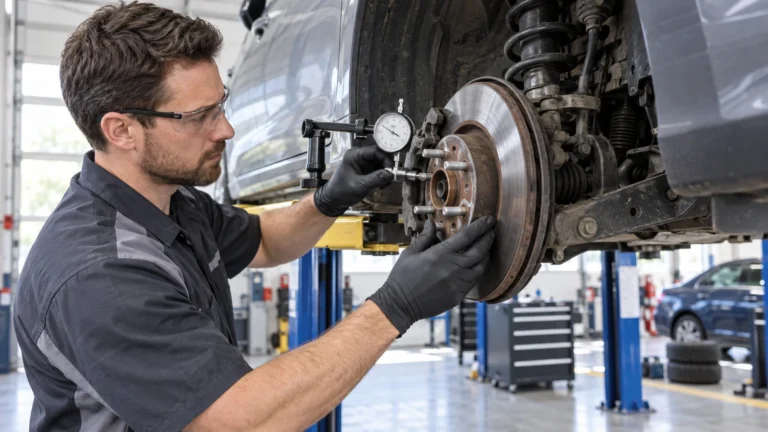
A sample inspection should confirm the characteristics that drive application and supply risk. Start with packaging and label traceability, then check supplied contents, markings, flange and pilot dimensions, bolt or stud pattern, spline, connector and cable routing, encoder orientation, rotation feel, visible seal damage and corrosion protection. Use controlled gauges and an approved method; a handheld caliper is not suitable for every tolerance.
Do not disassemble the only fitment sample before completing external and functional checks. If destructive analysis is required, define sample count and disposition. Link every photograph and result to sample identity. When possible, compare against an approved OE or known-good reference, but distinguish observed differences from nonconformities: a different seal color or machining pattern is not automatically a defect.
Installation trials need the correct vehicle or representative fixture, current service procedure, calibrated tools and before/after records. Monitor sensor function and road-test only under safe, authorized conditions. A successful single fit is evidence, not statistical proof of production capability.
Turn sample findings into a release record
Close the comparison with a signed decision that lists the exact supplier, manufacturer, part number, revision, approved application, sample IDs, unresolved limits and the documents used. State whether the approval is for a one-time purchase, a trial quantity or continuing production. If the decision depends on a deviation—such as temporary packaging, an alternate marking or a missing report—give it an expiry and quantity boundary. Keep rejected or superseded samples physically identified so they cannot return to saleable stock. This release record prevents a later buyer from assuming that approval of one bearing family covers every cross-reference offered by the same brand.
After launch, review returns and customer feedback by SKU, lot, vehicle and failure observation. Avoid treating every early failure as a manufacturing defect or every no-fault-found return as installer error. Preserve evidence, inspect mating parts and installation records where available, and use ISO 15243 terminology when classifying bearing damage. Verified field learning should update the application table, incoming checks and supplier controls. That feedback loop is a stronger quality signal than marketing claims from either channel.
Choose by use case, not by a universal brand tier
For a vehicle still covered by a manufacturer warranty or a repair subject to a fleet contract, the approved service channel and documented part may be the controlling requirement. The purchasing decision is then about obtaining the correct current part from a verifiable source, not searching for the broadest interchange. Confirm regional warranty rules rather than assuming that any non-dealer part has the same effect in every market.
For an independent distributor building a multi-brand range, a qualified aftermarket source may offer better assortment flexibility, private labeling, mixed-SKU logistics or technical cooperation. Those benefits are real only when the manufacturer controls application data, drawings, changes and traceability. Approve product families and risk groups deliberately; do not extend one successful sample to every SKU in a supplier’s spreadsheet.
For an emergency repair, availability can dominate, but urgent does not eliminate the fitment gate. Verify the OE relationship, wheel-end position, sensor configuration and included hardware before dispatch. If complete evidence cannot be obtained, record the limitation and route the decision to the responsible technician or buyer. For high-volume fleet or wholesale supply, use field returns and replenishment performance to refine the approved list while protecting against silent product changes.
A restoration, motorsport or modified-vehicle project requires an even clearer boundary. Vehicle modifications can change wheel offset, load, speed, heat and mating interfaces, so a standard catalog fitment may no longer describe the real duty. Do not ask a parts supplier to guarantee an application it has not evaluated. Provide the engineering owner with the dimensions, loads, intended use and service procedure, then document who accepts the final configuration. The OEM-versus-aftermarket label cannot replace engineering approval for a non-standard wheel end. This distinction protects both the buyer and the supplier from turning a component quotation into an unsupported vehicle-level safety claim.
OEM-channel and aftermarket comparison matrix
| Question | OEM-channel part | Aftermarket part | Approval evidence |
|---|---|---|---|
| Exact fitment? | Often strong catalog integration, but supersessions still need checking | Depends on catalog discipline and qualifiers | OE relationship, vehicle details, drawing and sample |
| Product identity? | Verify authorized channel and current part | Verify manufacturer, brand owner and revision | Supplier record, label-to-lot trace |
| Performance? | Vehicle-program validation may exist but may not be supplied to buyer | Evidence ranges from comprehensive to absent | Part-specific test scope and conditions |
| Price and availability? | May have higher price or channel constraints | May offer broader sourcing and MOQ choices | Normalized landed-cost comparison |
| Warranty support? | Defined by vehicle-brand channel and region | Defined by supplier or distributor | Written process, exclusions and traceability |
| Best choice? | The verified option that meets the exact application, duty, evidence and commercial requirements | Signed approval record | |
RFQ checklist for a fair comparison
- Vehicle make, model, year, market, VIN or platform qualifier when appropriate.
- OE number, supersession and source; front/rear, left/right and driven status.
- Required architecture, dimensions, spline, flange, bolt pattern and hardware.
- ABS encoder or tone ring, sensor, connector, cable and orientation details.
- Expected drawing, material, functional, traceability and test documents.
- Quantity by SKU, sample requirement, forecast, MOQ and destination.
- Packaging, label, Incoterm, warranty and change-notification requirements.
Use the wheel hub OE-number RFQ guide to normalize a mixed list. Review available wheel hub bearings and wheel hub assemblies, then request fitment confirmation instead of assuming a visual match.
Frequently asked questions
Are aftermarket wheel bearings always lower quality than OEM?
No. Aftermarket quality varies widely, and OEM-channel identity alone does not eliminate application or counterfeit risk. Compare the exact product, evidence, source and commercial program.
Can an OE number alone confirm interchangeability?
Not always. Supersessions, market variants, axle position, drivetrain, sensor and connector differences can require additional qualifiers. Preserve the source and confirm conflicts before release.
Is the longest warranty the best quality indicator?
No. Warranty terms are commercial risk allocation. Evaluate coverage, exclusions, claim evidence, traceability and response time alongside product conformity and field data.
Primary references and scope limits
- ISO 281:2007 — official public scope for dynamic load ratings and rating life, including stated limits.
- ISO 492:2023 — official public scope for radial-bearing geometrical specifications and tolerance values.
- IATF 16949 official overview and customer-specific requirement register.
- Timken hub-unit removal and installation technical guide — manufacturer guidance; vehicle service information remains controlling.
Need a bearing or hub quotation checked against an OE list?
Send the OE reference, vehicle model and year, axle position, quantity and destination market. Huayuan Bearing will review the available application data before confirming a supply proposal.
Send Your OE ListEditorial responsibility: Published by Huayuan Bearing. Written and technically reviewed by Andy. This guide supports buyer-side screening; it does not replace the vehicle maker’s current parts catalog, service procedure or torque specification.