Wheel Bearings and Vehicle Safety: Inspection Guide
Wheel bearings keep the rotating hub located under vehicle, cornering, braking and road loads. A damaged bearing, incorrect hub, lost clamp or wheel-speed sensing fault can affect wheel position and active safety systems, so diagnosis must consider the complete tire, brake, suspension, axle and electronic system.
How do wheel bearings affect vehicle safety?
A wheel bearing supports and locates the hub while the wheel rotates. Excessive looseness, roughness, heat, physical damage or incorrect clamp can change wheel and brake geometry; an integrated encoder or sensor fault can also affect ABS and stability-control information. Noise alone does not prove a dangerous bearing, but severe looseness, grinding, binding, smoke, a loose wheel or compromised retaining hardware requires the vehicle to be stopped and professionally inspected.
What a wheel bearing does in the safety chain
A wheel bearing supports radial and axial loads while allowing the hub and wheel to rotate with controlled friction. In a driven wheel it also surrounds or interfaces with the axle shaft; in many modern hub units it carries a magnetic encoder or wheel-speed sensor used by anti-lock braking, stability control and traction systems. The bearing therefore sits between the wheel, suspension, brake and electronic-control systems rather than acting as an isolated commodity.
The bearing does not steer or brake the vehicle by itself. Safety risk arises when excessive looseness, roughness, heat, damage, loss of clamp load or a sensing fault changes wheel location, brake geometry, tire contact or control-system information. The consequence depends on the failure mode and severity. A faint hum and a loose wheel are not equivalent conditions, so remote advice should never replace a physical inspection.
Safety boundary: stop using the vehicle and arrange professional inspection or recovery when there is severe looseness, grinding or binding, smoke, a loose retaining fastener, a visibly displaced wheel, loss of braking control or another condition that could affect wheel retention or steering.
Loads, clamp and interfaces determine behavior
A wheel end sees vehicle weight, cornering force, braking and drive torque, road impacts, vibration and temperature changes. These loads pass through the tire, wheel, hub, bearing, knuckle and suspension. The bearing must be the correct design and must be clamped and supported as the vehicle maker intended. A visually similar assembly can have a different offset, spline, flange, internal geometry or encoder even when it bolts to the knuckle.
Axle-nut or hub-bolt tightening is part of the mechanical system. The specified procedure accounts for fastener design, thread condition, coating, lubrication state and the required clamp. Too little clamp can permit movement and fretting; too much can alter internal setting, create heat or damage threads. An impact wrench does not demonstrate final torque unless the current service procedure explicitly defines a controlled impact method.
Mating components also matter. Corrosion or debris between a hub and knuckle can prevent full seating. Damaged splines, axle threads, a distorted knuckle bore, wheel runout or brake drag can create symptoms that remain after a new bearing is installed. A safe repair verifies the system rather than replacing the loudest-looking component.
Warning signals and what they can mean
| Observed condition | Possible wheel-end relevance | Other sources to exclude | Immediate response |
|---|---|---|---|
| Hum, growl or rumble changing with road speed | Raceway damage, contamination or changing bearing load | Tire tread, road surface, differential, CV joint | Record conditions and arrange diagnosis |
| Play or wheel movement | Bearing damage, lost clamp or damaged mounting interface | Ball joint, tie rod, suspension bushing | Do not rely on sound; measure using the specified method |
| Abnormal heat or odor | Friction, preload or lubrication concern | Dragging brake, tire or adjacent component | Stop if severe; inspect before continued use |
| ABS or stability warning | Encoder, sensor, air-gap or connector issue | Wiring, control module, another wheel sensor | Read and preserve codes and live data |
| Vibration or brake-pedal variation | Looseness or mounting/runout influence | Wheel balance, tire, rotor, driveline | Inspect the whole corner and measure |
No single entry in this table proves bearing failure. The value lies in connecting the symptom to speed, load, steering direction, braking, temperature and road surface, then confirming the source with a controlled inspection. Replacing a hub on sound alone can leave the original safety concern unresolved.
A safety-led inspection sequence
Capture the complaint before lifting the vehicle
Ask when the symptom began and whether it follows road speed or engine speed. Record the affected side reported by the driver without treating that side as confirmed. Note recent tire, brake, suspension, collision or hub work; curb or pothole impact; water or salt exposure; warning lights; and whether load or steering changes the symptom. A short, controlled road evaluation may be useful only when the vehicle is safe to operate and the manufacturer’s procedure permits it.
Check tire, wheel, brake and suspension evidence
Inspect tire pressure and condition, uneven or cupped tread, wheel damage, loose or missing hardware, brake heat and dragging, caliper and rotor condition, ball joints, tie rods and bushings. Timken’s public hub-check guidance specifically advises technicians to consider road surface, tread design, unusual wear, alignment and suspension before assigning noise to the bearing.
Support, rotate and measure correctly
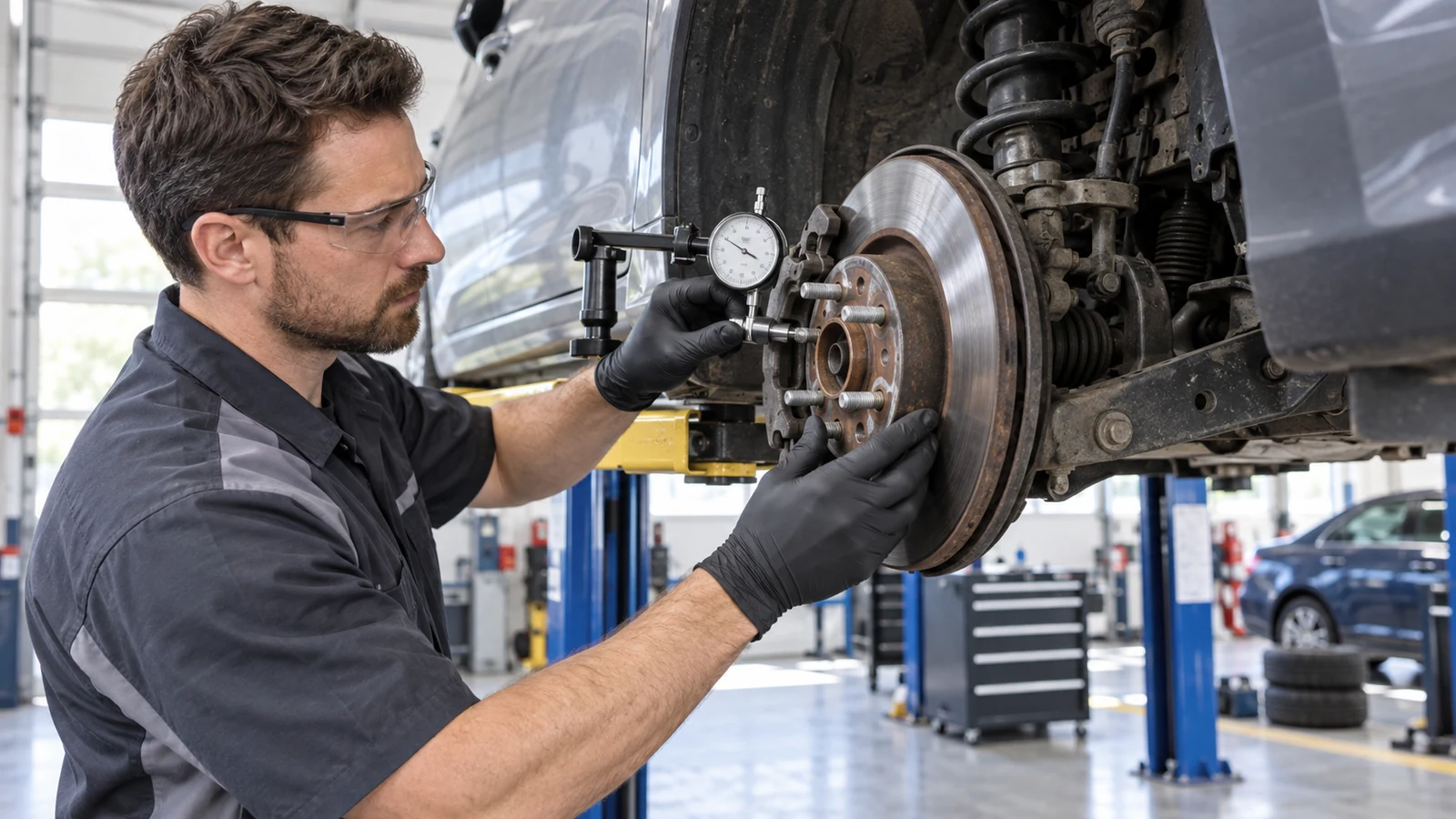
Lift at designated points and secure the vehicle. The approved check may include hand rotation, loading at different clock positions, removing brake components to isolate drag and measuring movement with a dial indicator. Driveline connection and brake design can change what the technician feels. Use the exact fixture location, direction and acceptance limit from current service information rather than a universal play figure copied from another vehicle.
Wheel-speed sensing and active safety systems
Many hub assemblies incorporate a magnetic multipole encoder in a seal or a tone ring read by a wheel-speed sensor. The controller compares wheel information for anti-lock braking, traction and stability functions. A mechanically fitted hub with the wrong encoder type, pole pattern, orientation or air-gap can therefore create an electronic safety fault even if the wheel rotates quietly.
Protect the sensing surface from impact, metallic debris, harsh cleaning and incorrect tools. Verify connector type, cable length and clip routing before installation. After repair, preserve diagnostic codes, inspect wiring and connector locks, and compare wheel-speed data when required. Clearing a code does not correct its cause, and repeatedly replacing the hub without checking the harness or sensor position destroys useful evidence.
A warning lamp does not automatically mean the hydraulic brakes have failed, but it indicates that one or more assistance functions may be limited. Follow the vehicle handbook and diagnostic procedure. Marketing copy should not promise that a replacement hub will restore a warning lamp without verified fault isolation.
Fitment errors can become safety errors
Part selection should connect the complete OE reference and suffix to vehicle, model year, market, axle, side where relevant, driven configuration and brake or ABS variant. Compare flange, bolt pattern, pilot, offset, studs and threads, spline, encoder, sensor, connector and supplied hardware. Packaging art, a shared diameter or a competitor cross-reference is not enough evidence for release.
When catalog sources conflict, stop and request the VIN, original label, clear dimensional photographs or a controlled sample comparison. Record the source and revision used for approval. A distributor should keep that application record linked to the shipped SKU and lot so a later correction can identify affected stock and customers.
The HJDP OE-number RFQ guide explains how to structure this evidence. Relevant product groups include the wheel hub bearing range and wheel hub assembly range; each candidate still needs application confirmation.
Installation controls that protect safety
For a pressed-in bearing, transmit force through the ring with the interference fit. Pressing through the balls or rollers can indent raceways before the vehicle returns to service. For a bolt-on hub, clean and inspect the knuckle face, start fasteners by hand and tighten in the specified sequence. Do not use one bolt to pull a cocked hub over corrosion.
Replace one-time axle nuts, locking devices, snap rings and other hardware when specified. Use calibrated tools for torque and angle. Route the sensor cable through its clips with clearance at full steering and suspension travel. Support the brake caliper rather than hanging it from the hose, and keep grease or anti-seize off dry-specified interfaces unless the manufacturer instructs otherwise.
Before release, verify rotation, specified play or runout, brake assembly, wheel fastener torque, sensor connection, codes and live data where relevant, and a controlled road test when authorized. Record the specification source and tool identity. A paint mark is useful process evidence only after correct tightening; it is not proof by itself.
Why bearings fail and why appearance is not enough
Possible contributors include fatigue, overload, impact, contamination, corrosion, inadequate or degraded lubricant, electrical erosion, incorrect fit, loss of clamp, misalignment, installation force and damaged mating parts. ISO 15243 provides standardized terms for describing rolling-bearing damage and failure modes. It does not permit a definitive root-cause conclusion from one photograph.
Preserve the returned part before cleaning. Photograph its installed orientation, labels, seals, encoder, raceways where accessible, fasteners, grease or contamination and mating components. Record mileage or hours, duty, symptom history, repair history, measurements and diagnostic data. Separate observation—such as flaking, corrosion or fretting—from the hypothesized cause and from the corrective action.
A no-fault-found return is also information. It may reveal tire noise, a catalog mismatch, an electrical fault or an inconsistent inspection method. Treating every return as product fatigue prevents the organization from correcting the actual safety risk.
Maintenance by wheel-end design
Modern sealed hubs are normally maintained through condition inspection, protection of their interfaces and correct replacement when diagnostic criteria are met. They are not routinely opened or injected with grease. Serviceable tapered-roller wheel ends use defined cleaning, inspection, lubrication, seal and adjustment procedures. Mixing these two maintenance models can damage a sealed unit or neglect an adjustable system.
Attach condition checks to tire rotation, brake work, suspension and alignment work, impacts and severe environmental exposure. Commercial vehicles need duty-specific schedules and documented endplay or lubrication procedures where applicable. The vehicle or axle maker’s latest instructions remain controlling; there is no responsible universal replacement mileage.
Useful records include vehicle, axle and side, mileage or hours, operating duty, procedure revision, readings with units, technician, installed SKU and lot, fastener results and post-repair verification. Review repeated events by application, route, load and repair team to identify patterns without inventing causation.
Safety evidence for distributors and fleet buyers
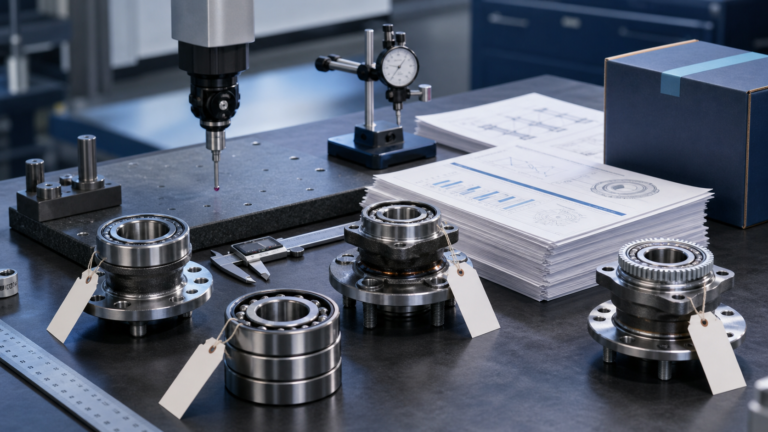
A buyer cannot inspect safety into a poorly defined product. Begin with the controlled drawing and application record, then ask for lot-linked material and process evidence appropriate to risk. Relevant controls may include dimensions and runout, heat-treatment records, seals and grease, assembly torque or endplay, encoder or sensor function, stud and thread checks, cleanliness, traceability and packaging. The required set varies by hub design and contract.
Verify any quality-system certificate against its issuing database, legal entity, manufacturing address, scope and validity. A system certificate is not a product approval. Ask how changes to steel, heat treatment, grease, seal, encoder, sensor, sub-supplier, tooling or location are notified and validated. Require temporary deviations to have a defined lot or quantity and expiry.
Conduct a trace exercise from carton label to finished-part lot and relevant component records. Trial packaging through the intended shipping route because threads, sensor leads and sealing faces can be damaged after final inspection. For a complaint, the supplier should be able to define the potentially affected scope without recalling unrelated production.
A wheel-end release checklist
- The exact OE reference, vehicle, market, axle, side and driven configuration were confirmed.
- Flange, pilot, offset, bolt pattern, studs, spline and brake interfaces match the controlled definition.
- Encoder or sensor architecture, connector and routing were verified.
- Mating faces, axle threads, spline, knuckle, brake and suspension were inspected.
- Specified one-time hardware and locking features were replaced and completed.
- Press force followed the correct load path; final fasteners used current specifications and calibrated tools.
- Rotation, play/runout, brakes, wheel torque, codes and wheel-speed data were checked as applicable.
- The installed part, lot, procedure source, readings and technician are recorded.
Train decisions, not only installation steps
Technician training should cover symptom isolation, safe lifting, load paths, measurement, torque-tool use, encoder handling and documentation. Counter and purchasing teams need fitment and suffix training because a catalog error reaches the workshop before any press is used. Warranty teams need consistent damage terminology and evidence preservation.
Use known-good and known-defect examples without presenting appearance as a universal diagnosis. Observe actual work, compare records to the service procedure and challenge how the team handles a conflicting catalog. Refresher training should follow tool changes, new hub generations, repeated returns or a service-information update.
Measure training by process outcomes: fewer unidentified parts, complete application records, correct hardware availability, recorded torque and measurements, lower no-fault-found returns and faster containment. A signed attendance sheet alone does not demonstrate competence.
Include supervisors and buyers in the review. A technically correct installation cannot succeed when the wrong variant reaches the bay or specified replacement hardware is unavailable. Periodically trace one completed repair from inquiry and catalog decision through goods receipt, installation and returned-part disposition. Correct gaps at their source and confirm the revised control on a later job.
Frequently asked questions
Can a noisy wheel bearing suddenly become unsafe?
Noise severity does not reliably predict remaining service. Because tires and other components can imitate bearing noise, arrange prompt physical diagnosis. Stop driving when there is severe looseness, grinding, heat, smoke, a loose wheel or another control-related symptom.
Does an ABS light prove the hub bearing is bad?
No. The hub encoder or integrated sensor may be involved, but wiring, connectors, sensor position, another wheel or the controller can cause similar faults. Preserve codes and test the complete circuit and application.
Should wheel bearings be replaced in pairs?
Not as a universal rule. Inspect both sides and base the decision on the exact application, condition, duty, repair access and documented fleet policy.
Is a high-price or OEM-labelled hub automatically safer?
No label or price alone demonstrates fitment and conformity. Verify identity, application, controlled specifications, traceability, process evidence and correct installation.
Primary technical and safety references
- Timken Automotive TechTips — public checking, installation, symptoms and commercial wheel-end resources.
- ISO 15243:2017 — official scope for rolling-bearing damage and failure terminology.
- NTN/BCA torque specification application — application-specific torque lookup context.
- NHTSA TireWise — related tire inspection, pressure and maintenance guidance.
- Timken LV3: Checking a Hub Bearing Assembly — source isolation and physical checking sequence.
Need a bearing or hub quotation checked against an OE list?
Send the OE reference, vehicle model and year, axle position, quantity and destination market. Huayuan Bearing will review the available application data before confirming a supply proposal.
Send Your OE ListEditorial responsibility: Published by Huayuan Bearing. Written and technically reviewed by Andy. This guide supports buyer-side screening; it does not replace the vehicle maker’s current parts catalog, service procedure or torque specification.