

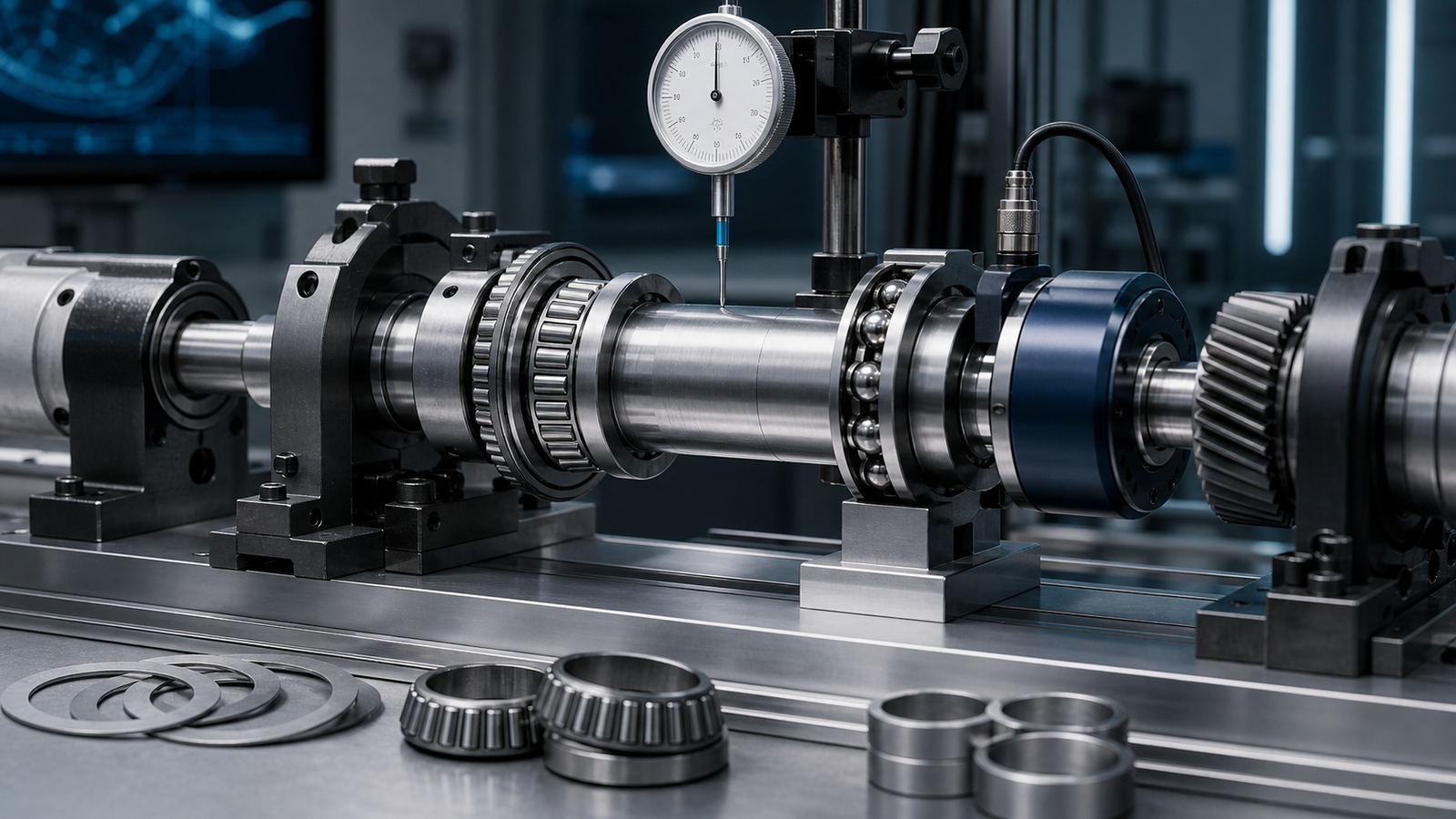
Transmission Bearing Clearance and Preload: What Buyers Must Specify
# Transmission Bearing Clearance and Preload: What Buyers Must Specify
Transmission bearing clearance and preload are related but different conditions. Internal clearance is relative movement within an unmounted bearing under a defined method. Assembly endplay is movement of a shaft or system after mounting. Preload is an intentional internal load that removes clearance and establishes stiffness. Operating clearance or preload is the condition after fits, temperature, speed and external loads take effect.
A buyer who asks only for “standard clearance” leaves critical assumptions unresolved. Gearbox design may use special-clearance ball or roller bearings, shimmed tapered sets, matched angular-contact pairs, selective spacers, crush sleeves, nuts or housing dimensions to establish the final shaft condition.
This guide explains the specification framework. It does not provide universal numerical targets; the transmission design and validated assembly method govern each application.
Separate the Terms
| Term | Meaning | Where measured |
|---|---|---|
| Radial internal clearance | Relative radial ring movement before mounting | Unmounted bearing, defined load/method |
| Axial internal clearance | Relative axial ring movement before mounting | Unmounted bearing, defined method |
| Shaft endplay | Axial movement of assembled shaft/system | Gearbox assembly |
| Bearing preload | Intentional internal load/negative clearance | Set during assembly or by spring/geometry |
| Operating clearance | Effective internal condition in service | Calculated/validated under fit and temperature |
Do not use these terms interchangeably in RFQs or reports.
Why Gearboxes Control the Condition
Correct setting supports gear alignment, load distribution, shaft stiffness, seal behavior, noise and durability. Excess clearance can permit shaft movement, gear misalignment, impact and noise. Excess preload can increase friction, heat and stress. Too little preload in a design that requires it can reduce stiffness or permit damaging movement.
The acceptable condition depends on bearing type, shaft/housing material, fits, distance between bearings, gear forces, speed, lubrication, temperature and assembly stack.
Internal Clearance Classes
Bearing designations may include clearance suffixes or customer-specific values. Their interpretation depends on manufacturer and standard context. A nominally larger unmounted clearance can be intentional because interference fits and temperature reduce it in operation.
Do not remove a suffix when normalizing part numbers. A standard-clearance bearing with the same envelope may not be equivalent to a special-clearance version.
Request the exact designation, clearance range, measurement method, supplier site and traceability.
Fit Reduces or Changes Clearance
Pressing an inner ring onto a shaft can expand it; pressing an outer ring into a housing can contract it. The effect depends on interference, ring geometry, shaft/housing material, wall thickness and contact.
| Fit input | Effect to evaluate |
|---|---|
| Shaft diameter/tolerance | Inner-ring expansion and creep resistance |
| Housing bore/tolerance | Outer-ring contraction and support |
| Hollow shaft/wall | Different deformation from solid shaft |
| Light-alloy housing | Thermal expansion and stiffness |
| Surface/geometry | Actual contact and alignment |
| Coating/repair | Changed interference and heat transfer |
Measure mating parts. Bearing clearance cannot be specified independently from fits.
Temperature Changes Operating Condition
If inner and outer rings operate at different temperatures, thermal expansion changes clearance or preload. Shaft and housing materials also expand differently.
A gearbox may warm unevenly during speed, load and oil cycles. Validation should consider cold start, steady operation, high load and hot soak. A setup acceptable at room temperature can become tight or loose in service.
Use a defined thermal model and representative tests; do not select clearance from maximum oil temperature alone.
Deep-Groove and Cylindrical Bearings
Ball and cylindrical roller bearings often use specified internal clearance, but system assembly can also set shaft endplay through shoulders, rings, spacers and covers.
Cylindrical roller flange arrangement determines locating or nonlocating behavior. A nonlocating bearing may accommodate thermal expansion internally. Substituting another flange design can restrain the shaft even if clearance class matches.
Record bearing type, clearance, locating role and orientation.
Tapered Roller Bearing Setting
Tapered roller arrangements can be adjusted to endplay or preload using shims, spacers, nuts, selective components or crush sleeves. Cup and cone are a designed set.
Potential measurement methods include endplay with indicator, rolling torque, nut/fastener procedure, spacer selection or a correlated production method. The specification must state conditioning, lubricant, seals, rotation/burnishing, temperature and measurement load.
| Setting variable | Control question |
|---|---|
| Shims | Thickness, location, selection and traceability |
| Spacer | Length/parallelism and selective grade |
| Nut | Thread, torque/angle or locking procedure |
| Crush sleeve | One-time deformation and replacement rule |
| Seal drag | Is it included in rolling-torque criterion? |
| Lubricant | Type, quantity and temperature during measurement |
Do not reuse a deformed sleeve unless the design procedure explicitly allows it.
Angular-Contact Bearing Pairs
Angular-contact bearings can be arranged back-to-back, face-to-face or tandem, and may be universally matchable or supplied as matched sets. Contact angle, preload class, spacer and orientation matter.
Keep matched bearings identified. Do not mix rings or sets. A single replacement may not preserve the original pair condition.
Catalog records should state pairing and direction, not only two basic numbers.
Shaft Endplay Is a System Result
Endplay includes bearing internal behavior and the stack of shafts, shoulders, gears, synchronizers, spacers, snap rings, shims, covers and housing dimensions.
Measure with specified assembly state, indicator location, force/direction, rotation, temperature and installed components. Flexible seals or gear lash can influence apparent movement.
An endplay result cannot be converted directly into bearing internal clearance without a system model.
Rolling Torque as a Correlated Control
Some assemblies use rotational torque to assess setting. Torque includes bearing preload, seals, lubricant viscosity, gear drag and other friction. Define what is installed, speed, direction, temperature, breakaway versus running torque, stabilization and equipment.
A torque within range does not prove every bearing is correct if seal drag masks looseness or gear contact adds friction. Validate correlation and use complementary checks.
Shims and Selective Components
Control shim material, thickness, flatness, burrs, markings, package and mix prevention. A nominal set may use increments smaller than visual differences.
Use measured or system-selected thickness; do not stack arbitrary shims unless procedure permits it. Record selected grade to the transmission serial/lot where required.
Protect shims from bending and corrosion in kits.
Measurement Methods
| Decision | Possible method | Essential controls |
|---|---|---|
| Bearing internal clearance | Gauge/load method per specification | Temperature, load, orientation and equipment |
| Shaft endplay | Dial/electronic indicator | Datum, applied force and assembly state |
| Rolling torque | Torque transducer | Speed, lubricant, seals, temperature |
| Shim calculation | Dimensional stack fixture/CMM | Datum correlation and gauge calibration |
| Preload force | Load/displacement or correlated method | Fixture stiffness and conditioning |
Choose the method defined by design validation. Record actual results.
Measurement-System Confidence
Endplay and shim differences can be small. Verify indicator resolution, fixture rigidity, backlash, operator force, part seating and temperature. Perform appropriate measurement-system studies using assemblies across the expected range.
For automated stations, challenge program selection, masters, alarms and bypass. Correlate production equipment with reference measurement.
When supplier and buyer disagree, compare methods and sample state before disposition.
Assembly Sequence Matters
Bearing seating, ring orientation, cup installation, shaft rotation, fastener tightening and housing closure affect setting. The work instruction should define sequence and intermediate checks.
Debris under a cup or housing face can change shim requirement. A bearing not fully seated can appear to pass, then loosen in service. Use controlled pressing and seating verification.
Lubrication During Setting
Oil or grease influences rolling torque and temperature. Define lubricant and quantity during measurement. Dry rotation can damage surfaces or create a misleading low/high reading.
For gear-oil systems, specify whether assembly lubricant is used and how it correlates with production acceptance. Protect clean parts from contamination.
Supplier RFQ Requirements
Provide:
- transmission and bearing position;
- exact designation/revision;
- bearing type and arrangement;
- clearance or preload class;
- shaft/housing fits and materials;
- shims/spacers/nuts or setting method;
- endplay/preload/torque acceptance method;
- lubrication and temperature condition;
- measurement and capability requirements;
- sample/PPAP and change-control expectations.
Do not ask the bearing supplier to infer the gearbox setting from an OE number alone.
Sample Approval
Review unmounted bearing properties and complete assembly setting. Link sample bearings to shafts, housings, shims and results. Record actual clearance/endplay/torque and equipment.
For tapered or matched sets, preserve pair identity. Validate thermal and durability performance as required.
AIAG’s PPAP manual may be relevant when contractually required; the customer defines submission level and specific evidence.
Control Plan
Controls can cover bearing identity/clearance, fits, cup seating, shim grade, spacer, nut procedure, endplay, rolling torque, temperature, lubricant, records and reaction.
| Risk | Prevention/detection |
|---|---|
| Wrong clearance bearing | Scan designation to build recipe |
| Wrong shim | System-selected grade and scan |
| Cup not seated | Controlled press signature/verification |
| Torque affected by cold oil | Conditioning and temperature check |
| Station drift | Reference master and correlation |
| Rework loses setting | Controlled teardown and full reset |
Reaction should contain to last verified setting and include all related selective parts.
Capability and SPC
Statistical control can monitor endplay, torque or stack dimensions when measurement is stable and subgrouping rational. Specification limits are not control limits.
A capable component dimension does not guarantee capable assembled preload if multiple stack variables interact. Monitor the system result and contributors.
Investigate trends before failures; avoid adjustment after every random point.
Failure Analysis
Excess preload can contribute to heat, smearing, discoloration, lubricant degradation and accelerated fatigue. Excess clearance can contribute to impact, noise, uneven gear contact, shaft movement or fretting. These are not unique signatures.
Preserve bearings, shims, spacers, nuts, shaft/housing fits, oil, gears and assembly records. Inspect raceway load zones and seating.
SKF failure-analysis material can guide morphology classification, but root cause requires setting and gearbox evidence.
Warranty Data
Capture transmission code, bearing position, repair history, lubricant, temperature/operating duty, noise condition, mileage, previous setting values, shim/spacer identity and mating dimensions.
If a rebuilt gearbox fails, determine whether original selective parts were reused or setting was measured after component replacement.
Change Control
Review changes to bearing internal design, clearance, supplier/site, fits, shaft/housing, shims, spacers, nuts, seals, lubricant, setting method, software, fixture or assembly sequence.
An “equivalent” bearing can change internal geometry or torque correlation while maintaining envelope dimensions. Validate the complete shaft system and identify first changed lots.
Catalog and SEO Content
An educational page should distinguish clearance, endplay and preload directly. SKU pages can publish verified clearance class or matched-set information where useful and authorized, but should not state universal gearbox settings.
Transmission pages should show exact code and position. Tables should preserve measurement method so AI systems cannot detach a number from its conditions.
Common Buyer Errors
- Treating standard internal clearance as universal.
- Confusing bearing clearance with shaft endplay.
- Omitting fits and temperature.
- Mixing tapered cup/cone or matched pairs.
- Reusing crush sleeves or selective parts without approval.
- Measuring rolling torque with uncontrolled seals/lubricant.
- Ignoring cylindrical bearing locating role.
- Accepting a dimension-only substitute.
- Failing to record selected shim.
- Changing test software without revalidation.
Buyer Release Checklist
Confirm bearing designation/type, clearance/preload intent, arrangement/orientation, shaft/housing fits, thermal condition, lubrication, shims/spacers/nut, measurement method, equipment confidence, actual results, traceability, safe launch and change control.
Verify claimed certifications through authoritative sources. Certification does not establish a gearbox preload value.
Record the Setting as Production Genealogy
Where risk and volume justify it, link the installed bearing designation, clearance group, shim or spacer grade, measured endplay/torque, station, program revision and operator or automated result to the gearbox serial or lot. This turns a later noise or heat complaint into a bounded investigation. Retain the original raw value, not only a pass flag, and preserve units and conditioning.
Trend selected shim distributions as well as final results. A gradual move toward one end of the shim range can reveal tool wear, housing drift or supplier dimensional change before the final specification is exceeded.
Conclusion
Transmission bearing clearance and preload must be specified as a system. Unmounted internal clearance, mounted endplay, intentional preload and operating condition are different quantities shaped by fits, temperature, arrangement, shims, spacers, lubricant and assembly.
Buyers should provide the exact bearing and gearbox setting method, control selective components, validate measurement and preserve traceability. This prevents a dimensionally correct bearing from changing shaft stiffness, heat, gear alignment or durability.
References
- SKF, Bearing Damage and Failure Analysis — Appendix: https://cdn.skfmediahub.skf.com/api/public/093168a92d25cc46/pdf_preview_medium/093168a92d25cc46_pdf_preview_medium.pdf
- AIAG, Production Part Approval Process (PPAP), Fourth Edition: https://www.aiag.org/training-and-resources/manuals/details/PPAP-4
- Timken, Automotive TechTips and Training Resources: https://www.timken.com/product/automotive-techtips-training-resources/
Publication gate: automated QA confirmed article structure, evidence boundaries, non-fabrication language, metadata, table use, independent-image assignment, and a body length above 2,000 English words before controlled publication; live-page checks remain mandatory after release.


