What Is 42410-58020? Toyota Rear Wheel Hub Bearing Guide
42410-58020 is a rear wheel hub bearing assembly: a sealed, pre-greased unit that carries the rear wheel, centres the brake disc or drum and provides the mounting face for the road wheel. HJDP supplies it as a complete hub assembly rather than a bare bearing, so the buyer has to match flange dimensions, stud pattern, ABS encoder type and overall width — the number alone does not define the geometry. A drawing and sample check should settle each order. This guide covers the structure, load path, failure signs and inspection points behind that decision.
What Is 42410-58020 and Where Does It Sit on the Vehicle?
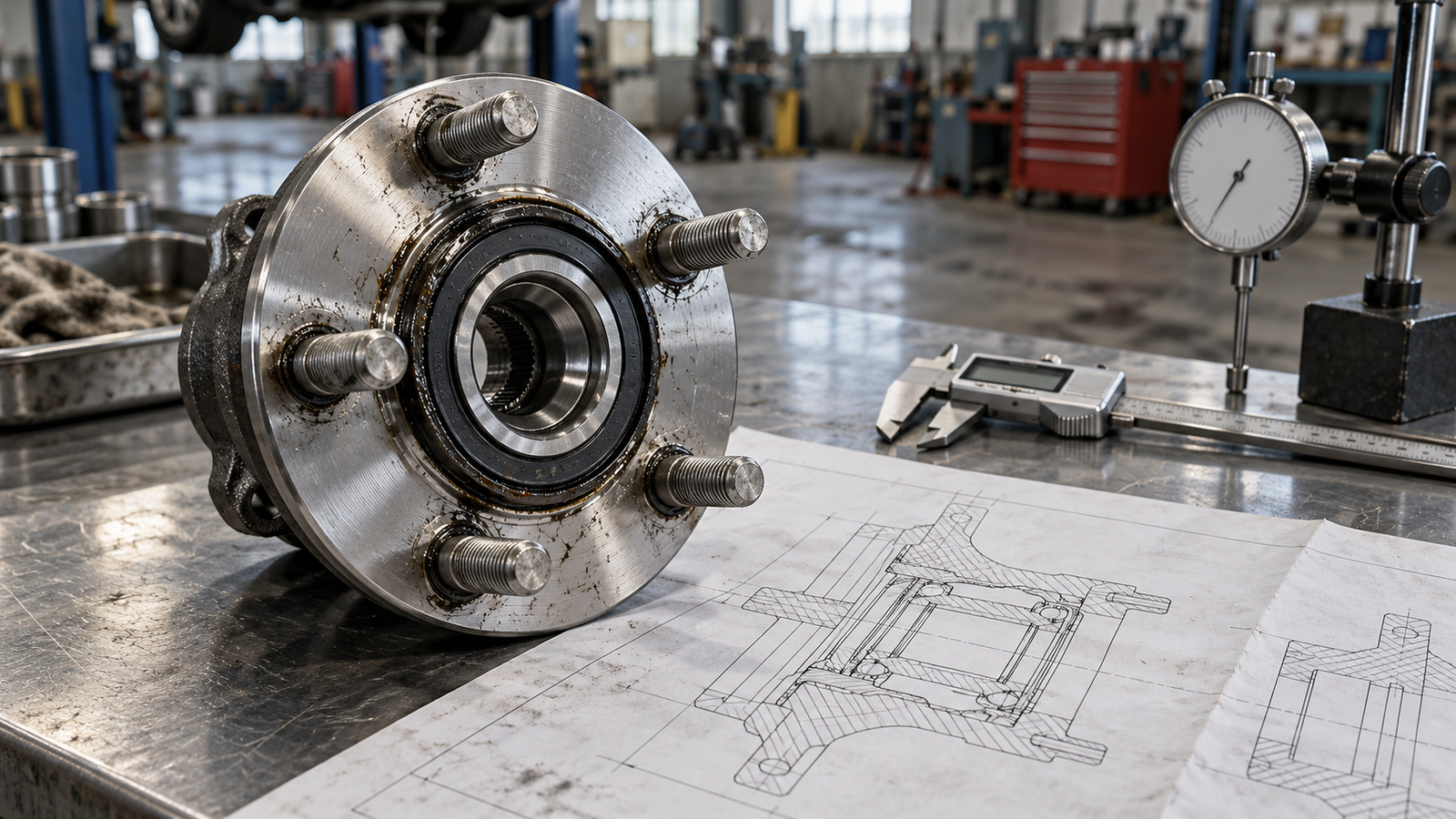
42410-58020 is a rear axle hub and bearing assembly, not a loose bearing. It combines the rolling bearing, the hub flange, the wheel studs and — where the application uses wheel-speed sensing — the encoder ring in one sealed part that mounts at the rear suspension corner.
In Toyota’s numbering convention the 42410 group covers rear axle hub and bearing assemblies, while the 42450 and 43550 groups cover front units. The five digits after the group code are an application code, assigned in sequence as models are introduced, so they encode no bore diameter, width or flange size; two assemblies with adjacent numbers can share no dimensions at all. The number is an index entry, not a specification.
Why the number alone cannot confirm a fit
Cross-referencing by number finds candidates; only the drawing confirms fit. Buyers who stop at the number tend to discover the difference after the container lands — a different stud knurl diameter, a deeper flange offset, an encoder where the original had none. The dimensional summary published with the 42410-58020 rear wheel hub assembly listing exists for exactly that comparison, and it is the document to check against the part in hand before any catalogue reference.
What the unit carries and what it must locate
A rear hub unit carries two loads and one alignment duty. Radially it takes the rear share of vehicle weight plus cornering load transfer; axially it takes the thrust generated when the tyre resists steering input, smaller than at the front axle but never zero, and on multi-link and semi-trailing rear suspensions it also absorbs camber and toe forces. The alignment duty is the one buyers underestimate: the flange face must hold the brake disc square and concentric. Flange runout returns later as pedal pulsation and disc thickness variation, and is often blamed on the bearing when the cause was a dirty mating face or a flange distorted by a poor pull.
What Is Inside a Rear Wheel Hub Bearing Assembly?
A rear hub assembly has four functional groups: the rolling bearing, the flanged hub, the sealing system and the sensor interface. Each fails differently, which is why a teardown of a returned unit says more than the noise it made in service.
Rings, rolling elements and cage
Passenger-car rear hub units usually use a double-row angular contact ball bearing, which carries combined radial and axial load in a compact envelope. Heavier rear axles — vans, pickups, rear-drive platforms — use a matched tapered roller pair or a double-row tapered unit, and cylindrical roller bearings appear where radial capacity is the priority and axial location is handled elsewhere. Rings are normally through-hardened bearing steel of the 100Cr6 / GCr15 type, the AISI 52100 equivalent, hardened and tempered to a martensitic structure, commonly in the 58–64 HRC band for rings and balls. Hubs and flanges are forged or cold-formed medium-carbon steel, induction hardened at stud seats and splines where the design calls for it. Cages are glass-fibre reinforced polyamide or steel depending on duty and grease.
Seals, grease and the encoder
The seal decides service life. A typical hub seal is a multi-lip NBR cassette: a dust lip that excludes water, grit and de-icing salt, a grease-retention lip behind it, and often a metal slinger that throws debris clear before it reaches the lip. Grease is factory-filled, usually lithium complex or polyurea, and the unit is sealed for life — there is no re-greasing interval, and grease added through a damaged lip does not rescue a contaminated bearing. Where the vehicle senses wheel speed for ABS or stability control, the encoder is a magnetised rubber ring bonded into the seal or onto the inner ring, while the sensor stays on the vehicle. A hub with the wrong encoder type, or a plain seal where an encoded one is required, fits perfectly and still lights the warning lamp.
Which generation is this — 1, 2 or 3?
The generation describes how much of the corner is built into the bearing, and it sets both the price level and the installation procedure. A unit sold as a complete rear hub assembly for a passenger car is usually second or third generation; first-generation bearings persist on older and heavier axles. Generation cannot be read from the number, which is why the 42410-08020 Toyota rear hub assembly and a later third-generation unit must each be checked against their own drawings.
| Attribute | Generation 1 | Generation 2 | Generation 3 |
|---|---|---|---|
| What is integrated | Bearing only | Bearing with flanged outer ring | Bearing, hub flange, studs and encoder |
| Mounting | Pressed into knuckle or hub carrier; separate hub | Bolted to suspension or axle; separate hub or shaft | Complete bolt-on corner unit |
| Clearance setting | Set during assembly, adjustable on tapered designs | Pre-set by the manufacturer | Pre-set and sealed |
| Sealing | Separate seals fitted on assembly | Integrated seals | Integrated cassette seal, sealed for life |
| ABS interface | Separate sensor ring on shaft or hub | Encoder often built into the seal | Encoder integrated in the unit |
| Service note | Preload procedure decides life | Mating faces and bolt torque decide life | Replace as a unit; no re-greasing |
Which Bearing Type Suits Which Rear Axle Duty?
Bearing type follows load direction, stiffness requirement and available space, not vehicle brand. The same platform can use different types front and rear, and a rear axle may use a type that would be a poor choice at the front.
| Bearing type | Load direction | Stiffness | Typical position | Setting at installation |
|---|---|---|---|---|
| Double-row angular contact ball | Radial plus axial in both directions | Moderate | Passenger car rear hub units, generations 2 and 3 | None; pre-set and sealed |
| Tapered roller, single or matched pair | High radial plus axial, one direction per row | High | Van, pickup and rear-drive axles, trailer hubs | Preload or end float set on assembly |
| Cylindrical roller | High radial only | High radial | Commercial vehicle wheel ends, some van rear axles | Axial location by a separate bearing |
| Deep groove ball | Radial plus light axial | Moderate | Idler and tensioner pulleys, auxiliary drives | None |
Why pre-set clearance matters more than a grade label
In a sealed hub unit the internal clearance is fixed at manufacture, so a P6 or P5 label on a quotation describes geometrical accuracy, not the clearance the bearing will run with. What matters is the clearance or preload the manufacturer set, plus the running accuracy that appears as flange runout. Buyers comparing quotations should ask for drawing values for bore and outer diameter tolerance, flange runout and starting torque rather than a single class, because two suppliers can both claim P6 and assemble visibly different preload. On first- and second-generation units, preload is set during installation, and an over-tightened tapered pair fails sooner than a slightly loose one.
Where tensioner and CV joint parts sit in the same range
HJDP also supplies parts that fit the same vehicles but work on different principles. Tensioner and tensioner pulley bearings run at high speed under light, mostly radial load and depend on grease retention in a small envelope; ball cage and CV joint assemblies transmit torque through an articulating joint and depend on boot integrity rather than seal lips. Sourcing them alongside hub units reduces the number of suppliers an importer must qualify, but each family needs its own inspection criteria — a hub checklist tells you nothing useful about a CV boot.
How Do You Read the Drawing and Check 42410-58020 Before Ordering?
The drawing defines fit; the number only points to it. Six checks cover the classes of return that matter.
- Confirm the assembly type. Decide whether the corner takes a bolt-on complete unit or a pressed-in bearing with a separate hub, and whether an encoder is present.
- Match the flange interface. Flange outer diameter, wheel pilot diameter, stud count, stud circle, stud thread and knurl diameter; one millimetre of pilot error is enough to seat a wheel off-centre.
- Check width and offset. Overall width, flange offset from the mounting face, and the position of the brake-disc seating face.
- Verify the sensor interface. Encoder location in the seal or on the ring, pole count where specified, and sensor air gap.
- Confirm material and marking. Steel grade and heat treatment for rings and flange, plus what is stamped on the part: origin, batch and brand mark.
- Approve a sample. Trial-fit on a knuckle or axle, check runout with a dial gauge, confirm the ABS signal, then release volume. Treat every number and OE reference as subject to drawing and sample confirmation.
| Parameter | Why it decides the fit | What to compare on arrival |
|---|---|---|
| Wheel pilot diameter | Centres wheel and brake disc | Measured at three points against the drawing |
| Stud circle and knurl | Wheel retention and press fit | Stud count, PCD, knurl diameter, stud grade |
| Flange offset and overall width | Wheel position and bearing load line | Height gauge against the drawing |
| Encoder type and air gap | ABS and stability function | Magnetic ring present, sensor seat clean |
| Seal design | Water and salt exclusion | Lip condition, slinger present, no shipping damage |
| Marking and packaging | Traceability and brand compliance | Batch code, origin, private-label artwork |
The parameters that cause the most returns
Pilot diameter, flange offset and encoder type account for most hub-assembly returns in aftermarket channels. None of the three is visible in a photograph and none is encoded in the part number. A buyer who confirms them against the drawing and keeps a photographed sample on file removes most of the risk from a first order. The same six checks apply to every rear unit in the range, including the 42410-08010 Toyota rear hub assembly, and running two drawings side by side shows quickly which dimensions actually vary between applications.
Samples, marking and private label
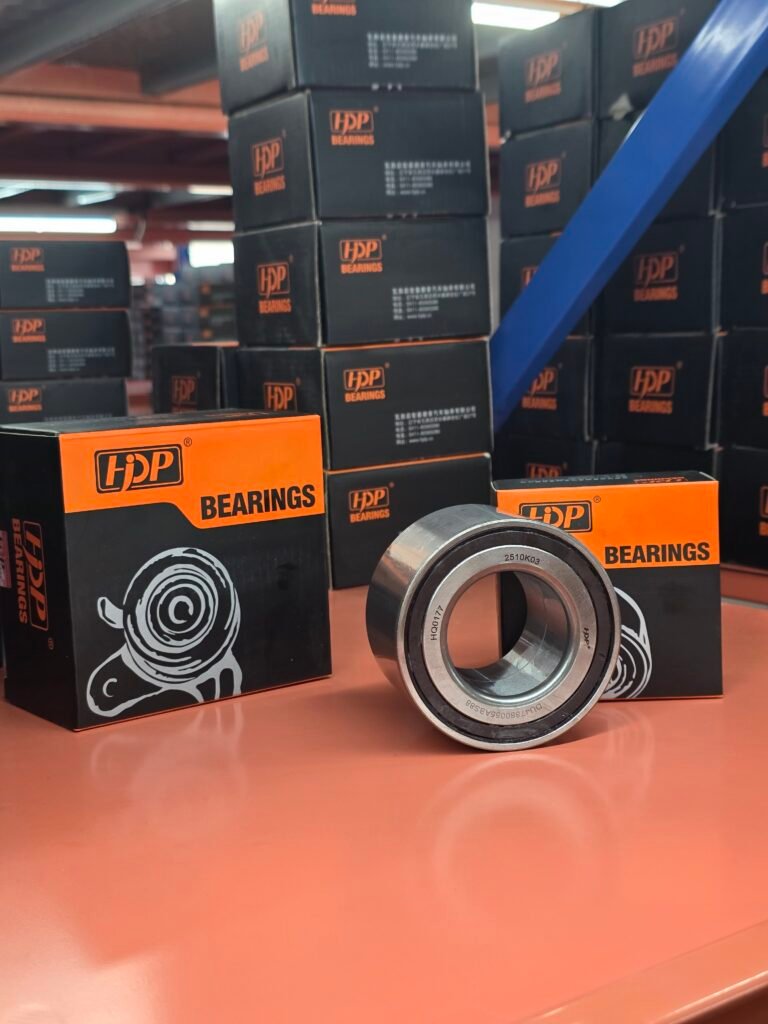
Sample confirmation is the cheapest quality control an importer has. HJDP, the brand of Jinan Huayuan Auto Bearing Co., Ltd. published at jnhjdp.com, provides drawing and sample confirmation, custom packaging and private-label marking for buyers selling under their own brand, and the route is identical across the range — the 42410-B2050 Daihatsu rear hub assembly is approved on the same basis as any other number. Private-label artwork must not reproduce another manufacturer’s marks, and neutral HJDP marking is used when no branding is requested. Agree the marking layout with the sample, not after the order.
What Are the Common Failure Modes and How Do You Tell Them Apart?
Most rear hub failures are sealing, installation or lubrication failures; genuine fatigue failure of a correctly installed, correctly sealed unit is comparatively rare. Read the evidence in order before condemning a part.
- Water and salt ingress. Rust streaks at the seal, grease emulsified to grey paste, raceway corrosion that ends in spalling; common on treated winter roads and in coastal humidity.
- False brinelling. Evenly spaced depressions from vibration in storage or long standing, not from road load.
- Impact brinelling. A single dent or short series of dents after a curb strike, often with a bent flange.
- Loose or reused axle nut. Fretting on the spline, polished thread flanks, play that returns after re-torquing.
- Seal lip wear from grit. A polished groove on the inner ring, grease thrown outward, dry noise rising with speed.
- Encoder damage. ABS warning with a mechanically sound bearing, usually from a pry bar, a hammer blow or metallic debris on the ring.
- Installation damage. Press marks on the inner ring, deformed cage, brinelling opposite the load zone.
Separating bearing noise from tyre noise
Bearing noise changes with load; tyre noise changes with surface. Load the suspect corner with a gentle swerve at speed — a right-hand swerve loads the left-hand bearings, so noise from a worn left rear unit rises and falls with the swerve while tyre roar stays constant. Then raise the wheel, check play at twelve and six o’clock and at three and nine, spin by hand for roughness, and compare hub temperatures after a drive: a noticeably hotter corner is overloaded or under-lubricated. An ABS lamp alongside mechanical noise points to the encoder rather than the raceway.
What a returned unit tells you
Press or cut the unit apart before writing it off. Grease condition, seal lip wear pattern and the location of raceway damage identify the cause together: damage at the loaded zone with intact grease means load or installation, damage spread around the raceway with emulsified grease means ingress, and evenly spaced marks with clean grease mean the unit stood still too long or was stored badly. That reading turns a return into a supplier conversation rather than a credit-note argument.
How Should a Rear Hub Assembly Be Installed and Received?
Two mistakes ruin more rear hub units than any other cause: sending press force through the rolling elements, and reusing a stretched axle nut. Both are avoidable with the right tool and the torque figure in the workshop manual.
- Clean the knuckle bore, axle face and flange mating surface; remove corrosion and burrs, and keep friction faces dry.
- Support the old unit and press or pull on the outer ring only; never transmit force through the flange or the balls.
- Seat the new unit squarely by hand, then press or torque in the specified sequence to the figure in the manual or drawing.
- Fit a new axle nut and new single-use fasteners where specified, torqued with the vehicle on the ground where the procedure requires it.
- Check flange runout with a dial gauge before the brake disc goes on, and confirm the ABS signal with a scan tool.
- Road test, re-check torque, and confirm no warning lamp returns after a full lock-to-lock manoeuvre.
What to inspect when the goods arrive
Goods-in inspection is the last point where a dimensional error is still cheap to fix. Check cartons against the packing list, then inspect the unit: no rust bloom on the flange face or stud threads, seals undistorted with the slinger in place, encoder ring present and clean, and free smooth rotation with no axial play beyond the drawing value. Spot-check pilot diameter, stud circle and overall width on a sample from every carton, not just the first. Confirm marking, batch code and private-label artwork, and keep one sealed unit per lot as a reference sample. Importers stocking several numbers from one family — the 42410-50042 Lexus rear hub assembly alongside the 42410-58020 unit — can run a single inspection sheet across all of them. Reject cartons with crushed corners: a dropped hub shows up as a single raceway dent months later.
Frequently Asked Questions
Is 42410-58020 a bearing or a complete hub assembly?
It is listed as a rear wheel hub assembly, meaning the bearing, hub flange and studs arrive as one sealed unit rather than as a loose bearing. Whether the corner also needs a separate hub or shaft depends on the generation. Confirm the assembly type on the drawing and with a sample before ordering, because the number does not state it.
Can I match 42410-58020 by cross-referencing the number alone?
No. Cross-references are useful for finding candidates, not for confirming fit. Pilot diameter, flange offset, stud pattern and encoder type vary between applications that look similar in a catalogue, and none of them is encoded in the number. Compare the drawing with the original part, and treat every OE reference as subject to drawing and sample confirmation.
How can I tell whether a rear hub unit needs replacing?
Load the corner with a gentle swerve at speed and listen for noise that rises and falls with the load, then check for play at twelve and six o’clock with the wheel raised. Roughness when spinning by hand, grease thrown from the seal, or an ABS lamp with mechanical noise all point to replacement. Compare hub temperatures between sides after a drive for a second opinion.
Does HJDP supply this hub assembly under private label?
Yes. HJDP, the brand of Jinan Huayuan Auto Bearing Co., Ltd. at jnhjdp.com, offers drawing and sample confirmation, custom packaging and private-label marking for importers and distributors. Private-label artwork must not reproduce another manufacturer’s marks, and neutral HJDP marking is used when no branding is requested. Agree the marking layout together with the sample approval.