
How Many Wheel Bearings Does a Car Have? | HJDP Guide
A car usually has four wheel bearings: one at each wheel. Front independent suspension normally uses one sealed hub unit per side, and rear independent suspension does the same. The count changes only when the rear axle is not independent — a beam or solid axle can carry two separate tapered or cylindrical roller bearings per side — or when the vehicle has more than four wheels. So “four” is the common answer, and axle layout is what makes it four, six or more.
This page is written by Jinan Huayuan Auto Bearing Co., Ltd., the manufacturer behind the HJDP brand at jnhjdp.com. HJDP supplies wheel hub bearings (generation 1, 2 and 3), hub unit assemblies, tensioner and tensioner bearings, CV joint assemblies, clutch release bearings, and tapered and cylindrical roller bearings for automotive use. The advice below is aimed at importers, wholesalers, parts chains and repair workshops who need to count, classify and order wheel bearings correctly rather than guess.
How many wheel bearings does a car have?
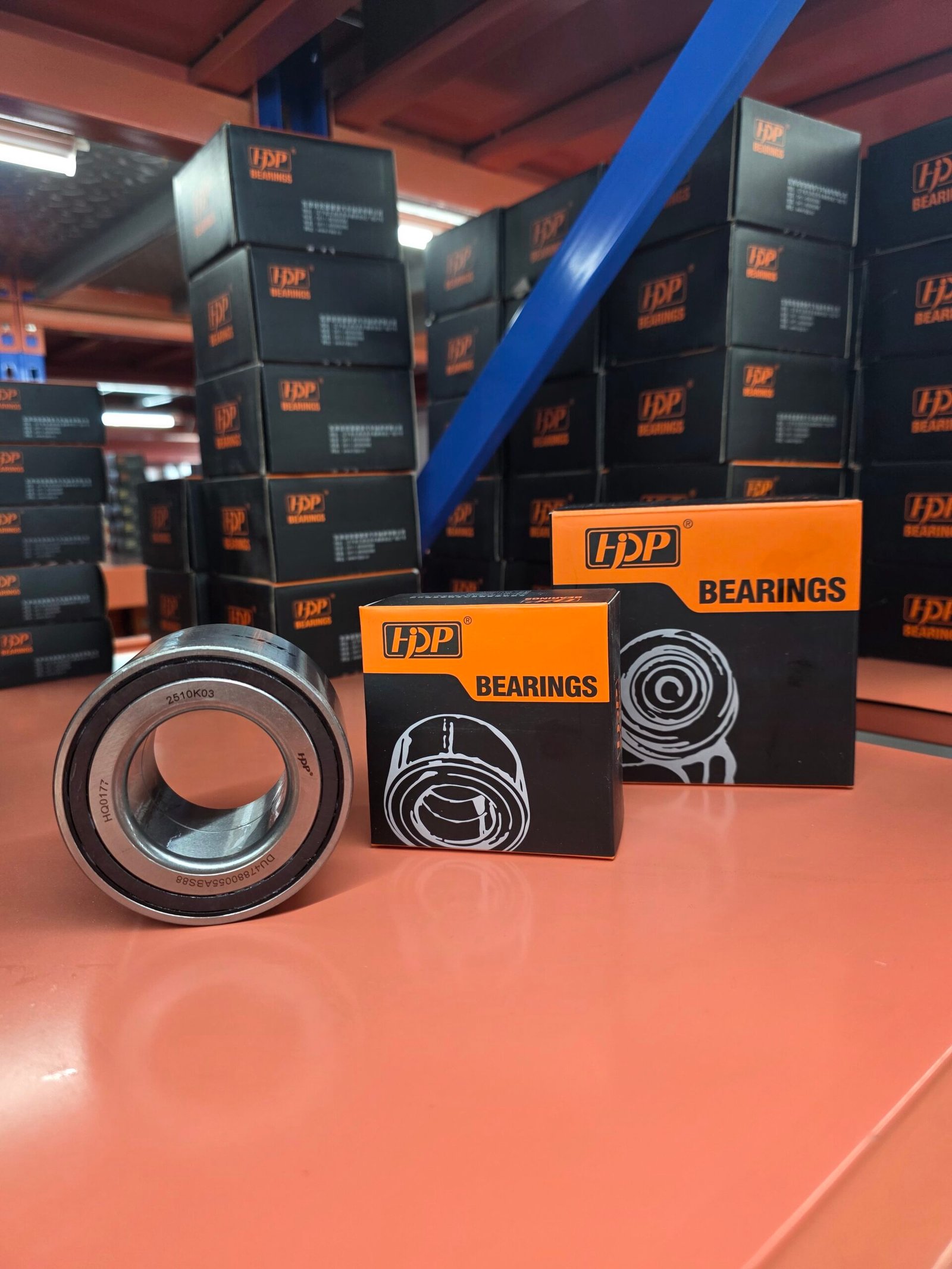
A passenger car normally has four wheel bearings, one per wheel, because each wheel needs its own support point to carry the vehicle load and allow rotation. The bearing sits between the rotating hub and the stationary axle or suspension upright, so it carries radial load (the weight of the vehicle) and often axial load (cornering and side forces). That is why the number tracks the number of wheels, not the number of axles alone.
Two driving layouts explain almost every count a parts counter will see:
- Independent suspension at both ends: one hub bearing unit per wheel corner, so four bearings in total.
- Independent front, beam or solid rear axle: one hub unit at each front corner, but the rear hubs may hold two separate bearings per side, so the total can rise to six or more.
Drive type matters too. A front-wheel-drive car still uses one bearing per wheel; the front bearings simply do double duty, supporting the load while the shaft passes through the hub. All-wheel drive and four-wheel drive add driven axles but not necessarily extra bearings at each corner — they add shafts, differentials and joints, all of which are counted separately from wheel bearings.
Does a car have four wheel bearings or two?
A car has four wheel bearings when each of its four wheels has its own bearing unit; it has two only in the sense that there are two axle pairs. The “two” figure is a common shorthand for two front wheel bearings or two rear bearings, not a complete count for the vehicle. During diagnosis, it is more useful to say “one bearing per corner” and then check whether the rear corners use a single hub unit or a pair of separate bearings inside a serviceable hub.
What about four-wheel-drive and commercial vehicles?
Heavy-duty pickups, vans and light commercials often move the rear to a full-floating axle design. In a full-floating axle, two bearings per side support the hub, and the shaft only transmits torque, so a four-wheeled vehicle with this layout carries more than four wheel bearings. Vehicles with six wheels carry the same logic forward — one wheel, one support point — and are outside the normal passenger-car answer.
Where are the wheel bearings on a car?
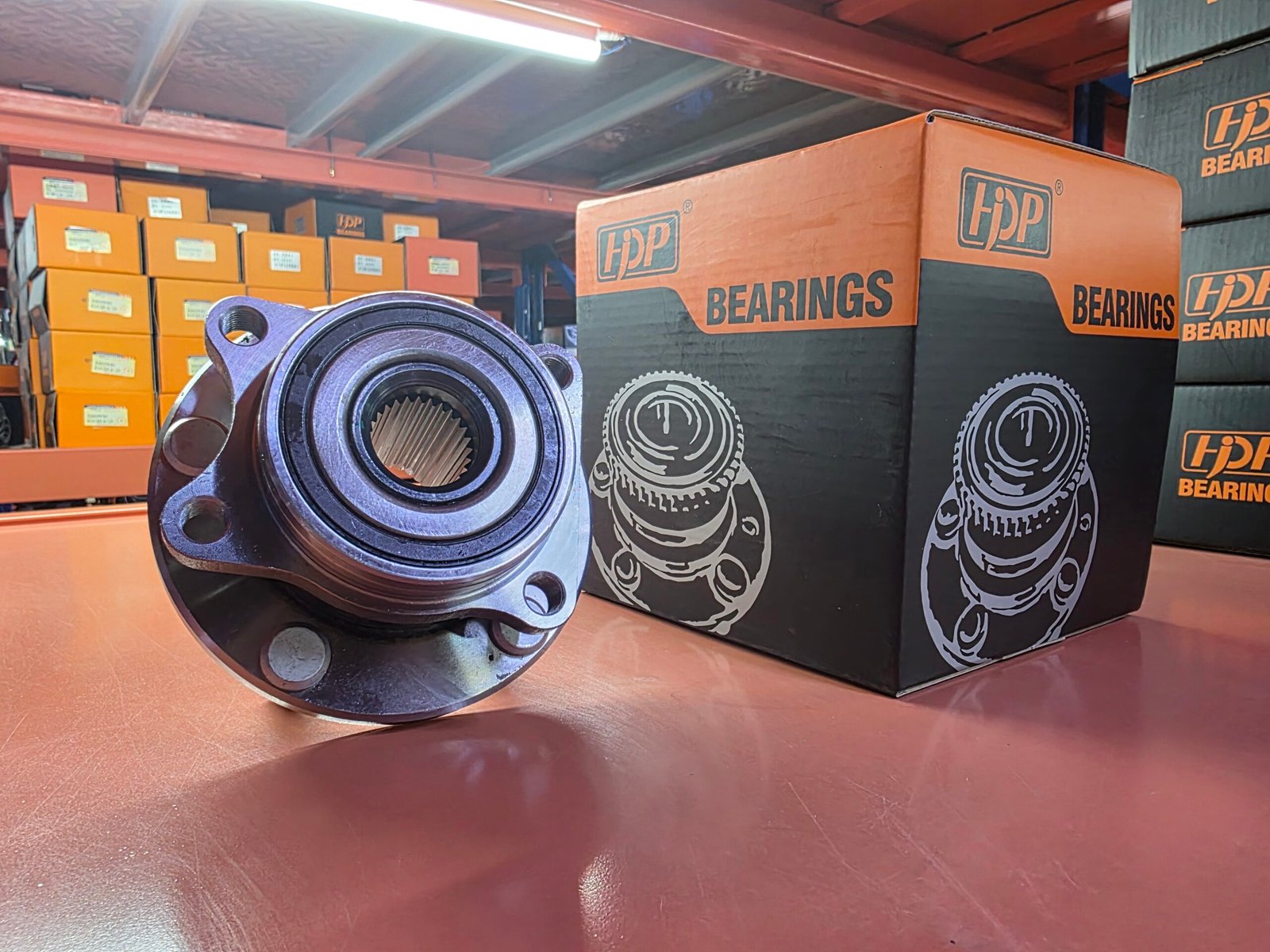
Wheel bearings sit inside the hub at each wheel corner, between the rotating hub or axle shaft and the non-rotating suspension or axle component. On the front of a front-wheel-drive car the hub also carries the brake disc and, on driven wheels, the outer CV joint. On the rear, the bearing may sit in a hub unit bolted to a trailing arm, or inside a hub fitted to an axle tube. For background on how these parts fail in service, see the common causes of wheel bearing failure.
Front wheel bearings
Front bearings carry the highest combined load because braking force, cornering force and steering angle all arrive at the same point. Most modern front corners use a sealed hub unit that is pressed or bolted in place and replaced as one part. Generation 3 hub units integrate the mounting flange, the bearing races and the wheel-speed sensor ring into a single assembly, which is why they are also called hub bearing units rather than plain bearings.
Rear wheel bearings
Rear bearings carry less steering load but still carry vehicle weight and traction force on driven axles. Rear design splits into three practical families: a bolt-on hub unit on independent suspension, two opposed tapered roller bearings inside a serviceable hub, and a sealed bearing set inside a live axle tube. Each family changes what a workshop orders — a complete hub assembly, a bearing and seal kit, or individual cones and cups.
How to count the wheel bearings on a specific vehicle
The reliable way to count wheel bearings is to identify the axle layout first, then confirm the part fitted at each corner against the parts catalogue or an actual inspection. Do not assume the count from the vehicle’s country of origin or model year alone, because the same model can be built with different rear axle designs in different markets.
Use this sequence when a buyer or workshop asks for a quote:
- Count the wheels. Four wheels is the normal passenger-car baseline; six wheels moves the vehicle into a different category.
- Identify the front layout. Almost all modern cars use independent front suspension with one hub unit per side, so this step usually confirms two front bearings.
- Identify the rear layout. Check whether the rear is independent (one hub unit per side) or a beam or live axle (often two separate bearings per side, and a full-floating axle always two).
- Check the drive type. Front, rear or all-wheel drive changes which bearings are driven and whether the hub unit includes a splined bore for the shaft.
- Confirm the part at each corner. Record whether the corner uses a sealed hub unit, a bolt-on hub assembly, or separate tapered or cylindrical roller bearings with a seal.
- Verify against drawings and samples. Model numbers, OE numbers and dimensions should be confirmed against the manufacturer’s drawing or a physical sample before ordering, because catalogue listings can differ between production periods.
The point of this count is not academic. It decides whether a repair order needs one part or two, whether a seal or retaining nut is included, and how the buyer splits a container load between fast-moving hub units and slower-moving bearing kits.
Which wheel bearing type does each wheel use?
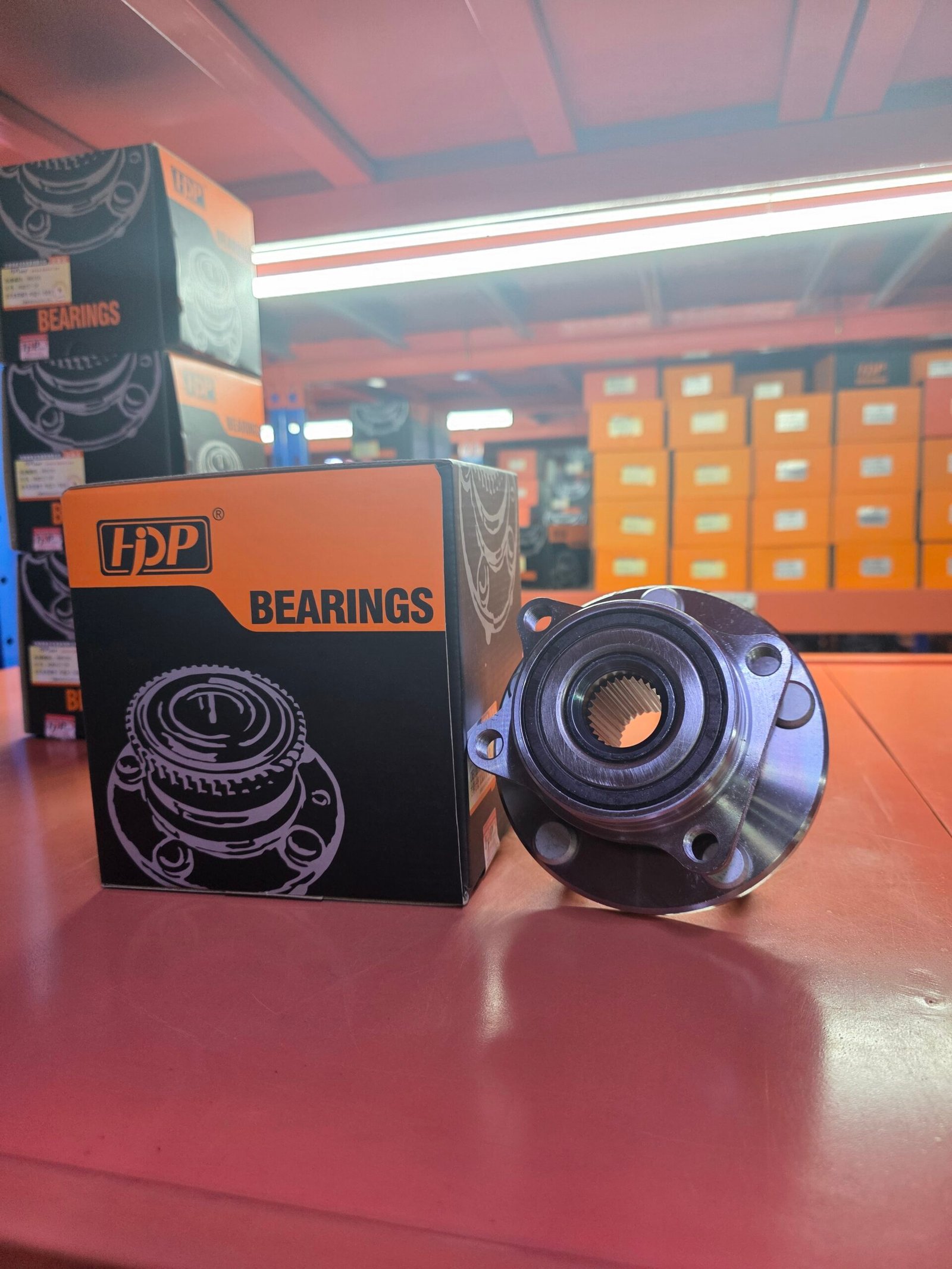
Most modern passenger-car wheels use a sealed hub bearing unit, while older, heavier and serviceable designs use tapered or cylindrical roller bearings installed in pairs. The distinction matters for aftermarket buyers because the two families are not interchangeable and are stocked, priced and replaced in different ways.
Sealed hub units and hub unit assemblies
A sealed hub unit combines the bearing, races, seals and often the mounting flange and sensor ring into a single non-serviceable part. Generation 1 hub units are the basic bearing-and-flange assembly; generation 2 adds the mounting arrangement for the brake and suspension interface; generation 3 integrates the constant-velocity joint outer race and the wheel-speed sensor function. HJDP supplies all three generations as well as complete hub unit assemblies, with specification confirmed against drawings and samples.
Tapered and cylindrical roller bearings
Tapered roller bearings handle combined radial and axial load and are typically fitted in opposed pairs, one on each side of the hub. Cylindrical roller bearings handle high radial load and appear in heavier hubs and axle applications. Both need correct preload or end-float, a serviceable seal and clean grease, which is why they are usually sold as a kit rather than a single bearing.
| Axle layout | Typical wheels | Typical wheel bearing count | Common bearing design |
|---|---|---|---|
| Independent front and rear | 4 | 4 | One sealed hub unit per corner |
| Independent front, beam rear | 4 | 4 to 6 | Hub units front, paired bearings in rear hubs |
| Independent front, full-floating rear axle | 4 | 6 or more | Two bearings per rear side |
| Light commercial, six wheels | 6 | 6 or more | Hub units or paired roller bearings by corner |
The table is a planning guide only. Actual counts depend on the specific axle fitted to the vehicle, so the bearing type and position at each corner should be confirmed against the manufacturer’s drawing or a sample before a purchase order is placed.
Wheel bearing generations and what they mean for replacement
The generation of a hub bearing tells a buyer how much of the corner comes as one part, which is the single biggest driver of replacement time and stock planning. A generation 1 unit is essentially a bearing with a flange; a generation 3 unit is a complete corner module that includes the wheel-speed sensing function.
| Hub bearing generation | What is integrated | Typical replacement approach | Buyer consideration |
|---|---|---|---|
| Generation 1 | Bearing races, seals and mounting flange | Press or bolt the unit into the existing hub carrier | Confirm bore and flange dimensions before ordering |
| Generation 2 | Generation 1 plus brake and suspension mounting interface | Replace the hub unit as a single assembly | Check whether the ABS sensor is separate or included |
| Generation 3 | Generation 2 plus CV joint outer race and sensor ring | Replace the complete hub unit assembly | Verify spline count, sensor type and flange geometry |
| Paired tapered or cylindrical roller bearings | Separate cones, cups, seal and grease | Fit as a matched pair and set preload or end-float | Order as a kit and confirm seal design |
For a workshop channel, generation 2 and 3 units are usually faster to fit because no bearing press work is required. For a distributor, that speed is offset by higher unit cost and a wider range of part numbers. HJDP produces wheel hub bearings across all three generations, plus hub unit assemblies and the roller bearing families used in serviceable hubs, with custom packaging and private label options for importers who sell under their own brand.
How the bearing count affects maintenance and parts buying
Knowing the bearing count tells a parts buyer how many line items a single vehicle can consume and how to split stock between fast-moving hub units and slower roller bearing kits. A four-corner car with sealed hub units needs at most four part references, while a serviceable rear axle may also need seals, nuts and grease. Understanding which bearing is actually failing is a separate skill, covered in identifying which wheel bearing is bad.
Why bearings are usually replaced in axle pairs
Bearings on the same axle share operating conditions, mileage and load history, so when one side is worn the opposite side is normally close behind. Workshops often quote both sides of an axle to avoid a second labour charge shortly afterwards. It does not change the total number of bearings fitted to the car, but it does change the order quantity.
What this means for stock planning
Match stock to the vehicles in your market. A region with a high share of independent suspension cars needs generation 2 and 3 hub units in volume. A region with older pickups and light commercials needs tapered and cylindrical roller bearing kits, seals and retaining hardware. Confirm demand vehicle by vehicle rather than by brand assumptions, and keep drawings on file so each part number can be checked before shipment.
How many wheel bearings should be replaced at once?
There is no single rule, but the axle-pair approach is the most common practice: replace both bearings on the affected axle, and replace the opposite-side bearing if it has covered similar mileage. The number of bearings fitted to the car does not change — a four-corner car still has four — but the number replaced in one visit can be one, two or four depending on wear, labour economics and the customer’s plan for the vehicle.
In practice, a workshop decision comes down to three questions. Is the failure isolated to one corner? Do the other corners show the same mileage and noise symptoms? Does the vehicle need to stay in service with minimal downtime? Answers to those questions are what determine whether the repair order lists one hub unit, two, or a full set.
For safety-related context on why corners are treated in pairs and why a failing bearing should not be left in service, see the role of wheel bearings in vehicle safety.
Frequently asked questions
How many wheel bearings does a car have in total?
A normal passenger car has four wheel bearings, one at each wheel. Front and rear independent suspension use one sealed hub unit per corner. If the rear axle is a beam or full-floating design, the rear hubs can carry two separate tapered or cylindrical roller bearings per side, so the total can be six or more. Confirm the count by axle layout, not by model name alone.
Does each wheel have one or two bearings?
Most modern wheels use a single sealed hub unit that contains the bearing, races and seals in one non-serviceable part. Older and heavier designs can use two opposed tapered or cylindrical roller bearings inside a serviceable hub, one on each side of the hub. The wheel looks identical from outside, so the part must be checked against a drawing or sample.
Is it better to replace one wheel bearing or both on an axle?
Replacing both bearings on the same axle is common practice because they share mileage, load history and operating conditions. If the opposite bearing is near the end of its service life, fitting it in the same visit avoids a second labour charge. A workshop decision should be based on the actual condition of each corner, not on the count alone.
Does all-wheel drive add extra wheel bearings?
All-wheel drive does not normally add a bearing at each corner; it adds driven shafts, a transfer case and CV joints. A four-wheel car with all-wheel drive still has four wheel bearing positions. What changes is the hub design, because driven hubs include a splined bore for the shaft and may integrate the wheel-speed sensor ring. See why wheel bearings fail in service for related wear factors.
For planning around replacement time, how long wheel bearing replacement takes explains the difference between bolt-on hub units and pressed or paired bearings. Buyers comparing suppliers can also review the HJDP wheel hub bearing product range and the guidance on spotting a failing wheel hub bearing. Within this site, how to choose high quality wheel bearings covers inspection criteria, and how long wheel bearings last helps set realistic replacement intervals. HJDP products are supplied for aftermarket replacement and OEM programs, with drawings and samples confirmed before production and custom packaging or private label available on request.