Wheel Hub External Laboratory Report: Scope, Method and Chain of Custody
A laboratory logo and report number do not prove that the requested method, range, sample or conformity statement falls within an accredited scope. The buyer must review the chain from submitted item to authorized result.
What should buyers verify in a wheel hub laboratory report?
Match the report to the exact submitted wheel hub and sealed sample record, verify the laboratory identity and relevant accreditation scope, and compare the named method, revision, range and any deviation with the buyer’s requirement. Review actual results, units, uncertainty and conformity statement together, including the stated decision rule when a pass or fail is reported. Confirm authorized signatory and report integrity. Keep accredited, subcontracted and outside-scope activities distinct; never treat the laboratory’s general accreditation as a blanket product certification.
Freeze the test request and sample identity
Connect the commercial question to one controlled physical sample. This is the controlling question for wheel hub external laboratory review, since a correct report can belong to another revision or unrepresentative sample. Procurement, catalog and quality teams should use the same definition so that a technical note cannot be converted into a stronger public or contractual claim downstream.
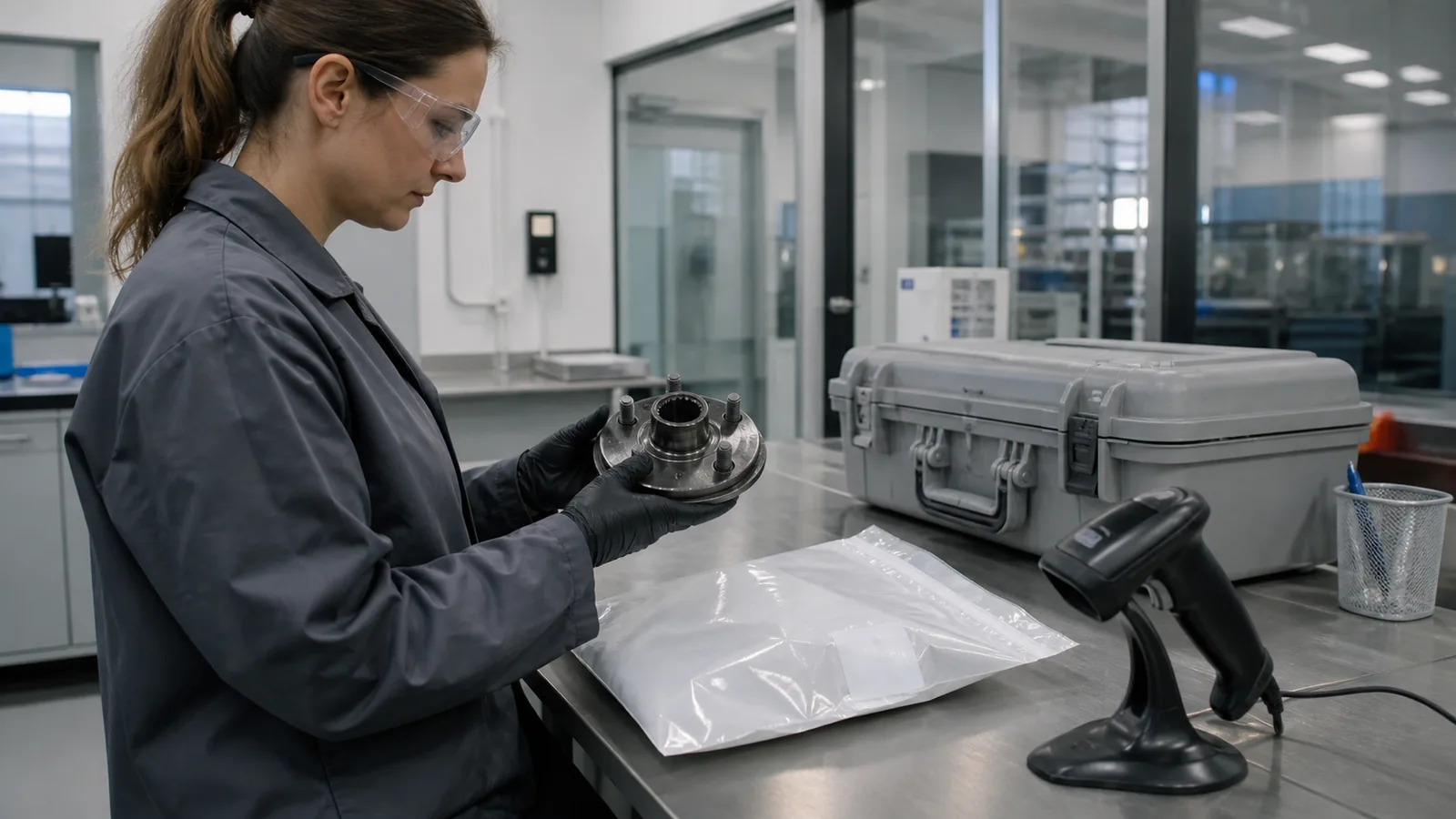
Collect buyer SKU, supplier model, OE reference, drawing, test request, sample ID, seal and condition. After intake, create a signed handoff record and photograph identifiers before dispatch. Do the comparison line by line rather than by overall resemblance, total price or a supplier’s confidence. Evidence can eliminate a candidate without proving the remaining candidate, and the workflow should preserve that distinction.
Decision rule and evidence owner
The evidence packet must retain request version, custodian, dates and condition changes. Give files stable names, retain the unedited originals and connect every conclusion to its source. A screenshot without the URL and access date, or a photograph without the SKU and sample ID, is difficult to reuse and should not carry an approval by itself.
Worked situation: a laboratory receives two visually similar hubs in one carton. Hold the decision if sample-to-request identity is ambiguous. Explain the hold with the disputed field and required evidence rather than speculation. That approach gives suppliers and customers a solvable question while protecting the distributor from an accidental interchange, capability or delivery promise.
Verify laboratory and accreditation scope
Check competence evidence for the requested activity rather than the logo alone. This is the controlling question for wheel hub external laboratory review, since an accredited organization may perform some work outside its listed scope. Procurement, catalog and quality teams should use the same definition so that a technical note cannot be converted into a stronger public or contractual claim downstream.
Collect laboratory legal identity, accreditation body, certificate status, scope fields, method and range. After intake, compare the exact activity with the current published scope and note subcontracting. Do the comparison line by line rather than by overall resemblance, total price or a supplier’s confidence. Evidence can eliminate a candidate without proving the remaining candidate, and the workflow should preserve that distinction.
A workable release condition
The evidence packet must retain scope URL or file, access date, reviewer and gaps. Give files stable names, retain the unedited originals and connect every conclusion to its source. A screenshot without the URL and access date, or a photograph without the SKU and sample ID, is difficult to reuse and should not carry an approval by itself.
Worked situation: the scope covers dimensional calibration but the report includes material testing. Hold the decision if the requested activity is not demonstrably in scope. Explain the hold with the disputed field and required evidence rather than speculation. That approach gives suppliers and customers a solvable question while protecting the distributor from an accidental interchange, capability or delivery promise.
Reconcile method, revision and deviations
Ensure the reported work matches the required procedure. This is the controlling question for wheel hub external laboratory review, since an internal method or altered setup may answer a different question. Procurement, catalog and quality teams should use the same definition so that a technical note cannot be converted into a stronger public or contractual claim downstream.
Collect standard or procedure, revision, specimen preparation, fixtures, conditions, equipment and deviations. After intake, map every requirement to the report and request clarification before interpreting results. Do the comparison line by line rather than by overall resemblance, total price or a supplier’s confidence. Evidence can eliminate a candidate without proving the remaining candidate, and the workflow should preserve that distinction.
How to document the exception
The evidence packet must record method source, deviations, approvals and limitations. Give files stable names, retain the unedited originals and connect every conclusion to its source. A screenshot without the URL and access date, or a photograph without the SKU and sample ID, is difficult to reuse and should not carry an approval by itself.
Worked situation: a test omits conditioning required by the buyer specification. Hold the decision if a deviation lacks technical and buyer disposition. Explain the hold with the disputed field and required evidence rather than speculation. That approach gives suppliers and customers a solvable question while protecting the distributor from an accidental interchange, capability or delivery promise.
Review results, uncertainty and conformity
Keep observations and the decision rule visible. This is the controlling question for wheel hub external laboratory review, since a pass statement can hide rounding, uncertainty or an unreported limit source. Procurement, catalog and quality teams should use the same definition so that a technical note cannot be converted into a stronger public or contractual claim downstream.
Collect sample-level values, units, limits, uncertainty, rule, comments and attachments. After intake, recalculate only from preserved source data and never overwrite the signed report. Do the comparison line by line rather than by overall resemblance, total price or a supplier’s confidence. Evidence can eliminate a candidate without proving the remaining candidate, and the workflow should preserve that distinction.
A case that exposes the hidden risk
The evidence packet must retain extraction checks, reviewer and disputed fields. Give files stable names, retain the unedited originals and connect every conclusion to its source. A screenshot without the URL and access date, or a photograph without the SKU and sample ID, is difficult to reuse and should not carry an approval by itself.
Worked situation: one sample fails but the summary page states overall pass. Hold the decision if the basis for the reported conclusion is unclear. Explain the hold with the disputed field and required evidence rather than speculation. That approach gives suppliers and customers a solvable question while protecting the distributor from an accidental interchange, capability or delivery promise.
Confirm authorization and report integrity
Verify the issued document, amendments and signatory path. This is the controlling question for wheel hub external laboratory review, since screenshots or edited tables can detach data from the authorized report. Procurement, catalog and quality teams should use the same definition so that a technical note cannot be converted into a stronger public or contractual claim downstream.
Collect report number, issue date, pages, signatures, amendment history, digital verification and recipient. After intake, obtain corrections through the laboratory’s formal route and preserve superseded versions. Do the comparison line by line rather than by overall resemblance, total price or a supplier’s confidence. Evidence can eliminate a candidate without proving the remaining candidate, and the workflow should preserve that distinction.
What a second reviewer should see
The evidence packet must record checksum, receipt source, status and authorized copy. Give files stable names, retain the unedited originals and connect every conclusion to its source. A screenshot without the URL and access date, or a photograph without the SKU and sample ID, is difficult to reuse and should not carry an approval by itself.
Worked situation: a revised page circulates without the full amended report. Hold the decision if the controlling authorized version cannot be established. Explain the hold with the disputed field and required evidence rather than speculation. That approach gives suppliers and customers a solvable question while protecting the distributor from an accidental interchange, capability or delivery promise.
External laboratory report review register
Use this buyer-side register to keep document presence, technical review and release authority as separate states.
| Control | Evidence to retain | Hold trigger |
|---|---|---|
| Freeze the test request and sample identity | buyer SKU, supplier model, OE reference, drawing, test request, sample ID, seal and condition | sample-to-request identity is ambiguous |
| Verify laboratory and accreditation scope | laboratory legal identity, accreditation body, certificate status, scope fields, method and range | the requested activity is not demonstrably in scope |
| Reconcile method, revision and deviations | standard or procedure, revision, specimen preparation, fixtures, conditions, equipment and deviations | a deviation lacks technical and buyer disposition |
| Review results, uncertainty and conformity | sample-level values, units, limits, uncertainty, rule, comments and attachments | the basis for the reported conclusion is unclear |
| Confirm authorization and report integrity | report number, issue date, pages, signatures, amendment history, digital verification and recipient | the controlling authorized version cannot be established |
Review scope before ordering the test
ILAC G18 describes accreditation scopes as a core statement of the conformity assessment body's demonstrated competence for defined services.
ILAC G17 addresses measurement uncertainty in testing, and ILAC G8 addresses conformity statements and decision rules.
Accreditation does not certify the tested wheel hub, guarantee every result or create JNHJDP approval; the actual scope, report and buyer decision remain controlling.
Claim boundary: No laboratory, accreditation, test method, result or product approval is claimed for JNHJDP wheel hubs.
Additional review scenarios for wheel hub external laboratory review
Review scenario 1 for wheel hub external laboratory review: Start from buyer SKU, supplier model, OE reference, drawing, test request, sample ID, seal and condition. The reviewer should create a signed handoff record and photograph identifiers before dispatch. An independent checker then tests the conclusion against the stated decision boundary and confirms that the record will retain request version, custodian, dates and condition changes. If sample-to-request identity is ambiguous, keep the affected line on hold, name the missing evidence and prevent the provisional interpretation from entering a quote, catalog, purchase order or customer promise. The case can move again when the evidence owner closes that exact field; a general assurance, familiar photograph or previous order is not a substitute for the missing source.
Review scenario 2 for wheel hub external laboratory review: Start from laboratory legal identity, accreditation body, certificate status, scope fields, method and range. The reviewer should compare the exact activity with the current published scope and note subcontracting. An independent checker then tests the conclusion against the stated decision boundary and confirms that the record will retain scope URL or file, access date, reviewer and gaps. If the requested activity is not demonstrably in scope, keep the affected line on hold, name the missing evidence and prevent the provisional interpretation from entering a quote, catalog, purchase order or customer promise. The case can move again when the evidence owner closes that exact field; a general assurance, familiar photograph or previous order is not a substitute for the missing source.
Review scenario 3 for wheel hub external laboratory review: Start from standard or procedure, revision, specimen preparation, fixtures, conditions, equipment and deviations. The reviewer should map every requirement to the report and request clarification before interpreting results. An independent checker then tests the conclusion against the stated decision boundary and confirms that the record will record method source, deviations, approvals and limitations. If a deviation lacks technical and buyer disposition, keep the affected line on hold, name the missing evidence and prevent the provisional interpretation from entering a quote, catalog, purchase order or customer promise. The case can move again when the evidence owner closes that exact field; a general assurance, familiar photograph or previous order is not a substitute for the missing source.
Review scenario 4 for wheel hub external laboratory review: Start from sample-level values, units, limits, uncertainty, rule, comments and attachments. The reviewer should recalculate only from preserved source data and never overwrite the signed report. An independent checker then tests the conclusion against the stated decision boundary and confirms that the record will retain extraction checks, reviewer and disputed fields. If the basis for the reported conclusion is unclear, keep the affected line on hold, name the missing evidence and prevent the provisional interpretation from entering a quote, catalog, purchase order or customer promise. The case can move again when the evidence owner closes that exact field; a general assurance, familiar photograph or previous order is not a substitute for the missing source.
Review scenario 5 for wheel hub external laboratory review: Start from report number, issue date, pages, signatures, amendment history, digital verification and recipient. The reviewer should obtain corrections through the laboratory's formal route and preserve superseded versions. An independent checker then tests the conclusion against the stated decision boundary and confirms that the record will record checksum, receipt source, status and authorized copy. If the controlling authorized version cannot be established, keep the affected line on hold, name the missing evidence and prevent the provisional interpretation from entering a quote, catalog, purchase order or customer promise. The case can move again when the evidence owner closes that exact field; a general assurance, familiar photograph or previous order is not a substitute for the missing source.
Review scenario 6 for wheel hub external laboratory review: Start from buyer SKU, supplier model, OE reference, drawing, test request, sample ID, seal and condition. The reviewer should create a signed handoff record and photograph identifiers before dispatch. An independent checker then tests the conclusion against the stated decision boundary and confirms that the record will retain request version, custodian, dates and condition changes. If sample-to-request identity is ambiguous, keep the affected line on hold, name the missing evidence and prevent the provisional interpretation from entering a quote, catalog, purchase order or customer promise. The case can move again when the evidence owner closes that exact field; a general assurance, familiar photograph or previous order is not a substitute for the missing source.
Related wheel hub buyer resources
- Wheel Hub Assembly catalog
- Wheel Hub Bearing catalog
- wheel bearing versus wheel hub assembly guide
- ABS encoder identification guide
- wheel hub OE number and RFQ guide
- fitment verification workflow
- sample approval workflow
- kit contents and BOM verification
- supplier evaluation evidence guide
- export packaging checklist
- MOQ and lead-time planning guide
- incoming inspection checklist
- About Jinan Huayuan Auto Bearing
Sources, dates and claim boundaries
- ILAC guidance documents for accredited laboratories — official entry point for ILAC G8 decision rules, G17 measurement uncertainty in testing and G18 accreditation-scope descriptions
- NIST measurement-process characterization — official overview of repeatability, reproducibility, stability, calibration and measurement uncertainty
- NIST metrological traceability FAQ and policy — official boundary that traceability requires a documented measurement result and unbroken calibration chain, not merely an instrument carrying a NIST label
- Timken Purchased Product for Prototype procedure — official example distinguishing prototype evidence and production PPAP; it applies to Timken transactions, not automatically to JNHJDP orders
Technical review: Jinan Huayuan Auto Bearing editorial review for source fidelity, procurement-data consistency and unsupported-claim removal. This review does not replace an OE catalog, vehicle service procedure, legal or customs advice, a customer-approved drawing, or mutually agreed commercial and inspection terms.
Corrections: Send the page URL and supporting evidence through the contact page. Material corrections are reviewed, linked records are rechecked and the updated date is changed when warranted.