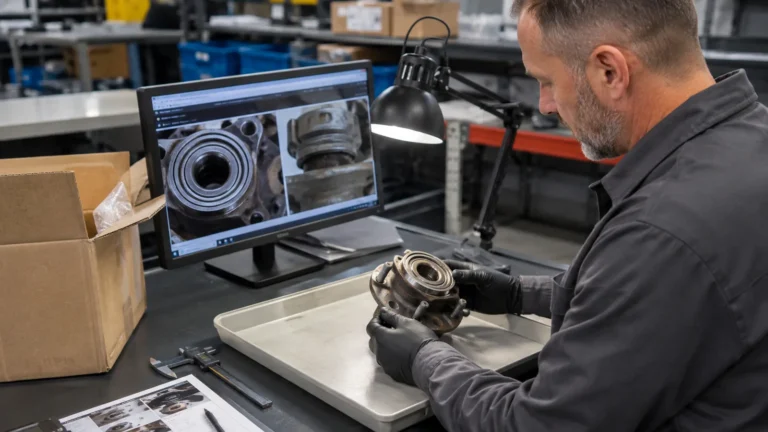

Wheel Hub Measurement Uncertainty: Decision Rule and Conformance Review
A measurement near a specification limit cannot be interpreted from the displayed digits alone. Buyers need the measurand, method, uncertainty statement and agreed decision rule before a result becomes a conformance decision.
How should buyers use measurement uncertainty for wheel hub conformance?
Define the exact measurand, datum, method, unit and specification limit first. Review the contributors and stated uncertainty for the actual setup, range and conditions, then agree how uncertainty enters the conformity decision before results are known. Record any guard band, false-accept and false-reject considerations, borderline-result treatment and authorization. Report the measured value, expanded uncertainty and decision rule together where required. Do not invent a universal uncertainty ratio or silently convert a value inside the drawing limit into unconditional conformity.
Define the measurand and acceptance source
Ensure the result answers one precise dimensional or functional question. In a wheel hub uncertainty decision review workflow, the practical risk is similar labels can conceal different datums, filters or calculations. Treat the task as a release gate with a named owner, an evidence date and a defined output. The output may be approved, rejected or held; all three are useful when the reason is visible.
The starting packet contains drawing revision, characteristic ID, datum, orientation, method, unit and specification limits. Reviewers should preserve what the customer, warehouse or supplier actually sent before they write a measurement model and method sketch before reviewing uncertainty. Separating received data from interpreted data prevents a later correction from rewriting history and allows two plausible candidates to stay separate while evidence is gathered.
Decision rule and evidence owner
A durable entry will retain requirement source, method owner and decision use. It should be readable outside an email thread and portable into the product master, purchase order or claim system. The record is not extra administration: it is the mechanism that keeps sales copy, receiving checks and supplier communication attached to the same configuration.
Example: supplier and buyer measure flange runout from different seats. Pause when the results do not address the same measurand. A pause is cheaper than releasing inventory with a convenient assumption. State which evidence would close the issue, who must provide it and which downstream records are blocked until that evidence is accepted.
Review the uncertainty budget
Identify material contributors under the actual method. In a wheel hub uncertainty decision review workflow, the practical risk is a certificate value may not represent fixture, operator, part form or environment. Treat the task as a release gate with a named owner, an evidence date and a defined output. The output may be approved, rejected or held; all three are useful when the reason is visible.
The starting packet contains instrument data, reference standards, resolution, repeatability, fixture, setup, environment and calculation. Reviewers should preserve what the customer, warehouse or supplier actually sent before they evaluate significant contributors and document exclusions without inventing precision. Separating received data from interpreted data prevents a later correction from rewriting history and allows two plausible candidates to stay separate while evidence is gathered.
A workable release condition
A durable entry will preserve input values, distributions, sensitivity, source and version. It should be readable outside an email thread and portable into the product master, purchase order or claim system. The record is not extra administration: it is the mechanism that keeps sales copy, receiving checks and supplier communication attached to the same configuration.
Example: fixture seating dominates variation but is omitted from the budget. Pause when a material contributor or calculation basis is unsupported. A pause is cheaper than releasing inventory with a convenient assumption. State which evidence would close the issue, who must provide it and which downstream records are blocked until that evidence is accepted.
Agree the decision rule before inspection
Define how uncertainty affects pass, fail and indeterminate outcomes. In a wheel hub uncertainty decision review workflow, the practical risk is choosing a rule after seeing the value creates inconsistent risk allocation. Treat the task as a release gate with a named owner, an evidence date and a defined output. The output may be approved, rejected or held; all three are useful when the reason is visible.
The starting packet contains contract, laboratory statement, specification limits, uncertainty, guard band and customer requirement. Reviewers should preserve what the customer, warehouse or supplier actually sent before they state the conformity logic in testable language and obtain authorized agreement. Separating received data from interpreted data prevents a later correction from rewriting history and allows two plausible candidates to stay separate while evidence is gathered.
How to document the exception
A durable entry will retain rule version, risk discussion, owner and effective scope. It should be readable outside an email thread and portable into the product master, purchase order or claim system. The record is not extra administration: it is the mechanism that keeps sales copy, receiving checks and supplier communication attached to the same configuration.
Example: the value lies near a limit and reviewers apply different rules. Pause when no agreed decision rule controls the statement. A pause is cheaper than releasing inventory with a convenient assumption. State which evidence would close the issue, who must provide it and which downstream records are blocked until that evidence is accepted.
Read the complete measurement statement
Keep value, unit, uncertainty, coverage information and method context together. In a wheel hub uncertainty decision review workflow, the practical risk is a copied pass result can lose the conditions needed for interpretation. Treat the task as a release gate with a named owner, an evidence date and a defined output. The output may be approved, rejected or held; all three are useful when the reason is visible.
The starting packet contains reported value, uncertainty, coverage statement, method, sample ID, date, equipment and conditions. Reviewers should preserve what the customer, warehouse or supplier actually sent before they compare the report with laboratory scope and buyer requirement. Separating received data from interpreted data prevents a later correction from rewriting history and allows two plausible candidates to stay separate while evidence is gathered.
A case that exposes the hidden risk
A durable entry will retain original report, extraction trace and reviewer notes. It should be readable outside an email thread and portable into the product master, purchase order or claim system. The record is not extra administration: it is the mechanism that keeps sales copy, receiving checks and supplier communication attached to the same configuration.
Example: a spreadsheet imports only the rounded value from a laboratory report. Pause when the uncertainty or reporting scope cannot be verified. A pause is cheaper than releasing inventory with a convenient assumption. State which evidence would close the issue, who must provide it and which downstream records are blocked until that evidence is accepted.
Escalate borderline and conflicting results
Prevent automatic release when the decision depends on unresolved uncertainty. In a wheel hub uncertainty decision review workflow, the practical risk is repeated measurements can be cherry-picked until one appears inside the limit. Treat the task as a release gate with a named owner, an evidence date and a defined output. The output may be approved, rejected or held; all three are useful when the reason is visible.
The starting packet contains raw observations, repeat policy, method comparison, uncertainty statements, sample condition and authority. Reviewers should preserve what the customer, warehouse or supplier actually sent before they follow the agreed repeat or referee route and preserve all results. Separating received data from interpreted data prevents a later correction from rewriting history and allows two plausible candidates to stay separate while evidence is gathered.
What a second reviewer should see
A durable entry will record containment, technical disposition and final authority. It should be readable outside an email thread and portable into the product master, purchase order or claim system. The record is not extra administration: it is the mechanism that keeps sales copy, receiving checks and supplier communication attached to the same configuration.
Example: supplier and buyer results overlap after uncertainty but have opposite pass labels. Pause when the conflict or affected population remains open. A pause is cheaper than releasing inventory with a convenient assumption. State which evidence would close the issue, who must provide it and which downstream records are blocked until that evidence is accepted.
Measurement-uncertainty decision matrix
Use this buyer-side register to keep document presence, technical review and release authority as separate states.
| Control | Evidence to retain | Hold trigger |
|---|---|---|
| Define the measurand and acceptance source | drawing revision, characteristic ID, datum, orientation, method, unit and specification limits | the results do not address the same measurand |
| Review the uncertainty budget | instrument data, reference standards, resolution, repeatability, fixture, setup, environment and calculation | a material contributor or calculation basis is unsupported |
| Agree the decision rule before inspection | contract, laboratory statement, specification limits, uncertainty, guard band and customer requirement | no agreed decision rule controls the statement |
| Read the complete measurement statement | reported value, uncertainty, coverage statement, method, sample ID, date, equipment and conditions | the uncertainty or reporting scope cannot be verified |
| Escalate borderline and conflicting results | raw observations, repeat policy, method comparison, uncertainty statements, sample condition and authority | the conflict or affected population remains open |
Make the decision rule part of the RFQ evidence
ILAC G8 addresses decision rules and statements of conformity, while ILAC G17 addresses evaluation and reporting of measurement uncertainty in testing.
NIST describes measurement-process characterization through calibration, repeatability, reproducibility, stability and uncertainty rather than through instrument resolution alone.
The actual contract, specification and authorized laboratory or metrology owner determine the decision rule; this guide supplies no universal guard band or acceptance ratio.
Claim boundary: No wheel hub tolerance, uncertainty value, guard band, risk probability or conformance result is stated for JNHJDP.
Additional review scenarios for wheel hub uncertainty decision review
Review scenario 1 for wheel hub uncertainty decision review: Start from drawing revision, characteristic ID, datum, orientation, method, unit and specification limits. The reviewer should write a measurement model and method sketch before reviewing uncertainty. An independent checker then tests the conclusion against the stated decision boundary and confirms that the record will retain requirement source, method owner and decision use. If the results do not address the same measurand, keep the affected line on hold, name the missing evidence and prevent the provisional interpretation from entering a quote, catalog, purchase order or customer promise. The case can move again when the evidence owner closes that exact field; a general assurance, familiar photograph or previous order is not a substitute for the missing source.
Review scenario 2 for wheel hub uncertainty decision review: Start from instrument data, reference standards, resolution, repeatability, fixture, setup, environment and calculation. The reviewer should evaluate significant contributors and document exclusions without inventing precision. An independent checker then tests the conclusion against the stated decision boundary and confirms that the record will preserve input values, distributions, sensitivity, source and version. If a material contributor or calculation basis is unsupported, keep the affected line on hold, name the missing evidence and prevent the provisional interpretation from entering a quote, catalog, purchase order or customer promise. The case can move again when the evidence owner closes that exact field; a general assurance, familiar photograph or previous order is not a substitute for the missing source.
Review scenario 3 for wheel hub uncertainty decision review: Start from contract, laboratory statement, specification limits, uncertainty, guard band and customer requirement. The reviewer should state the conformity logic in testable language and obtain authorized agreement. An independent checker then tests the conclusion against the stated decision boundary and confirms that the record will retain rule version, risk discussion, owner and effective scope. If no agreed decision rule controls the statement, keep the affected line on hold, name the missing evidence and prevent the provisional interpretation from entering a quote, catalog, purchase order or customer promise. The case can move again when the evidence owner closes that exact field; a general assurance, familiar photograph or previous order is not a substitute for the missing source.
Review scenario 4 for wheel hub uncertainty decision review: Start from reported value, uncertainty, coverage statement, method, sample ID, date, equipment and conditions. The reviewer should compare the report with laboratory scope and buyer requirement. An independent checker then tests the conclusion against the stated decision boundary and confirms that the record will retain original report, extraction trace and reviewer notes. If the uncertainty or reporting scope cannot be verified, keep the affected line on hold, name the missing evidence and prevent the provisional interpretation from entering a quote, catalog, purchase order or customer promise. The case can move again when the evidence owner closes that exact field; a general assurance, familiar photograph or previous order is not a substitute for the missing source.
Review scenario 5 for wheel hub uncertainty decision review: Start from raw observations, repeat policy, method comparison, uncertainty statements, sample condition and authority. The reviewer should follow the agreed repeat or referee route and preserve all results. An independent checker then tests the conclusion against the stated decision boundary and confirms that the record will record containment, technical disposition and final authority. If the conflict or affected population remains open, keep the affected line on hold, name the missing evidence and prevent the provisional interpretation from entering a quote, catalog, purchase order or customer promise. The case can move again when the evidence owner closes that exact field; a general assurance, familiar photograph or previous order is not a substitute for the missing source.
Related wheel hub buyer resources
- Wheel Hub Assembly catalog
- Wheel Hub Bearing catalog
- wheel bearing versus wheel hub assembly guide
- ABS encoder identification guide
- wheel hub OE number and RFQ guide
- fitment verification workflow
- sample approval workflow
- kit contents and BOM verification
- supplier evaluation evidence guide
- export packaging checklist
- MOQ and lead-time planning guide
- incoming inspection checklist
- About Jinan Huayuan Auto Bearing
Sources, dates and claim boundaries
- ILAC guidance documents for accredited laboratories — official entry point for ILAC G8 decision rules, G17 measurement uncertainty in testing and G18 accreditation-scope descriptions
- NIST measurement-process characterization — official overview of repeatability, reproducibility, stability, calibration and measurement uncertainty
- NIST metrological traceability FAQ and policy — official boundary that traceability requires a documented measurement result and unbroken calibration chain, not merely an instrument carrying a NIST label
- NIST/SEMATECH Engineering Statistics Handbook — official engineering-statistics reference, updated in 2025; method applicability still belongs to the actual measurement decision
Technical review: Jinan Huayuan Auto Bearing editorial review for source fidelity, procurement-data consistency and unsupported-claim removal. This review does not replace an OE catalog, vehicle service procedure, legal or customs advice, a customer-approved drawing, or mutually agreed commercial and inspection terms.
Corrections: Send the page URL and supporting evidence through the contact page. Material corrections are reviewed, linked records are rechecked and the updated date is changed when warranted.