How to Choose a Cheap Wheel Bearing Version Without Losing Safety
Short answer: a cheap wheel bearing is safe when it matches the required generation, uses properly heat-treated bearing steel, carries a correctly specified multi-lip seal with a defined grease fill, and holds the clearance and ABS interface written on the drawing. Price should be negotiated inside a frozen specification, never instead of one. HJDP, the own brand of Jinan Huayuan Auto Bearing Co., Ltd. (jnhjdp.com), supplies wheel hub bearings and running-gear parts to aftermarket and OEM buyers, and the checks below separate a low-cost version from a risky one.
What Does a Cheap Wheel Bearing Version Actually Mean?
In wheel bearing sourcing, a version means the design generation plus the internal specification, and price is a consequence of those two rather than a category of its own.
That distinction matters because two suppliers can quote very different prices for a part that looks identical in a catalogue photo and fits the same vehicle. One is offering a lower-cost build of the same engineering specification; the other is offering a reduced build in which the steel, the heat treatment, the seal lips or the encoder have been quietly changed. The first is a commercial decision. The second is a safety decision. A wheel bearing is the only component holding the wheel to the suspension, and its failure mode runs from noise to wheel-end play and, in the worst case, loss of the wheel; the load path is described in how wheel bearings affect vehicle safety.
Generation 1, 2 and 3 are different products, not three quality levels
Generation numbers describe how much of the hub is built into the bearing, and each generation is mounted, loaded and replaced differently.
- Generation 1: a double-row angular contact ball bearing, or a double-row tapered or cylindrical roller bearing on heavier axles, supplied as a bearing only. The hub flange, knuckle and brake disc are reused, so the bearing is pressed into the knuckle or hub, often with a separate seal and retaining ring, and its axial position is set by the axle nut and spacer.
- Generation 2: the bearing carries one integrated flange and bolts to the knuckle or strut, while the original brake disc and wheel still mount to it. An ABS encoder ring is common but not universal.
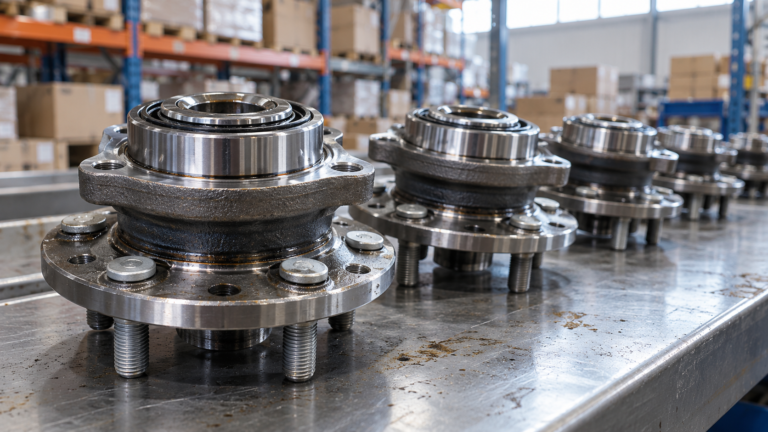
- Generation 3: a complete hub unit with integrated flange, sealed-for-life bearing set and, in most modern designs, a magnetic encoder ring for the ABS sensor. It bolts on with three or four fasteners and needs no press.
Because these are different assemblies, moving between generations is not a cost decision: the knuckle, brake and ABS interfaces decide which one a vehicle takes.
Identical dimensions can hide different content
Two bearings with the same bore, outside diameter and width can still differ in every property that determines service life: steel grade and cleanliness, hardening process and hardness range, rolling element tolerance class, cage material, seal lip configuration, grease type and fill quantity, and whether a magnetic encoder is present. None of this appears in a catalogue photo, which is why a dimensional match proves fitment only.
Where a lower-cost version can legitimately save money
Cost can come out of a bearing without touching its engineering content: production volume, packaging, logistics, the number of handling steps, and whether the buyer accepts a standard grease instead of a special low-torque grade all move the price. A supplier working to one fixed drawing can also be cheaper because it is not carrying several specification variants. What should never move is the drawing itself: dimensions, steel, heat treatment, seal, grease, clearance and encoder.
Which Wheel Bearing Generation and Roller Type Fits the Application?
Match the bearing to the load path and the mounting method first, because generation and roller type follow from where the part sits on the vehicle, not from what is cheapest to keep in stock.
Wheel bearings carry the vehicle weight as radial load and cornering force as axial load. The outer front wheel of a car in a turn sees the highest combined figure in normal driving, which is why front hub units usually show wear first in stop-and-go urban use. Rear bearings on light trailers and vans carry high radial load with little axial load, which changes both the bearing type and the seal requirement.
Where each generation is normally found
- Gen 1 — rear axles of passenger cars, light trailers, older models, and commercial axle ends where a separate hub is retained.
- Gen 2 — rear and some front positions on mid-size passenger cars and light commercial vehicles where a flanged bearing suits the knuckle casting.
- Gen 3 — front and rear of modern passenger cars, SUVs and vans, including driven axles, where the unit also carries the ABS encoder.
These are patterns, not fitment lists. For a specific vehicle the OE number and the drawing decide, and both are confirmed against a sample before an order is placed.
Tapered roller, cylindrical roller or ball: what the load demands
The roller type is a load decision. Tapered roller bearings take combined radial and axial load, cylindrical roller bearings take very high radial load with almost no axial capacity, and double-row angular contact ball bearings give low friction in passenger-car hub units.
Tapered roller bearings use line contact between cone and cup, so they carry heavy combined loads and suit pickups, vans and light truck axle ends, usually as an opposed pair with a defined end-float or preload set at installation. They are supplied as separate cone and cup, which means the installer controls the setting and a poorly finished low-cost set will still fail early if that setting is wrong. Cylindrical roller bearings are used where radial capacity dominates and axial location is provided by another component, typically inside transmissions and certain commercial hub arrangements. Double-row angular contact ball bearings are the standard inside Gen 1 to Gen 3 passenger-car hub units, because low friction and pre-set clearance matter more than ultimate load rating. The difference between a bearing and a complete assembly is set out in this comparison of wheel bearings versus hub assemblies.
The rest of the running-gear range
Tensioner and tensioner pulley bearings are sealed deep-groove ball bearings running continuously at engine speed; their life is decided by seal integrity and by whether coolant or oil reaches them, not by load. CV joint assemblies are ball type on steering axles and tripod type on the inboard plunge side, where the boot is the critical part. Clutch release bearings are thrust bearings that carry the diaphragm spring load only while the pedal is pressed, and are normally replaced together with the clutch. Tapered and cylindrical roller bearings for commercial axles complete the range HJDP supplies.
How Do You Tell Whether a Low-Cost Bearing Is Safe?
Five things decide it: steel and heat treatment, raceway geometry and clearance, seal design, grease, and traceability. The seal is both the most common place to cut cost and the part that ends life first.
Steel, hardening and what the drawing must state
Bearing rings and rolling elements are made from through-hardening bearing steel such as 100Cr6 or GCr15, equivalent to AISI 52100, hardened and tempered to a hardness normally specified in the 58 to 65 HRC range, with case-carburizing used where impact resistance matters more than pure hardness. A bearing made from the correct grade but under-hardened, or hardened with excess retained austenite, passes a dimensional check and still spalls early. Hardness and microstructure are supplier-side checks, so the practical protection for an importer is a steel and heat-treatment requirement on the drawing plus batch traceability, not a visual check at goods-in.
Precision class, clearance and preload are three separate things
Tolerance class controls dimensional and running accuracy, and clearance controls internal play; confusing them is one of the most common errors in aftermarket sourcing. The ISO 492 ladder, commonly P0, P6 or P5, governs bore, outside diameter and runout, while clearance governs axial and radial play inside the bearing. Gen 1 bearings are usually supplied in a defined clearance group and their axial position is set by the axle nut and spacer, while Gen 2 and Gen 3 hub units are built with pre-set clearance or preload and cannot be adjusted after assembly. Ask for the clearance or preload range and the measurement method, because a range without a method cannot be inspected on arrival. An axle-nut torque above the drawing value reduces internal clearance and can destroy a correctly built unit within a few thousand kilometres.
Seals and grease decide service life more than steel grade
Most wheel bearings that fail in service fail because water, salt or grit reached the raceway, not because the steel was wrong. Look for a multi-lip seal with a separate dust lip, a cassette seal on Gen 1 and Gen 2 applications exposed to heavy contamination, and a firm, correctly seated encoder ring on Gen 3 units. Grease should be specified by type and fill quantity rather than by the word greased: a lithium-complex or polyurea grease matched to the operating temperature, filled to a defined share of free space. A unit that shows grease weeping at the seal on arrival has been overfilled or stored badly, and either is a reason to question the batch. Seal construction and the inspection points are covered further in this guide to wheel bearing seal inspection, and the broader selection logic is set out in how to choose high-quality wheel bearings for your vehicle.
Does selling into France change the specification?
France does not require a different bearing design, but it changes what buyers expect to see on paper and which generations dominate the order. The French parc is weighted towards modern European passenger cars, so Gen 3 hub units with ABS encoders make up a large share of demand, while Gen 1 and Gen 2 remain needed for older vehicles and light commercial fleets. Workshops there work against tight comeback costs and vehicles pass periodic roadworthiness inspection, so a noisy hub or a triggered ABS light returns quickly. In practice French buyers ask for an OE cross-reference, a batch code and a frozen drawing more often than price-only markets do. Any marking, approval or documentation requirement must be written into the drawing and confirmed on the sample; HJDP works from buyer drawings and samples and does not claim approvals that are not specified there.
How Do You Read a Drawing, Sample and OE Reference Before Ordering?
An order is only as safe as the drawing behind it, so confirm dimensions, internals, encoder and marking in writing before the sample is approved. OE references are the normal starting point, and the way ABS identifiers change within one family is explained in this note on OE number fitment and ABS wheel hub bearings.
- Start from the OE number and axle data, not from a photo. The OE reference narrows the family; cross-reference lists are leads, and final fitment is confirmed by drawing and sample.
- Confirm the three primary dimensions. Bore, outside diameter and overall height including the flange, measured at the datum the drawing specifies.
- Confirm the mounting features. Bolt circle, hole count, thread size, flange offset and pilot diameter decide whether the unit physically fits the knuckle.
- Confirm the ABS interface. Encoder type, sensor position and pole count, or an explicit statement that no encoder is fitted — a large share of wrong-part claims starts here.
- Confirm sealing and grease. Seal type on both sides, grease type and fill quantity, and whether the unit is sealed for life.
- Confirm clearance or preload and the measurement method. A number without a method cannot be checked at goods-in.
- Confirm material, heat treatment and marking. Steel grade, hardness requirement, and where the batch code is applied: on the ring, the flange or the box.
- Approve the sample, then freeze the specification. The approved sample and signed drawing become the reference for every later batch, and production must not drift from them.
| Parameter | What to put in writing | Why it matters | How to verify |
|---|---|---|---|
| Generation and OE reference | Gen 1, 2 or 3 plus OE cross-reference list | Prevents fitting a different assembly | Compare the sample with the original part |
| Principal dimensions | Bore, outside diameter, overall height, flange offset | Physical fit on the knuckle | Calipers or drawing gauge at goods-in |
| Mounting features | Bolt circle, hole count, thread, pilot diameter | The unit must bolt on without modification | Trial fit on a sample axle or knuckle |
| ABS interface | Encoder type, sensor position, pole count, or none | ABS function and warning light | Sensor gap check and scanner after fitting |
| Seal | Lip configuration, both sides, cassette type where used | Contamination resistance and life | Visual check plus the buyer’s agreed test method |
| Grease | Type, base oil grade, fill quantity | Life, drag torque and heat | Supplier declaration and sample weighing |
| Clearance | Axial clearance or preload range and method | Noise, heat and fatigue life | Measurement to the drawing method |
| Material and heat treatment | Steel grade and hardness range | Fatigue and spalling resistance | Batch documentation from the supplier |
| Marking | Batch code location and format | Traceability and claim handling | Goods-in record against the drawing |
What Fails First, and What Does It Tell You About Build Quality?
Most wheel bearing failures begin at the seal and progress to the raceway, so the condition of the seal and the grease on a failed part tells you more about build quality than the mileage does.
Water and road salt ingress leave rust pitting on the raceway that develops into spalling and the familiar speed-related hum. Grease loss through a hardened or damaged lip leads to overheating and cage discoloration. Long storage and transport vibration can leave false brinelling, standstill marks spaced to the roller pitch, on a bearing that has never turned, which is why importers should specify rust preventive and rotate stock. Impact damage from hammering a unit into place, or pressing through the rolling elements instead of the outer ring, shows as indentation and is an installation fault rather than a manufacturing one. An ABS light with no mechanical noise usually points to a damaged encoder ring or a sensor gap disturbed during fitting.
The diagnosis sequence and the meaning of each symptom are covered in how to tell which wheel bearing is bad.
What Should You Check on Arrival and at Installation?
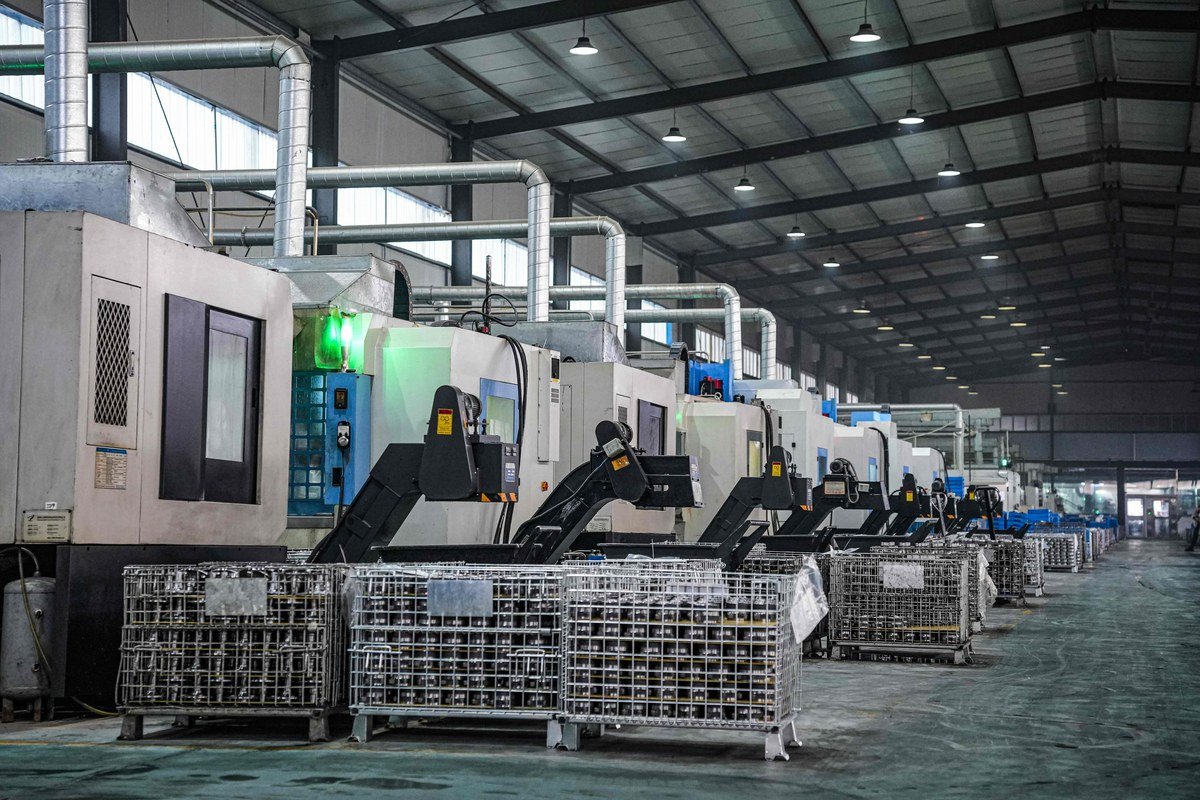
Goods-in inspection should be short, repeatable and tied to the frozen drawing, and installation should follow the torque and press points on that same drawing.
On arrival
- Label and batch code match the purchase order and the drawing.
- Sample dimensions checked with calipers against the drawing, including flange offset.
- Seal lips intact and seated, no grease weeping, no gap around the encoder.
- Rotation smooth by hand with no axial play outside the specified range and no roughness.
- Flange faces free of fretting marks, rust preventive still present.
- Packaging holds the unit so the encoder and seal cannot move in transit.
At installation
- Clean the knuckle bore and remove old seal residue; a burr will misalign the unit.
- Press or draw on the outer ring or flange as the drawing specifies, never through the rolling elements.
- Fit a new axle nut or new bolts; do not reuse a staked nut.
- Torque to the drawing value, then check the ABS sensor gap and the warning light after the first drive.
Typical sequences are shown in this guide to front wheel bearing replacement, and a quick roadside check is described in how to check a wheel bearing.
Frequently Asked Questions
Is a cheap wheel bearing safe if the dimensions are correct?
Correct dimensions prove only that the part will fit, not that it will last. Safety depends on steel grade, heat treatment, seal design, grease fill and the clearance or preload built into the unit. A low-cost bearing that matches a frozen drawing on all of those points is a reasonable buy; one that matches only the catalogue dimensions is a risk carried by the customer.
Which generation should I stock for workshops in France?
Gen 3 hub units dominate modern European passenger cars because the ABS encoder is integrated, so they are the volume line for French workshops. Gen 1 and Gen 2 still move for older vehicles and light commercial fleets, and tapered roller sets remain relevant for vans. Confirm every reference by OE number and drawing rather than by vehicle name.
Can HJDP supply this range under my own brand?
Yes. HJDP is the own brand of Jinan Huayuan Auto Bearing Co., Ltd., covering wheel hub bearings, hub units, tensioner bearings, CV joint assemblies, clutch release bearings and tapered and cylindrical roller bearings. Custom packaging and private-label marking are available, and each reference is confirmed against a drawing and an approved sample before production.
How do I compare two quotations for the same bearing fairly?
Put both against one frozen specification sheet covering generation, dimensions, mounting features, encoder, seal, grease, clearance and marking. If a line is missing or answered as standard, the two prices are not comparable. A lower quotation is only meaningful when every line matches the drawing you approved and the sample confirms it.