Wheel Bearing Water Ingress: Evidence, Seal Checks and Prevention
Water ingress in a wheel hub bearing is an investigation problem before it is a supplier-blame problem. Corrosion, contaminated lubricant or a damaged seal can justify further examination, but each observation needs context. A useful investigation records the assembly identity, exposure history, installation condition and handling after removal, then examines possible entry paths without destroying the evidence.
For a distributor, the immediate objectives are to protect the customer, preserve the returned part and identify the next technical question. Do not promise that a wet or noisy bearing can be restored by cleaning or adding grease. Have the vehicle assessed by a qualified workshop, and keep service decisions separate from the later determination of cause and responsibility.
Understand what moisture can change
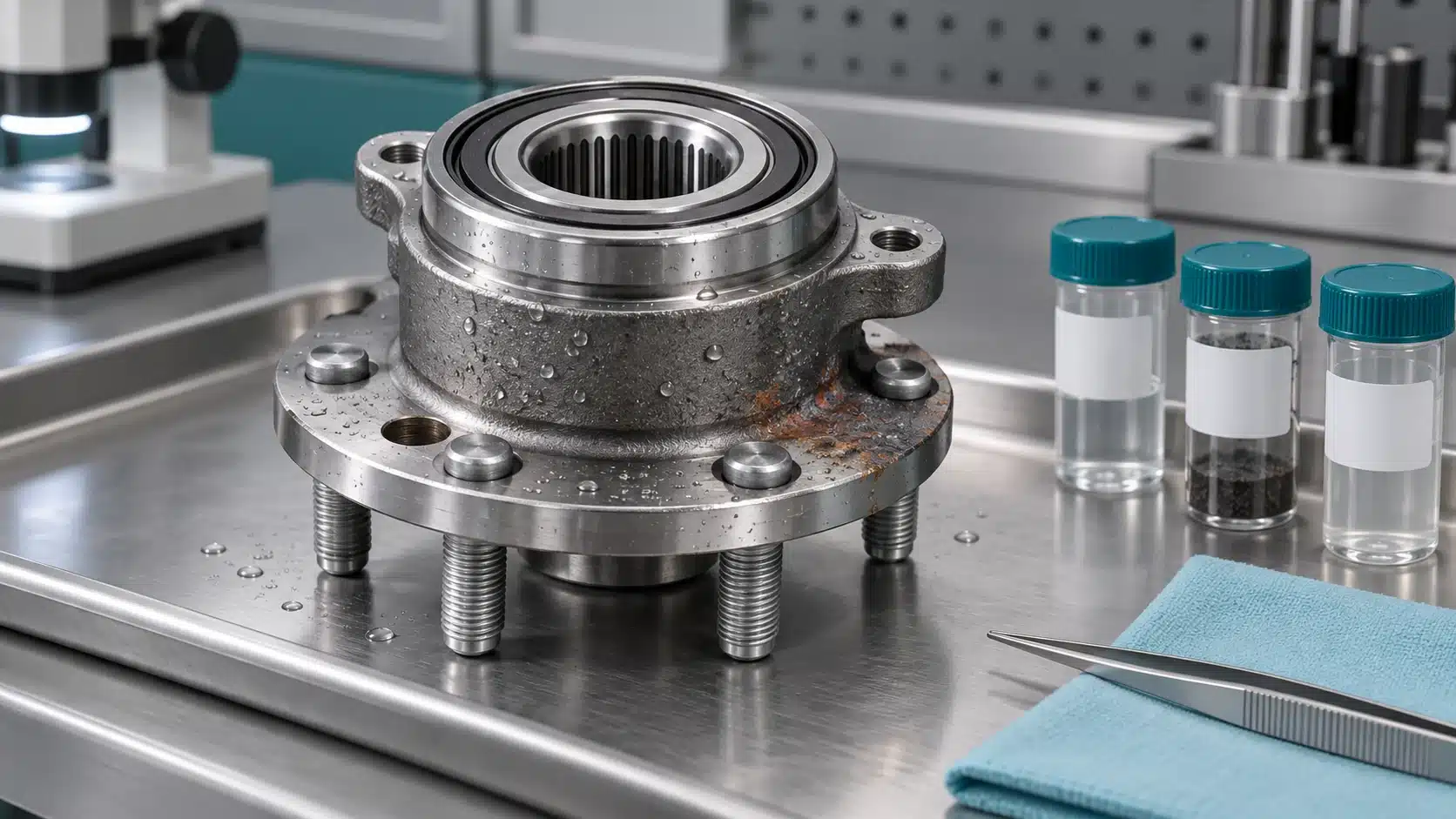
Bearing damage analysis distinguishes moisture-related corrosion from other mechanisms that can also create discoloured surfaces or rough rotation. SKF’s guide to bearing damage classification explains moisture corrosion and the importance of identifying damage patterns. That framework helps describe observations; it does not identify the source of water in a particular returned wheel hub.
An investigation therefore needs more than the word “rust.” Record where the marks are located, whether the part was operating or stored, and whether the condition was photographed before cleaning. External corrosion on exposed metal and evidence inside the bearing answer different questions. Do not convert a photograph of an exterior surface into proof of internal contamination.
Lubricant condition can provide another line of evidence, but appearance alone has limits. If analysis is justified, a competent laboratory should determine the appropriate sampling and test method. Record the sample location and handling. A mixed or contaminated sample can make an otherwise careful investigation inconclusive.
Build a timeline from delivery to examination
Start with the dates that can be established: delivery, storage, installation, first complaint, removal and return. Record mileage or service duration only when the customer provides it, and identify the source. Missing information should remain missing. An estimated interval should not be presented later as a confirmed test duration.
Ask about exposure without assuming a cause. Relevant circumstances may include immersion, unusual washing, damaged protective components, prolonged storage or a packaging incident. Phrase the questions neutrally. “Was the vehicle exposed to flooding or deep water?” invites information; “the customer must have driven through water” prejudges the result.
Include handling after removal. Was the component washed, left outdoors, stored with wet parts, opened or repeatedly rotated? These actions may change what can be inferred from the returned sample. Recording them does not dismiss the complaint; it defines the limits of the available evidence and helps the technical team choose a sensible next step.
Map possible entry paths before disassembly
Consider the assembly as installed, including seals, mating surfaces, protective features and adjacent components. A seal’s condition is important, but it is only one part of the wheel-end environment. Identify what is present in the actual design and compare it with the applicable drawing or service information.
Photograph the wheel-side and inboard sides, any protective cap, the connector area if relevant, and the mounting interfaces. Use consistent orientation labels so later reviewers can understand the images. Close-up photographs need wider context; a highly magnified mark is difficult to interpret if its position on the assembly is unknown.
Do not infer an entry route solely from where corrosion is most visible. The most damaged area may reflect exposure, operation or storage after the initial event. Treat each proposed route as a hypothesis with supporting and contradictory evidence. The investigation becomes stronger when it can explain why alternatives were considered and set aside.
| Possible issue to investigate | Evidence worth preserving | Question it can help answer |
|---|---|---|
| Seal damage | Close-up and whole-part photographs | Was damage present and where was it located? |
| Mating-surface condition | Photographs before cleaning and measured observations | Could the installation interface require attention? |
| Unusual environmental exposure | Customer timeline and service record | What conditions preceded the complaint? |
| Packaging moisture | Carton, bag and receipt photographs | Was moisture observed before installation? |
| Handling after removal | Return and storage notes | Could the examination condition have changed? |
Preserve the returned assembly as evidence
Assign a return identifier immediately and link it to the original order line. Keep the product marking, lot information and packaging label together. If the removed part has no readable identification, record that limitation and retain photographs of any distinguishing features. Do not attach a convenient lot number merely because it appears on a nearby carton.
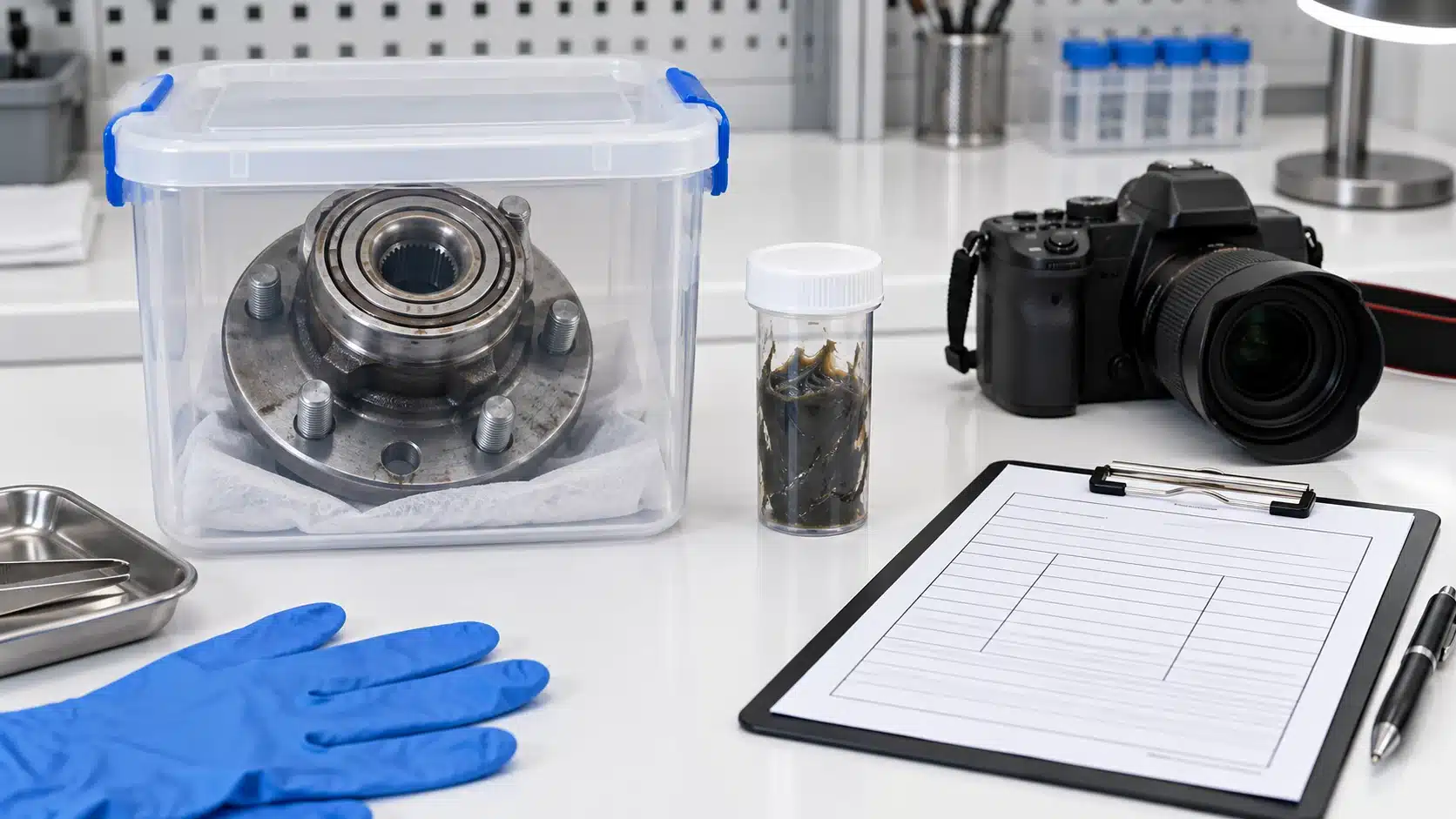
Before any cleaning, photograph the complete assembly and visible deposits. Protect the part from further contamination using a handling method agreed with the investigator. Keep loose residues and associated components separately identified. If a laboratory will analyse lubricant or deposits, follow its instructions for containers and sample preservation rather than improvising a universal method.
Record who received, moved or examined the sample. A practical chain-of-custody log can be simple: date, person, activity and resulting condition. This is especially useful when the same part passes through a workshop, distributor and supplier. The log prevents later uncertainty about whether a mark was present at receipt or appeared during handling.
Do not dismantle a unitised assembly merely to produce more dramatic photographs. The investigation plan should specify whether destructive examination is needed and who will perform it. Timken’s hub unit guidance warns against disassembling and reassembling unitised hubs for service. An examined return should not be put back into use without an applicable authorised basis.
Examine the seal and surrounding surfaces systematically
The technical examiner should document seal position, visible deformation, cuts, displaced protective elements and the condition of associated surfaces. Compare observations with the relevant product definition. A different seal appearance may be an approved design variation, a changed revision or a discrepancy; the drawing and supply record establish which interpretation is justified.
Keep installation questions specific. Ask which tools were used, how the assembly was supported and whether the required mounting information was available. For a press-in design, evidence of tool contact near a sensitive surface may deserve examination. For a bolt-on unit, mounting-face condition and the fitting record may be more relevant. Do not assume every wheel bearing shares one installation process.
The installation damage discussion covers the distinction between observed damage and an established cause. Use it alongside the part’s service instructions. Where the record is incomplete, state that the cause remains unresolved rather than replacing missing evidence with a confident narrative.
If the assembly also contains an encoder, preserve its condition and identity as a separate observation. An ABS complaint and a water-related complaint may occur together, but they do not automatically share one cause. The encoder handling guide can help structure those additional questions.
Distinguish road exposure from storage exposure
A part can encounter moisture before or after installation. Receiving photographs, package condition and storage records can therefore be as useful as workshop observations. If corrosion is found in an unopened delivery, record the package integrity and affected quantity before rearranging or repacking the shipment. Inspect according to an agreed plan and keep suspect stock identified.
For warehouse control, consider environmental variation, water leaks, open packaging and handling practices. Timken’s bearing packaging and storage guidance discusses clean, dry storage and condensation risks in its stated product context. Do not transfer that document’s product-specific storage periods to every automotive hub. Obtain the supplied product’s actual storage conditions and preservation period.
For installed parts, record the vehicle’s exposure and the condition of the wheel-end surroundings. Flood exposure, road splash and directed washing are different circumstances and should not be collapsed into a single “wet use” category. The responsible technical reviewer must decide which information is relevant to the particular assembly and complaint.
Use a cause matrix instead of a one-line verdict
Create a short table with the observation, possible explanation, supporting evidence, contrary evidence and next action. This makes the investigation reviewable by someone who was not present when the part arrived. It also reveals whether a conclusion rests on one uncertain detail or several independent observations.
For example, an illustrative case might include a wet outer carton, intact inner packaging and external rust on one returned hub. Those facts do not by themselves establish when internal moisture entered or whether it entered at all. The next action would depend on identification, package evidence and the condition observed by the examiner. This is a fictional workflow example, not a product failure statistic.
Avoid using “seal failure” as both the observation and the cause. A damaged seal may be a result, an entry path or an associated condition. The report should say what was found and what evidence connects it to the complaint. Where the evidence cannot establish timing, retain that uncertainty in the final conclusion.
Make corrective actions match the evidence
If the investigation identifies a packaging issue, the action should address the protective system, handling route and verification of the revised pack. If an installation issue is established, the response may involve instructions, tools or workshop training. If a product or process issue is established, the supplier should define the affected scope and the appropriate containment and corrective measures.
Do not close an investigation merely because replacement parts were shipped. Replacement resolves one commercial need; prevention requires evidence that the relevant cause has been addressed. Define what will be checked on the next delivery or review, who will check it and how the result will be recorded.
Keep the scope proportionate to the evidence. One return may justify a targeted review, while repeated linked complaints may require broader containment. Record the basis for the decision, including what is known about lots and applications. Avoid announcing an entire range as defective from one unidentified or heavily altered sample.
Improve the next order before a complaint happens
Purchasing can reduce uncertainty by agreeing identification, packaging and investigation requirements before shipment. Specify which lot information appears on the individual package and how it connects to the supplier’s records. Ask what evidence should accompany a return, and agree how the original product and associated materials will be preserved.
The JNHJDP export packaging guide addresses the physical protection side of the order. For the accompanying document and receiving record, the Huayuan quality documents and packaging checklist provides a complementary buyer-focused structure. Together they help connect the product, protective pack and delivery record.
Ask for order-specific commitments in writing. A generic statement such as “waterproof bearing” leaves the exposure, method and acceptance criteria undefined. If an environmental performance claim is important to the application, request the applicable specification and evidence through the technical approval process. Do not infer a water-resistance rating from a sealed appearance or a generated illustration.
Prepare a useful return dossier
The return dossier should allow the technical team to understand the complaint without first reconstructing the transaction. Include the order reference, part identity, lot information, application, installation date where known, complaint description and photographs. Attach relevant fitting and diagnostic records without adding unrelated personal information about the vehicle owner.
State the requested decision. The buyer may need a technical examination, a proposed replacement, containment advice or an explanation of which additional evidence is required. Separating those requests helps the supplier respond clearly. Keep commercial handling and technical findings in their appropriate records so that one does not silently overwrite the other.
For JNHJDP wheel hub bearings, use the contact page to provide the reference and a concise description of the issue. Request instructions before sending a contaminated or dismantled sample. A planned return is more likely to preserve useful evidence than an unlabelled parcel containing several loose parts.
Frequently asked questions
Does exterior rust prove that water entered the bearing?
No. Exterior condition is relevant evidence, but it does not establish the internal condition or entry route. Record the location and examine the assembly through an appropriate process. The conclusion should reflect what was actually observed rather than what the appearance suggests at first glance.
Can a noisy hub be cleaned and reused?
Do not treat cleaning as a service approval. A qualified workshop must assess the vehicle, and the product’s applicable service instructions determine the permitted action. Unitised hubs should not be dismantled and reassembled as an improvised repair. An investigation sample is not automatically a reusable part.
Should every returned bearing receive laboratory analysis?
The investigation objective determines the method. Identity checks and good photographs may resolve some questions; others need controlled examination or analysis. Agree the scope with a competent technical reviewer so that the work answers a defined question and preserves evidence needed for later stages.
What is the most valuable prevention record?
A record linking the exact part and lot to its approved specification, packaging and delivery condition is often the best starting point. Add installation and exposure information when available. The value comes from the connection between records, not the number of documents collected.