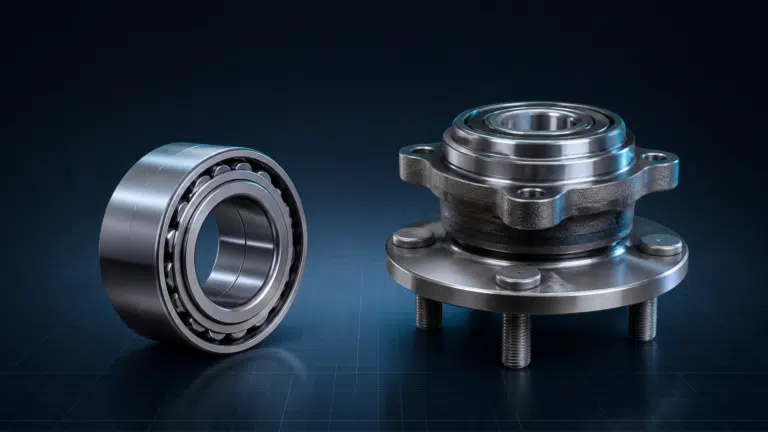

Wheel Hub Assembly Packaging for Export: Preventing Flange and Encoder Damage
# Wheel Hub Assembly Packaging for Export: Preventing Flange and Encoder Damage
Wheel hub assembly packaging is an engineered protection system, not merely a printed box. It must keep the hub’s flange, studs, pilot surfaces, seals, connector, and ABS encoder in approved condition from final inspection through warehousing, ocean freight, inland transport, and customer receipt. It must also preserve the part’s identity and lot traceability.
A hub unit is compact but relatively heavy, with hard edges and precision interfaces. If it can move inside the retail carton, the flange can cut the packaging, studs can puncture neighboring packs, an encoder can attract debris, and impact loads can pass directly into the bearing. Moisture and salt-laden air introduce a separate corrosion risk. A good specification controls these hazards as one system: product preparation, primary protection, cushioning, retail pack, master carton, pallet, labels, test method, and release evidence.
What Must Wheel Hub Assembly Packaging Protect?
The packaging team should begin with the product’s critical-to-quality surfaces rather than with an available carton size. The following interfaces typically require explicit protection.
| Hub feature | Main transit hazard | Packaging control |
|---|---|---|
| Wheel mounting face | Scratches, dents, fretting against the box | Nonabrasive face pad and axial restraint |
| Wheel studs or threaded holes | Impact, thread damage, carton puncture | Stud cap, recessed insert, or rigid clearance zone |
| Wheel and rotor pilots | Corrosion, edge impact, coating transfer | Clean barrier, shaped support, no hard contact |
| Knuckle mounting flange | Corner impact and carton wear | Load-spreading insert with controlled support points |
| Bearing seals | Tool contact, concentrated load, contamination | No insert pressure on seal lips; sealed clean environment |
| Magnetic ABS encoder | Steel debris, impact, incorrect contact material | Nonmagnetic cover and contamination barrier |
| Sensor cable and connector | Kink, crush, pullout, broken latch | Defined bend radius, connector pocket, strain-free routing |
| Marking and lot code | Abrasion or loss of traceability | Protected orientation and linked external label |
The list must be product-specific. A Gen 1 press-in bearing, a Gen 2 flanged bearing, and a Gen 3 bolt-on hub assembly have different support and clearance needs. Packaging that works for one wheel hub cannot be approved automatically for another merely because both fit the same outer carton.
Start With a Packaging Data Sheet
Create one controlled packaging data sheet per saleable part or packaging family. It should link the product drawing revision to the packaging bill of materials and state the limits within which the design is valid.
Record the following information:
- finished part mass and center of gravity;
- maximum envelope including studs, cable, cap, and hardware;
- protected surfaces and no-contact zones;
- approved rust-preventive material and application condition;
- primary bag or wrap material and closure;
- insert material, density, geometry, and orientation;
- retail carton dimensions, board specification, and closure;
- quantity per master carton and total gross mass;
- master-carton board, partitions, tape, and strapping;
- pallet pattern, height, edge protection, wrap, and restraint;
- label content, placement, barcode format, and traceability link;
- target distribution route and packaging test plan;
- acceptance criteria and revalidation triggers.
Avoid a specification such as “export standard packing.” It cannot be inspected consistently and tells the supplier nothing about the expected distribution environment.
Product Preparation Before Packing
Packaging cannot correct a product that enters the packing line wet, contaminated, or damaged. Final inspection and packing should therefore be linked.
Cleanliness
Remove machining chips, abrasive particles, loose coating, paper dust, and fingerprints from controlled surfaces using an approved process. Magnetic encoder surfaces deserve special attention because ferrous debris can remain attached and later affect a wheel-speed signal. Do not use steel wool or a dirty magnetic pickup around the encoder.
Dryness
Parts should be dry before a sealed moisture barrier is closed. Trapping wash water or condensation inside a bag creates a local corrosion environment. If products move between temperature-controlled and humid areas, define an equilibration rule that prevents condensation during packing.
Rust prevention
Select rust protection based on material, coating, route, storage time, customer cleanliness requirements, and compatibility with seals and ABS components. Options can include an approved oil or film, vapor-corrosion-inhibiting material, a sealed barrier, or a combination. The purchasing specification should name the approved product or performance requirement and the surfaces to which it applies.
More oil is not automatically better. Excess fluid can migrate onto labels, soften paperboard, contaminate connectors, or create a customer cleaning problem. A controlled method should define application, coverage, drain time, and inspection.
Installation hardware
Axle nuts, bolts, circlips, seals, or caps should be packed so they cannot strike the hub or become lost. Use a sealed, labeled accessory compartment when loose metal hardware could damage precision surfaces. The contents must match the controlled wheel hub bearing kit bill of materials.
Primary Barrier and Corrosion Control
The primary pack is the first clean barrier around the product. It should resist puncture from studs and edges, remain compatible with rust-preventive materials, and close in a repeatable way.
Bag selection
Specify material, thickness or performance grade, dimensions, seal type, and any VCI or barrier requirement. A thin bag draped over exposed studs may tear before it reaches the carton. A shaped protector or stud cap can remove the puncture point, while a properly sized bag avoids stretched seams.
Moisture management
Desiccant can support a moisture-barrier system, but it is not a substitute for a valid barrier and closure. If desiccant is used, define its type, quantity calculation, placement, activation condition, and indicator policy. Prevent direct contact with the hub and make sure the customer cannot mistake it for installation hardware.
VCI compatibility
Vapor corrosion inhibitor materials should be approved for the metals and storage environment. Verify compatibility with elastomers, electrical contacts, coatings, grease, and customer processes. Store VCI material according to its shelf-life and closure requirements; an open roll left in humid air may not perform as intended.
Seal integrity
Define how bags are folded, taped, heat-sealed, or otherwise closed. Inspect for holes and channels. A completely sealed high-barrier pack may need internal dryness controls; a breathable pack follows a different moisture strategy. Do not combine elements without understanding the resulting system.
Designing Inserts That Protect the Hub
An insert has two jobs: restrain movement and route transit loads through safe structural areas. It should not clamp the seal, encoder, connector, cable, or a thin dust shield.
Control all directions of movement
The hub should not gain enough velocity inside the box to create a second impact. Control axial, radial, and rotational movement. Where the product has studs, provide true clearance pockets rather than allowing the stud ends to become locating pins against paperboard.
Support structural faces
Use broad support on approved flange areas. Avoid small hard pads that concentrate load on a machined face. For asymmetric hub units, a keyed insert can prevent reverse packing and protect a cable or sensor boss.
Isolate metal parts
If several units share a master carton, no metal-to-metal contact should occur under vibration or compression. Partitions and individual retail packs must stay in position when the carton is rotated.
Choose materials by performance
Molded pulp, corrugated structures, foams, and reusable plastics each have tradeoffs. Evaluate cushioning, creep under stacking, dust, moisture response, abrasion, recyclability, recovery after impact, and consistency across temperature. Do not substitute insert density or flute grade without change review.
Protecting ABS Encoders and Sensors
A magnetic encoder may be integrated into a seal or ring and can be difficult to distinguish visually. Its active side, pole pattern, and target position are application-specific, as described in the ABS magnetic encoder specification guide.
Packaging controls should include:
- a no-contact zone around the active surface;
- nonmagnetic, clean covers and inserts;
- separation from loose steel hardware and grinding debris;
- protection from direct impact and abrasion;
- cable routing without sharp bends or tensile load;
- a connector pocket that protects the latch and pins;
- orientation instructions that do not rely only on color;
- post-test signal or encoder inspection where risk requires it.
A plastic cap can protect against touch and debris, but it must not rub the encoder or become a contamination source. Define when the cap is removed and whether it is part of the saleable kit.
Retail Carton and Master Carton Controls
The printed retail carton provides identity and handling protection, while the master carton carries combined transport loads. Treat them as separate controlled components.
| Component | Fields to control | Common failure |
|---|---|---|
| Retail carton | Dimensions, board, print revision, closure, orientation | Hub moves and wears through a corner |
| Insert | Material, geometry, support points, cavity orientation | Seal or encoder receives stacking load |
| Master carton | Board grade, quantity, partition, tape, gross mass | Bottom or sidewall collapses in humidity |
| Pallet | Size, entry, deck condition, pattern, height, restraint | Overhang crushes cartons and destabilizes load |
| Stretch wrap/straps | Material, application, edge protection | Excess tension deforms cartons |
| Labels | Part, quantity, lot, PO, barcode, country data | Inner and outer identity disagree |
Gross mass limits should account for manual handling and customer requirements. Leave no unfilled vertical space that allows cartons to collapse, but do not force oversized packs into a master carton. If void fill is used, define its material and placement.
Palletization for Ocean Freight
Ocean routes expose shipments to extended time, humidity, repeated handling, container vibration, and stacking. The pallet must be dry, sound, suitable for the destination, and compliant with applicable wood-packaging rules when solid wood is used. Record pallet dimensions, load pattern, maximum height, gross mass, and securing method.
Keep cartons within the pallet footprint. Overhang removes edge support and invites impact. Use corner boards or load spreaders where straps would crush boxes. Stretch wrap can stabilize the load, but it should not be the only restraint for a heavy unstable stack.
Container planning should consider mass distribution, condensation risk, ventilation strategy where applicable, separation from water sources, and safe blocking or bracing. These decisions belong to the logistics plan and should not be guessed from a generic “ocean export” label.
Label and Traceability Requirements
The physical part, retail carton, master carton, pallet, packing list, and electronic shipment record should resolve to the same identity.
Recommended label fields include:
- customer and supplier part number;
- product description that identifies the saleable unit;
- quantity and unit of measure;
- manufacturing or packing lot;
- production date code where required;
- purchase order and line reference;
- country-of-origin statement as legally applicable;
- barcode symbology and human-readable value;
- package revision or artwork version;
- handling marks that are accurate for the pack.
Verify barcodes after printing and after environmental/transit testing. Labels that scan at the packing station can wrinkle, abrade, bleed, or detach after humidity and rubbing. Do not place a critical label over a carton seam unless the design intentionally uses it as a tamper indicator.
Packaging Validation and Transit Testing
Package testing should represent the intended distribution route. ASTM D4169 provides a uniform laboratory framework for evaluating shipping units through a sequence of anticipated distribution hazards. ISTA likewise advises users to understand the real distribution environment when selecting procedures and notes hazards such as shock, vibration, compression, temperature, and humidity.
The correct procedure and levels depend on shipment type, package mass, palletization, route, handling, and customer requirements. A test name alone is not an acceptance criterion.
Create a validation matrix such as this:
| Test stage | What to observe | Product acceptance | Package acceptance |
|---|---|---|---|
| Preconditioning | Temperature/humidity exposure and closure condition | No corrosion or contamination | No unacceptable softening or delamination |
| Compression | Stack load paths and carton deformation | No load through prohibited hub features | Stack remains stable within limit |
| Vibration | Movement, abrasion, hardware migration | No flange/encoder/seal damage | Insert and partitions remain located |
| Shock/drop/impact | Stud and corner protection | No functional or dimensional damage | Closure remains effective |
| Final inspection | Appearance, dimensions, rotation, signal where required | All CTQs pass | Labels readable; no product exposure |
Follow the selected standard’s specimen, sequence, conditioning, and reporting rules. ASTM states that D4169 performance testing normally uses the same unopened shipping unit through the sequence; opening it between hazards can change what the result proves. ISTA recommends tracking package and product specification changes when deciding whether retesting is required.
Packaging Release Checklist
Before approving production packaging, confirm:
- the packed product revision matches the approved drawing;
- critical surfaces and no-contact zones are documented;
- corrosion protection matches route and storage duration;
- primary bag cannot be punctured by normal handling;
- the hub cannot move or contact metal inside the pack;
- studs, seals, encoder, connector, and cable are protected;
- accessories match the approved bill of materials;
- retail and master cartons match controlled specifications;
- labels scan and trace to product and shipment lots;
- pallet pattern has no overhang and remains stable;
- packaging tests use an appropriate route-based procedure;
- product inspections pass after the complete test sequence;
- approved photographs and a signed report are retained;
- change and revalidation triggers are defined.
When Must Packaging Be Revalidated?
Revalidation should be risk-based and documented. Triggers commonly include a new hub geometry or mass, a different stud or cable arrangement, insert material or density change, carton board or supplier change, closure or tape change, quantity-per-carton change, pallet pattern change, new route or transport mode, increased storage time, repeated transit damage, or customer requirement change.
ISTA specifically advises tracking changes to the product and package, including components, materials, interior packaging, and closure methods, when determining retest needs. Even a lower-cost “equivalent” carton can change compression and humidity performance.
Frequently Asked Questions
Is VCI paper enough for ocean freight?
Not automatically. Performance depends on the metal, exposure, barrier, closure, duration, environment, and material compatibility. Validate the complete corrosion-control system.
Should the wheel hub be tightly clamped in foam?
It should be restrained at approved structural areas, but the insert must not load seals, encoders, cables, connectors, or delicate shields. Excessive clamp force and foam creep can create new risks.
Can one package fit several hub assemblies?
Only within a validated packaging family with defined mass, envelope, support, and no-contact limits. Otherwise each design requires its own controlled insert and test evidence.
Does a passed drop test approve the export package?
No. The route may also require vibration, compression, atmospheric conditioning, impact, and corrosion evaluation in an appropriate sequence.
What evidence should a buyer request?
Request the packaging specification, bill of materials, packed photographs, label sample, pallet plan, test protocol, complete report, post-test product inspections, deviations, approvals, and revalidation rules.
Final Takeaway
Effective wheel hub assembly packaging protects precision product interfaces while maintaining identity and traceability. Define the hazards, control preparation and corrosion protection, restrain the hub through safe load paths, isolate encoders and hardware, validate retail carton and pallet performance, and test the complete packed product against its intended route.
For a packaging review, send Jinan Huayuan Auto Bearing the part number, drawing or sample, kit contents, order quantity, destination, route, storage requirement, customer label specification, and required test method. Product interchange, shelf-life, and route-specific protection should be confirmed from controlled evidence rather than assumed from a generic packaging description.
Technical Sources
- ASTM International, D4169 Standard Practice for Performance Testing of Shipping Containers and Systems: https://store.astm.org/standards/d4169
- International Safe Transit Association, Selecting and Using ISTA Test Procedures: https://ista.org/transit-tested_program.php
- International Safe Transit Association, Test Procedures: https://www.ista.org/test_procedures.php
- International Safe Transit Association, Retesting Guidance: https://support.ista.org/portal/en/kb/articles/when-should-a-packaged-product-be-retested
- SKF, Bearing Damage and Failures—Modes and Causes: https://cdn.skfmediahub.skf.com/api/public/093168a92d25cc46/pdf_preview_medium/093168a92d25cc46_pdf_preview_medium.pdf
Publication gate: Automated evidence, structure, word-count, metadata, image, and live-page QA must pass. Route-specific packaging claims remain conditional on the selected standard, customer requirements, and approved test report.