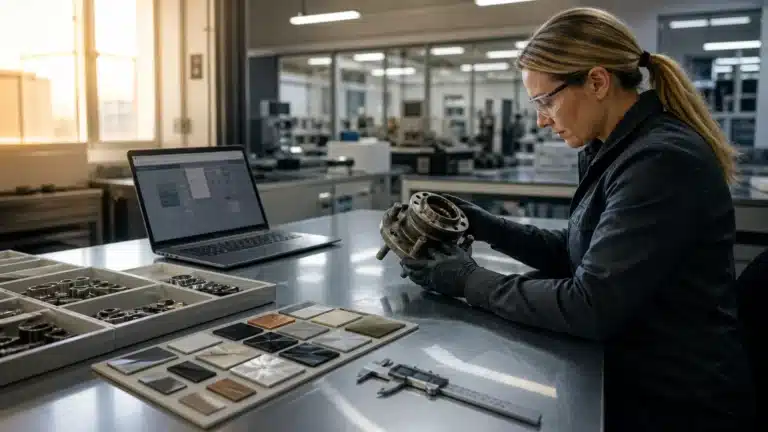

Wheel Hub Reman Cleaning and Dimensional Requalification
Cleaning changes visibility; it does not restore geometry or prove remaining life. For a design that is actually authorized for remanufacturing, requalification must distinguish removable contamination from material loss, distortion and prohibited repair.
How should a buyer review wheel hub cleaning and dimensional requalification?
Confirm that the exact design has an approved remanufacturing route before specifying any cleaning or measurement. Freeze allowed cleaning media, exposure, masking, handling and post-cleaning preservation. Inspect for cracks, corrosion, fretting, impact, unauthorized machining and material loss before dimensional acceptance. Measure only defined characteristics against the controlled drawing or engineering criteria, using stated datums, calibrated equipment and a documented decision rule. Preserve raw results and photographs, separate cosmetic observations from functional characteristics, and hold parts near limits or affected by uncertain damage for qualified engineering review. Never infer internal bearing condition from a cleaned exterior.
Confirm the authorized product and operation
Keep requalification inside a valid engineering route. For wheel hub reman dimensional requalification, that boundary matters because cleaning a non-serviceable unit can disturb seals or hide evidence needed for rejection. The responsible reviewer should decide the question being answered before opening a catalog, measuring a sample or requesting a supplier statement. A narrow decision can be audited; a broad promise assembled from partial clues cannot.
Begin with product family, serviceability approval, allowed operations, masked features and prohibited methods. Keep the original input unchanged beside every normalized value, translation or derived field. Then compare the work plan with current manufacturer and engineering instructions. Unknown is a controlled status, not permission to copy the most common value from a neighboring SKU. A field remains open until the cited evidence actually resolves it.
Decision rule and evidence owner
The retained record should retain the authorization record, evidence source and date, reviewer, decision scope and unresolved exceptions. This makes a later quotation, receipt, complaint or correction understandable to someone who did not take part in the first conversation. If the team cannot reconstruct the source and decision, the status should return to review rather than remain approved through habit.
Consider this case: a sealed sensor hub is immersed using a process written for bare castings. The stop condition is the operation conflicts with product instructions. Record the conflict at field level, identify an owner and ask one precise question. Do not hide the open point inside a general note such as “please confirm,” because that wording rarely survives into the next system or order revision.
Control cleaning and preservation
Make the surface condition reproducible for inspection. For wheel hub reman dimensional requalification, that boundary matters because aggressive blasting or chemicals can remove material, markings or protective finish. The responsible reviewer should decide the question being answered before opening a catalog, measuring a sample or requesting a supplier statement. A narrow decision can be audited; a broad promise assembled from partial clues cannot.
Begin with media, concentration, time, temperature, equipment, masking, rinse, dry and corrosion protection. Keep the original input unchanged beside every normalized value, translation or derived field. Then record actual settings and verify critical markings remain legible. Unknown is a controlled status, not permission to copy the most common value from a neighboring SKU. A field remains open until the cited evidence actually resolves it.
A workable release condition
The retained record should retain the cleaning record, evidence source and date, reviewer, decision scope and unresolved exceptions. This makes a later quotation, receipt, complaint or correction understandable to someone who did not take part in the first conversation. If the team cannot reconstruct the source and decision, the status should return to review rather than remain approved through habit.
Consider this case: shot blasting rounds an edge used as a measurement datum. The stop condition is cleaning limits or actual exposure are unknown. Record the conflict at field level, identify an owner and ask one precise question. Do not hide the open point inside a general note such as “please confirm,” because that wording rarely survives into the next system or order revision.
Screen damage before measurement
Prevent numeric results from normalizing an unsafe condition. For wheel hub reman dimensional requalification, that boundary matters because a dimension may be within limits despite a crack, galling or localized corrosion. The responsible reviewer should decide the question being answered before opening a catalog, measuring a sample or requesting a supplier statement. A narrow decision can be audited; a broad promise assembled from partial clues cannot.
Begin with crack method if authorized, visual standard, corrosion depth, fretting, impact, thread damage and prior repair. Keep the original input unchanged beside every normalized value, translation or derived field. Then apply defined defect categories and escalate ambiguous indications. Unknown is a controlled status, not permission to copy the most common value from a neighboring SKU. A field remains open until the cited evidence actually resolves it.
How to document the exception
The retained record should retain the damage record, evidence source and date, reviewer, decision scope and unresolved exceptions. This makes a later quotation, receipt, complaint or correction understandable to someone who did not take part in the first conversation. If the team cannot reconstruct the source and decision, the status should return to review rather than remain approved through habit.
Consider this case: a mounting ear meets size but shows a crack from impact. The stop condition is a safety-relevant indication remains unresolved. Record the conflict at field level, identify an owner and ask one precise question. Do not hide the open point inside a general note such as “please confirm,” because that wording rarely survives into the next system or order revision.
Measure controlled characteristics
Tie acceptance to correct datums and evidence. For wheel hub reman dimensional requalification, that boundary matters because different fixture orientation can produce incompatible runout or diameter results. The responsible reviewer should decide the question being answered before opening a catalog, measuring a sample or requesting a supplier statement. A narrow decision can be audited; a broad promise assembled from partial clues cannot.
Begin with characteristic, nominal and tolerance source, datum, method, equipment ID, result and uncertainty decision. Keep the original input unchanged beside every normalized value, translation or derived field. Then follow the approved drawing and measurement instruction without publishing universal limits. Unknown is a controlled status, not permission to copy the most common value from a neighboring SKU. A field remains open until the cited evidence actually resolves it.
A case that exposes the hidden risk
The retained record should retain the measure record, evidence source and date, reviewer, decision scope and unresolved exceptions. This makes a later quotation, receipt, complaint or correction understandable to someone who did not take part in the first conversation. If the team cannot reconstruct the source and decision, the status should return to review rather than remain approved through habit.
Consider this case: one operator references the bore while another references the flange face. The stop condition is the method or acceptance source cannot be reproduced. Record the conflict at field level, identify an owner and ask one precise question. Do not hide the open point inside a general note such as “please confirm,” because that wording rarely survives into the next system or order revision.
Reconcile requalification and preservation
Keep accepted parts from degrading or mixing before assembly. For wheel hub reman dimensional requalification, that boundary matters because a measured component can corrode or lose identity in open storage. The responsible reviewer should decide the question being answered before opening a catalog, measuring a sample or requesting a supplier statement. A narrow decision can be audited; a broad promise assembled from partial clues cannot.
Begin with inspection status, protective method, container, location, expiry or recheck trigger, owner and downstream lot. Keep the original input unchanged beside every normalized value, translation or derived field. Then apply controlled status and verify it at assembly issue. Unknown is a controlled status, not permission to copy the most common value from a neighboring SKU. A field remains open until the cited evidence actually resolves it.
What a second reviewer should see
The retained record should retain the release record, evidence source and date, reviewer, decision scope and unresolved exceptions. This makes a later quotation, receipt, complaint or correction understandable to someone who did not take part in the first conversation. If the team cannot reconstruct the source and decision, the status should return to review rather than remain approved through habit.
Consider this case: accepted components sit unprotected beside rejected cores. The stop condition is status, identity or post-cleaning protection is lost. Record the conflict at field level, identify an owner and ask one precise question. Do not hide the open point inside a general note such as “please confirm,” because that wording rarely survives into the next system or order revision.
Cleaning and dimensional requalification register
Use this receiver-side register to separate file presence, technical validation, open exceptions and authorized release.
| Acceptance control | Evidence to retain | Hold trigger |
|---|---|---|
| Confirm the authorized product and operation | product family, serviceability approval, allowed operations, masked features and prohibited methods | the operation conflicts with product instructions |
| Control cleaning and preservation | media, concentration, time, temperature, equipment, masking, rinse, dry and corrosion protection | cleaning limits or actual exposure are unknown |
| Screen damage before measurement | crack method if authorized, visual standard, corrosion depth, fretting, impact, thread damage and prior repair | a safety-relevant indication remains unresolved |
| Measure controlled characteristics | characteristic, nominal and tolerance source, datum, method, equipment ID, result and uncertainty decision | the method or acceptance source cannot be reproduced |
| Reconcile requalification and preservation | inspection status, protective method, container, location, expiry or recheck trigger, owner and downstream lot | status, identity or post-cleaning protection is lost |
A clean surface is an inspection condition, not a performance claim
Timken's wheel-end resources separate inspection, damage analysis, seals, lubrication and installation into controlled technical subjects.
Timken warns against disassembling unitized assemblies, so this workflow applies only after product-specific authorization.
Industry remanufacturing definitions require a defined process and product specification rather than cosmetic restoration alone.
Claim boundary: No cleaning process, dimensional result, repair limit, product life, serviceability or remanufacturing capability is asserted for JNHJDP.
Additional review scenarios for wheel hub reman dimensional requalification
Review scenario 1 for wheel hub reman dimensional requalification: Start from product family, serviceability approval, allowed operations, masked features and prohibited methods. The reviewer should compare the work plan with current manufacturer and engineering instructions. An independent checker then tests the conclusion against the stated decision boundary and confirms that the record will retain the authorization record, evidence source and date, reviewer, decision scope and unresolved exceptions. If the operation conflicts with product instructions, keep the affected line on hold, name the missing evidence and prevent the provisional interpretation from entering a quote, catalog, purchase order or customer promise. The case can move again when the evidence owner closes that exact field; a general assurance, familiar photograph or previous order is not a substitute for the missing source.
Review scenario 2 for wheel hub reman dimensional requalification: Start from media, concentration, time, temperature, equipment, masking, rinse, dry and corrosion protection. The reviewer should record actual settings and verify critical markings remain legible. An independent checker then tests the conclusion against the stated decision boundary and confirms that the record will retain the cleaning record, evidence source and date, reviewer, decision scope and unresolved exceptions. If cleaning limits or actual exposure are unknown, keep the affected line on hold, name the missing evidence and prevent the provisional interpretation from entering a quote, catalog, purchase order or customer promise. The case can move again when the evidence owner closes that exact field; a general assurance, familiar photograph or previous order is not a substitute for the missing source.
Review scenario 3 for wheel hub reman dimensional requalification: Start from crack method if authorized, visual standard, corrosion depth, fretting, impact, thread damage and prior repair. The reviewer should apply defined defect categories and escalate ambiguous indications. An independent checker then tests the conclusion against the stated decision boundary and confirms that the record will retain the damage record, evidence source and date, reviewer, decision scope and unresolved exceptions. If a safety-relevant indication remains unresolved, keep the affected line on hold, name the missing evidence and prevent the provisional interpretation from entering a quote, catalog, purchase order or customer promise. The case can move again when the evidence owner closes that exact field; a general assurance, familiar photograph or previous order is not a substitute for the missing source.
Review scenario 4 for wheel hub reman dimensional requalification: Start from characteristic, nominal and tolerance source, datum, method, equipment ID, result and uncertainty decision. The reviewer should follow the approved drawing and measurement instruction without publishing universal limits. An independent checker then tests the conclusion against the stated decision boundary and confirms that the record will retain the measure record, evidence source and date, reviewer, decision scope and unresolved exceptions. If the method or acceptance source cannot be reproduced, keep the affected line on hold, name the missing evidence and prevent the provisional interpretation from entering a quote, catalog, purchase order or customer promise. The case can move again when the evidence owner closes that exact field; a general assurance, familiar photograph or previous order is not a substitute for the missing source.
Review scenario 5 for wheel hub reman dimensional requalification: Start from inspection status, protective method, container, location, expiry or recheck trigger, owner and downstream lot. The reviewer should apply controlled status and verify it at assembly issue. An independent checker then tests the conclusion against the stated decision boundary and confirms that the record will retain the release record, evidence source and date, reviewer, decision scope and unresolved exceptions. If status, identity or post-cleaning protection is lost, keep the affected line on hold, name the missing evidence and prevent the provisional interpretation from entering a quote, catalog, purchase order or customer promise. The case can move again when the evidence owner closes that exact field; a general assurance, familiar photograph or previous order is not a substitute for the missing source.
Related wheel hub buyer resources
- Wheel Hub Assembly catalog
- Wheel Hub Bearing catalog
- wheel bearing versus wheel hub assembly guide
- ABS encoder identification guide
- wheel hub OE number and RFQ guide
- fitment verification workflow
- sample approval workflow
- kit contents and BOM verification
- supplier evaluation evidence guide
- export packaging checklist
- MOQ and lead-time planning guide
- incoming inspection checklist
- About Jinan Huayuan Auto Bearing
Sources, dates and claim boundaries
- Timken automotive TechTips training resources — official collection covering hub inspection, installation, damage analysis, bearing setting, seals and lubrication
- Timken Hub Unit Bearing Installation Tech Series — official safety and installation guidance warning against disassembling and reassembling unitized wheel-end hubs
- Remanufacturing Industries Council Reman 101 — industry council explanation of its consensus remanufacturing definition and process standard
- APRA Europe common remanufacturing definitions — industry-association definitions distinguishing a core and the remanufacturing process
Technical review: Jinan Huayuan Auto Bearing editorial review for source fidelity, procurement-data consistency and unsupported-claim removal. This review does not replace an OE catalog, vehicle service procedure, legal or customs advice, a customer-approved drawing, or mutually agreed commercial and inspection terms.
Corrections: Send the page URL and supporting evidence through the contact page. Material corrections are reviewed, linked records are rechecked and the updated date is changed when warranted.