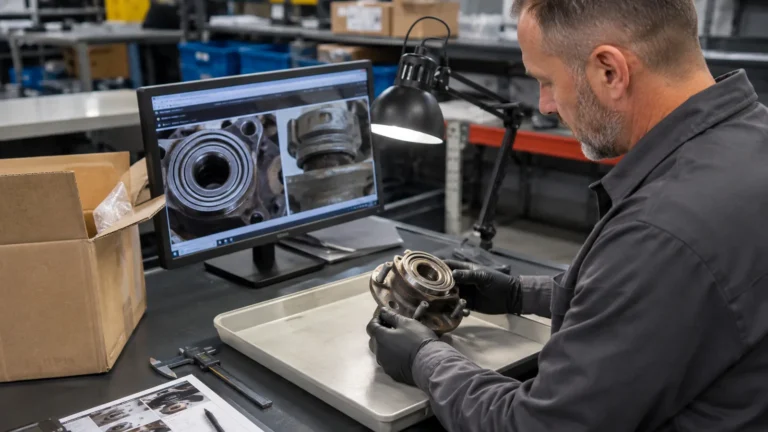

Remanufactured Wheel Hub BOM: Reused, Repaired and New Components
A remanufactured assembly can contain reused, repaired and new elements only when its approved technical route permits them. The bill of materials must describe those roles without implying that an inaccessible sealed component was safely renewed.
What should a remanufactured wheel hub BOM prove?
Start with an engineering-approved product structure for the exact serviceable design. For every component, define whether it may be retained, inspected, repaired, replaced with new material or rejected, and name the evidence required for that status. Link retained parts to the parent core, new parts to supplier and lot records, and repaired parts to the authorized operation and inspection result. Control alternatives, effectivity and substitutions through formal approval. Reconcile the as-built record with the released unit and its label. If a unitized hub cannot be opened under authoritative instructions, do not create a fictional internal BOM that suggests otherwise.
Freeze the approved product structure
Define what the reman process is technically allowed to contain. For teams handling remanufactured wheel hub BOM, a generic diagram may omit sensors, seals, fasteners or design-specific interfaces. The decision should therefore begin with an explicit scope, not with a preferred part, price or supplier. This keeps evidence from being selected only because it supports the answer someone already expects.
Assemble product family, drawing, BOM revision, serviceability decision, mandatory parts and prohibited operations. With the baseline frozen, obtain engineering approval before linking commercial part numbers. Use controlled terms for confirmed, candidate, conflict, rejected and unknown. Those statuses are more informative than a single yes/no field and let the organization move safe lines forward while isolating unresolved ones.
Decision rule and evidence owner
The record needs to retain the structure record, evidence source and date, reviewer, decision scope and unresolved exceptions. It should show the source owner, review date, revision and linked artifacts, plus the effect on catalog, order, inventory or claim status. A complete record shortens the next review and makes corrections possible without deleting the earlier evidence.
Practical example: one family has an integrated sensor while another uses an external harness. The review must stop when the approved structure or design scope is missing. Send the evidence owner a specific request and keep the affected line outside approval. Never widen the claim to cover both possibilities merely because either could be true.
Assign allowed component status
Distinguish reused, repaired, replaced and rejected parts. For teams handling remanufactured wheel hub BOM, the word remanufactured can conceal an uncontrolled mixture of histories. The decision should therefore begin with an explicit scope, not with a preferred part, price or supplier. This keeps evidence from being selected only because it supports the answer someone already expects.
Assemble component, allowed status, acceptance evidence, repair route, replacement requirement and rejection trigger. With the baseline frozen, write unambiguous disposition codes and examples. Use controlled terms for confirmed, candidate, conflict, rejected and unknown. Those statuses are more informative than a single yes/no field and let the organization move safe lines forward while isolating unresolved ones.
A workable release condition
The record needs to retain the status record, evidence source and date, reviewer, decision scope and unresolved exceptions. It should show the source owner, review date, revision and linked artifacts, plus the effect on catalog, order, inventory or claim status. A complete record shortens the next review and makes corrections possible without deleting the earlier evidence.
Practical example: a stud is cleaned and reused although the approved route requires replacement. The review must stop when component status or rule is unclear. Send the evidence owner a specific request and keep the affected line outside approval. Never widen the claim to cover both possibilities merely because either could be true.
Trace new and retained components
Connect every installed item to adequate origin evidence. For teams handling remanufactured wheel hub BOM, new components can be mixed across unapproved suppliers while retained parts lose parent identity. The decision should therefore begin with an explicit scope, not with a preferred part, price or supplier. This keeps evidence from being selected only because it supports the answer someone already expects.
Assemble supplier, part number, incoming lot, core parent, certificate or inspection record and storage status. With the baseline frozen, maintain parent-child and supplier-lot links through assembly. Use controlled terms for confirmed, candidate, conflict, rejected and unknown. Those statuses are more informative than a single yes/no field and let the organization move safe lines forward while isolating unresolved ones.
How to document the exception
The record needs to retain the source record, evidence source and date, reviewer, decision scope and unresolved exceptions. It should show the source owner, review date, revision and linked artifacts, plus the effect on catalog, order, inventory or claim status. A complete record shortens the next review and makes corrections possible without deleting the earlier evidence.
Practical example: a replacement encoder arrives in bulk with no lot identity. The review must stop when a critical installed item lacks origin evidence. Send the evidence owner a specific request and keep the affected line outside approval. Never widen the claim to cover both possibilities merely because either could be true.
Control alternatives and substitutions
Prevent availability pressure from changing the approved design silently. For teams handling remanufactured wheel hub BOM, dimensionally similar seals or sensors may not have equivalent performance. The decision should therefore begin with an explicit scope, not with a preferred part, price or supplier. This keeps evidence from being selected only because it supports the answer someone already expects.
Assemble requested change, reason, comparison, test need, affected stock, approvers and effective date. With the baseline frozen, route every alternative through the same technical release process. Use controlled terms for confirmed, candidate, conflict, rejected and unknown. Those statuses are more informative than a single yes/no field and let the organization move safe lines forward while isolating unresolved ones.
A case that exposes the hidden risk
The record needs to retain the change record, evidence source and date, reviewer, decision scope and unresolved exceptions. It should show the source owner, review date, revision and linked artifacts, plus the effect on catalog, order, inventory or claim status. A complete record shortens the next review and makes corrections possible without deleting the earlier evidence.
Practical example: a replacement bearing is substituted after the approved source is delayed. The review must stop when the alternative lacks authorization or validation. Send the evidence owner a specific request and keep the affected line outside approval. Never widen the claim to cover both possibilities merely because either could be true.
Reconcile the as-built unit
Prove what the released assembly actually contains. For teams handling remanufactured wheel hub BOM, the planned BOM and physical build can diverge after rework. The decision should therefore begin with an explicit scope, not with a preferred part, price or supplier. This keeps evidence from being selected only because it supports the answer someone already expects.
Assemble unit or lot ID, component statuses, source lots, deviations, rework, final inspection and release. With the baseline frozen, sample or record consumption and investigate unexplained variance. Use controlled terms for confirmed, candidate, conflict, rejected and unknown. Those statuses are more informative than a single yes/no field and let the organization move safe lines forward while isolating unresolved ones.
What a second reviewer should see
The record needs to retain the asbuilt record, evidence source and date, reviewer, decision scope and unresolved exceptions. It should show the source owner, review date, revision and linked artifacts, plus the effect on catalog, order, inventory or claim status. A complete record shortens the next review and makes corrections possible without deleting the earlier evidence.
Practical example: the traveler lists a new seal but inventory consumption shows none. The review must stop when as-built content cannot be reconstructed. Send the evidence owner a specific request and keep the affected line outside approval. Never widen the claim to cover both possibilities merely because either could be true.
Remanufactured hub BOM status register
Use this receiver-side register to separate file presence, technical validation, open exceptions and authorized release.
| Acceptance control | Evidence to retain | Hold trigger |
|---|---|---|
| Freeze the approved product structure | product family, drawing, BOM revision, serviceability decision, mandatory parts and prohibited operations | the approved structure or design scope is missing |
| Assign allowed component status | component, allowed status, acceptance evidence, repair route, replacement requirement and rejection trigger | component status or rule is unclear |
| Trace new and retained components | supplier, part number, incoming lot, core parent, certificate or inspection record and storage status | a critical installed item lacks origin evidence |
| Control alternatives and substitutions | requested change, reason, comparison, test need, affected stock, approvers and effective date | the alternative lacks authorization or validation |
| Reconcile the as-built unit | unit or lot ID, component statuses, source lots, deviations, rework, final inspection and release | as-built content cannot be reconstructed |
A component-status record is more useful than a vague reman label
Industry consensus definitions describe remanufacturing as an industrial process that returns a product to a specified useful condition, not as a free-form mix of parts.
FTC guidance requires accurate representations about prior use, reconstruction and the rebuilder rather than allowing appearance to substitute for disclosure.
SKF and Timken product resources illustrate integrated seals, sensors and unitized designs that require product-specific technical authority.
Claim boundary: No remanufactured BOM, component source, substitution, as-built record, product performance or factory process is claimed for JNHJDP.
Additional review scenarios for remanufactured wheel hub BOM
Review scenario 1 for remanufactured wheel hub BOM: Start from product family, drawing, BOM revision, serviceability decision, mandatory parts and prohibited operations. The reviewer should obtain engineering approval before linking commercial part numbers. An independent checker then tests the conclusion against the stated decision boundary and confirms that the record will retain the structure record, evidence source and date, reviewer, decision scope and unresolved exceptions. If the approved structure or design scope is missing, keep the affected line on hold, name the missing evidence and prevent the provisional interpretation from entering a quote, catalog, purchase order or customer promise. The case can move again when the evidence owner closes that exact field; a general assurance, familiar photograph or previous order is not a substitute for the missing source.
Review scenario 2 for remanufactured wheel hub BOM: Start from component, allowed status, acceptance evidence, repair route, replacement requirement and rejection trigger. The reviewer should write unambiguous disposition codes and examples. An independent checker then tests the conclusion against the stated decision boundary and confirms that the record will retain the status record, evidence source and date, reviewer, decision scope and unresolved exceptions. If component status or rule is unclear, keep the affected line on hold, name the missing evidence and prevent the provisional interpretation from entering a quote, catalog, purchase order or customer promise. The case can move again when the evidence owner closes that exact field; a general assurance, familiar photograph or previous order is not a substitute for the missing source.
Review scenario 3 for remanufactured wheel hub BOM: Start from supplier, part number, incoming lot, core parent, certificate or inspection record and storage status. The reviewer should maintain parent-child and supplier-lot links through assembly. An independent checker then tests the conclusion against the stated decision boundary and confirms that the record will retain the source record, evidence source and date, reviewer, decision scope and unresolved exceptions. If a critical installed item lacks origin evidence, keep the affected line on hold, name the missing evidence and prevent the provisional interpretation from entering a quote, catalog, purchase order or customer promise. The case can move again when the evidence owner closes that exact field; a general assurance, familiar photograph or previous order is not a substitute for the missing source.
Review scenario 4 for remanufactured wheel hub BOM: Start from requested change, reason, comparison, test need, affected stock, approvers and effective date. The reviewer should route every alternative through the same technical release process. An independent checker then tests the conclusion against the stated decision boundary and confirms that the record will retain the change record, evidence source and date, reviewer, decision scope and unresolved exceptions. If the alternative lacks authorization or validation, keep the affected line on hold, name the missing evidence and prevent the provisional interpretation from entering a quote, catalog, purchase order or customer promise. The case can move again when the evidence owner closes that exact field; a general assurance, familiar photograph or previous order is not a substitute for the missing source.
Review scenario 5 for remanufactured wheel hub BOM: Start from unit or lot ID, component statuses, source lots, deviations, rework, final inspection and release. The reviewer should sample or record consumption and investigate unexplained variance. An independent checker then tests the conclusion against the stated decision boundary and confirms that the record will retain the asbuilt record, evidence source and date, reviewer, decision scope and unresolved exceptions. If as-built content cannot be reconstructed, keep the affected line on hold, name the missing evidence and prevent the provisional interpretation from entering a quote, catalog, purchase order or customer promise. The case can move again when the evidence owner closes that exact field; a general assurance, familiar photograph or previous order is not a substitute for the missing source.
Review scenario 6 for remanufactured wheel hub BOM: Start from product family, drawing, BOM revision, serviceability decision, mandatory parts and prohibited operations. The reviewer should obtain engineering approval before linking commercial part numbers. An independent checker then tests the conclusion against the stated decision boundary and confirms that the record will retain the structure record, evidence source and date, reviewer, decision scope and unresolved exceptions. If the approved structure or design scope is missing, keep the affected line on hold, name the missing evidence and prevent the provisional interpretation from entering a quote, catalog, purchase order or customer promise. The case can move again when the evidence owner closes that exact field; a general assurance, familiar photograph or previous order is not a substitute for the missing source.
Related wheel hub buyer resources
- Wheel Hub Assembly catalog
- Wheel Hub Bearing catalog
- wheel bearing versus wheel hub assembly guide
- ABS encoder identification guide
- wheel hub OE number and RFQ guide
- fitment verification workflow
- sample approval workflow
- kit contents and BOM verification
- supplier evaluation evidence guide
- export packaging checklist
- MOQ and lead-time planning guide
- incoming inspection checklist
- About Jinan Huayuan Auto Bearing
Sources, dates and claim boundaries
- Remanufacturing Industries Council Reman 101 — industry council explanation of its consensus remanufacturing definition and process standard
- FTC Guides for Rebuilt, Reconditioned and Other Used Automobile Parts — official US guidance on condition, prior-use and rebuilder representations for automobile parts
- SKF wheel hub bearings and kits — official description of wheel-hub generations, sealed-for-life designs, ABS features, kits and fitting resources
- Timken Hub Unit Bearing Installation Tech Series — official safety and installation guidance warning against disassembling and reassembling unitized wheel-end hubs
Technical review: Jinan Huayuan Auto Bearing editorial review for source fidelity, procurement-data consistency and unsupported-claim removal. This review does not replace an OE catalog, vehicle service procedure, legal or customs advice, a customer-approved drawing, or mutually agreed commercial and inspection terms.
Corrections: Send the page URL and supporting evidence through the contact page. Material corrections are reviewed, linked records are rechecked and the updated date is changed when warranted.