Outer CV Joint Manufacturer: How to Specify and Inspect Units
An outer CV joint manufacturer supplies the fixed ball-type constant velocity joint that sits at the wheel end of a driveshaft, carries torque through the steering angle, and is judged on articulation range, spline accuracy, boot sealing and grease life rather than on appearance. HJDP is the own brand of Jinan Huayuan Auto Bearing Co., Ltd., published on jnhjdp.com, and covers outer CV joints and joint assemblies alongside wheel hub bearings, tensioner bearings and clutch release bearings. Buyers should specify by drawing, confirm by sample, then verify dimensions, hardness, boot fit and grease fill at goods-in.
What Is an Outer CV Joint and What Loads Does It Carry?
The outer CV joint is a fixed, non-plunging constant velocity joint mounted at the wheel end of a driveshaft; it transfers torque to the hub while the wheel steers and the suspension moves. Because it cannot change length, every change in driveshaft length is absorbed by the inner joint on the gearbox side. That division of labor explains why the two ends wear differently, fail with different symptoms and must be specified separately.
Where does the outer joint sit in the driveline?
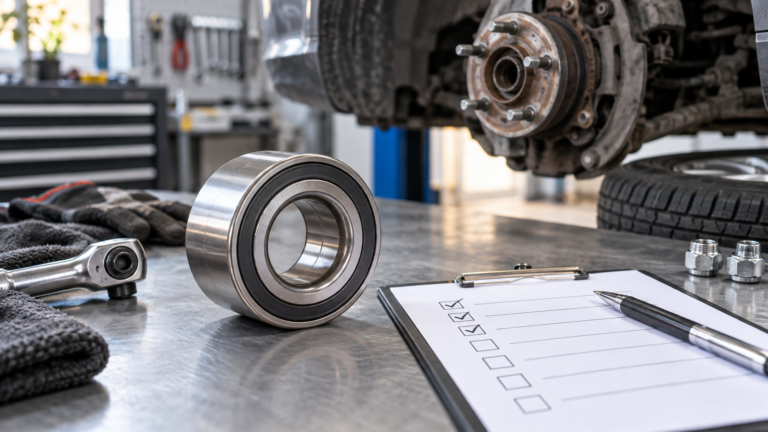
It sits in the steering knuckle, splined onto the outer end of the driveshaft and usually retained by a circlip, with the hub nut clamping the wheel hub against the joint stem. A convoluted boot held by two clamps keeps grease in and keeps water and grit out. The joint does not carry the weight of the vehicle: vertical load passes through the wheel hub bearing, a separate component with a different failure signature. Confusing hub bearing noise with CV joint noise is one of the most common diagnostic errors in a workshop, and it usually ends with the wrong part being replaced.
What loads and angles does an outer CV joint see?
Four loads shape the design of an outer joint, and each one should appear on the drawing or in the purchase specification:
- Torque: highest in first and reverse gear and on full lock at low speed, when the joint is at its largest angle.
- Articulation: front outer joints follow the steering, and road-car designs commonly need up to roughly 45–50° at full lock depending on suspension geometry.
- Rotational speed: at cruising speed the joint turns at wheel speed, so grease channeling and boot balance matter as much as static strength.
- Environment: brake heat, road salt, standing water, dust and, in some markets, sustained high ambient temperature.
How does the outer joint differ from the inner joint?
The outer joint handles angle; the inner joint handles angle and length change. Treating the two as interchangeable is the fastest way to order the wrong part.
| Feature | Outer CV joint | Inner CV joint |
|---|---|---|
| Position | Wheel end, inside the steering knuckle | Gearbox or differential end |
| Function | Constant velocity torque transfer at steering angle | Torque transfer plus axial plunge |
| Length change | None; it is a fixed joint | Yes, it follows suspension travel |
| Typical design | Ball and cage with six balls, Rzeppa or Birfield type | Tripod, double offset or cross groove |
| Typical wear symptom | Rhythmic click on full lock, knock under acceleration | Shudder or vibration under acceleration |
| Main heat source | Brakes and steering load | Gearbox and engine bay |
Which Outer CV Joint Designs Are Made, and How Do You Choose?
Nearly every outer CV joint in passenger cars and light commercial vehicles is a fixed ball-and-cage joint; the variation lies in raceway geometry, ball size, cage design and the hub interface. Choosing between them is a question of articulation angle, torque capacity and package space, not of brand preference.
What is a Rzeppa fixed joint?
A Rzeppa joint uses six balls running in matching grooves in an inner race (the star) and an outer race (the housing), held equally spaced by a cage. The cage keeps every ball in the bisecting plane of the joint angle, so output speed equals input speed at any articulation — the definition of constant velocity. Torque capacity comes from ball diameter, groove depth and case hardness; usable angle comes from groove geometry and cage window clearance. A Rzeppa joint is compact for its torque rating, which is why it dominates front-wheel-drive passenger car applications.
What is a Birfield joint and when is it used instead?
A Birfield joint is a ball-and-cage fixed joint with curved raceways that allow the ball set to shift slightly along the joint axis as it articulates. That axial freedom spreads contact stress along the groove instead of concentrating it at one point, which suits larger articulation angles and heavier torque. The two families overlap in service, so buyers should not treat the name as a guarantee: what matters is the drawing, the rated angle and the torque class the joint was designed for.
Are there outer joints that are not ball type?
A limited number of vehicle families use fixed tripod outer joints, and cross-groove joints appear mainly as inner joints. When replacing a joint, match the design family as well as the dimensions: a ball joint and a tripod joint of similar size behave differently in noise, angle range and grease life, and swapping families changes the driveshaft behavior even if the splines fit.
How do part numbers map to joint families?
HJDP publishes its outer CV joint range as individual part pages on jnhjdp.com, grouped by joint size and hub interface. A typical listing such as the T11-XLB3AFA2203030W outer CV joint identifies one joint within a family, with the dimensions confirmed on its drawing.
The same logic applies across the range: a different size group is a different drawing and a different tooling set, as with the SS22003A outer CV joint. A part number identifies a family; it never proves vehicle fitment on its own. Spline count, stem thread, housing diameter, boot groove position and articulation angle must be confirmed against the drawing and a physical sample before production.
Which Drawing Parameters Decide Fit and Durability?
Six drawing parameters decide whether an outer CV joint fits and how long it lasts: spline specification, housing geometry, stem and thread, articulation angle, material and hardness, and the boot and grease specification. Everything else on the sheet is secondary, and none of these values should be accepted as “standard” without a figure.
| Drawing parameter | What to read | Why it decides fit or life |
|---|---|---|
| Spline | Number of teeth, module or diametral pitch, major diameter, pressure angle, effective length, chamfer | A wrong spline means no fit, or a rocking fit that frets and fails |
| Housing | Outer diameter, ball groove profile, boot groove diameter and position, circlip groove | Controls knuckle clearance, boot retention and joint retention |
| Stem and thread | Stem diameter, thread size and pitch, flat or keyway, overall length | Controls hub nut engagement and the hub interface |
| Articulation | Maximum angle at rated torque, axial clearance, cage window clearance | Prevents binding at full lock and controls noise at the limit |
| Material and hardness | Steel grade, case depth, surface hardness, core hardness | Sets wear life and cage fatigue resistance |
| Boot and grease | Boot material, clamp type, grease type, fill weight | Determines sealing life and lubrication life |
How do you read the spline callout?
The spline callout is the first thing to check, because it is the hardest characteristic to correct later. Read the tooth count together with the module or diametral pitch, the major diameter and the pressure angle: two joints with the same tooth count but different pressure angles will fit the same hub and still run with play. Effective spline length and the entry chamfer decide how much of the stem actually carries torque under load.
What housing and stem dimensions matter?
Housing outer diameter sets knuckle clearance, and the boot groove diameter and position decide whether the boot stays seated through full steering lock. On the stem side, thread size and pitch decide hub nut engagement, while the flat or keyway and overall length decide how the joint seats against the hub. Every dimension of this kind is stated on the part drawing, and is confirmed against a sample before a production order. For a mid-size joint group, dimensions of this type are listed on pages such as the T11-XLB3AH2203030 outer CV joint.
Which hardness and tolerance values should be on the drawing?
Ask for the steel grade, the case depth and both surface and core hardness for the housing and races, plus a hardness range for the cage. Ask also for shaft runout, ball groove profile tolerance and internal axial clearance, because those three values set the noise level a rebuilt vehicle will produce. Hardness and clearance figures are confirmed on the drawing and against a sample; they are not inferred from a part number.
How Do Boots, Grease and Sealing Decide Joint Life?

The boot and the grease decide most outer CV joint life: a joint that keeps clean grease and loses none will usually outlast the vehicle, while a split boot can destroy the same joint within a few thousand kilometers. Joints rarely fail because the steel was too soft; they fail because lubrication was lost first.
Which boot material should be specified?
Chloroprene rubber remains the common choice for general replacement market use, with thermoplastic polyester elastomer boots specified where longer life or higher running temperature is required, and silicone grades reserved for very hot installations. The boot has to resist ozone, grease attack, abrasion and repeated flexing at low temperature, so the material callout belongs in the purchase specification rather than being left to the supplier.
Which grease, and how much?
Outer joints are normally filled with a molybdenum disulfide fortified grease, lithium or polyurea based depending on the design, and the fill weight belongs on the drawing. Too little grease starves the ball grooves at high angle; too much can balloon the boot and force it off its groove at speed. Grease type is not interchangeable between joint families, and mixing two thickener systems inside one joint produces a soft, leaking paste.
Why do clamps and boot seating matter?
The clamp is a sealing component, not a fastener. Stainless steel clamps crimped with the correct tool hold tension far better than pliers-crimped bands, and the boot must sit squarely in its groove without twisting. A boot fitted with a single twist will run off-center, rub against itself and split within a short distance.
What Are the Common Failure Modes and How Do You Diagnose Them?
Outer CV joints almost always lose lubrication or take in contamination before they wear, and the classic first sign is a rhythmic click on full lock that later becomes a knock under acceleration. Reading the symptom correctly avoids replacing a healthy joint and a healthy wheel bearing at the same time.
| Symptom | Most likely cause | How to confirm |
|---|---|---|
| Click or tick on full lock at walking pace | Ball and groove wear, increased internal clearance | Slow circles in both directions on a clean, quiet surface |
| Knock or clunk under acceleration in a straight line | Advanced wear, cage or ball damage | Hand check for play, inspect grease for metal particles |
| Vibration that rises with road speed | Joint wear, bent shaft, excessive running angle | Shaft runout check, compare both sides of the vehicle |
| Grease on the inner wheel arch or wheel face | Split boot, loose or damaged clamp | Visual inspection and a gentle squeeze of the boot |
| Rough or notchy rotation by hand | Contamination, brinelling, corrosion | Rotate the joint through its full angle with the shaft off the car |
| Hub nut keeps loosening | Spline fretting, incorrect torque, poor staking | Check spline condition and the staked collar |
How do you confirm a failing outer joint on the car?
- Road test slowly on full lock in both directions and listen for a regular click that follows wheel rotation.
- Inspect the boot along every convolution for cracks, grease seepage and clamp condition.
- Grasp the driveshaft close to the joint and check for radial and axial play.
- Check hub nut torque and staking before condemning the joint.
- Test the wheel bearing separately: bearing noise usually changes with cornering load, joint noise with drive torque and steering angle.
- Remove the shaft and rotate the joint through its full angle by hand, feeling for notches and looking for metallic sheen in the grease.
What do wear patterns inside the joint tell you?
Polished, discolored bands in the ball grooves point to lubrication loss; a single dented groove with matching ball marks suggests brinelling from impact or long storage in one position; a cracked or worn cage window points to excessive angle or grease failure; and rust-colored grease indicates a boot that has been split for some time. Spline fretting, visible as reddish-brown staining on the stem, explains a loosening hub nut even when the joint itself still rotates smoothly.
How Should Outer CV Joints Be Installed and Replaced?
Correct installation is mostly about not damaging the new joint and sealing the boot: draw the joint on with a puller instead of hammering it, always fit a new boot and clamps, and torque the hub nut to the figure in the workshop manual with the vehicle on the ground. Whether the part is a small-car unit or a larger one such as the SLAL22003 outer CV joint, the sequence does not change.
What is the correct installation sequence?
- Clean the knuckle and shaft, and inspect the hub bearing and both spline sets before fitting anything new.
- Cut and remove the old boot clamps, wipe out the old grease and note the wear pattern for warranty records.
- Release the circlip and draw the joint off the shaft with a puller; never hammer on the cage or the stem.
- Deburr the shaft splines and trial-fit the new joint dry to confirm spline engagement and seating.
- Pack the joint with the specified grease weight, fit the new boot and equalize air pressure before clamping.
- Crimp new clamps with the correct tool and check that the boot is not twisted and sits fully in both grooves.
- Insert the shaft, confirm the circlip is engaged, reconnect the suspension and check wheel alignment afterward.
- Torque the hub nut to the workshop manual figure with the wheel on the ground, stake or lock it, then road test on full lock both ways.
Which installation mistakes cause repeat failures?
- Hammering the joint onto the shaft, which dents the cage and brinells the grooves before the car moves.
- Reusing the old boot or clamps to save one line item, then losing the joint to water ingress.
- Using a general-purpose grease instead of the specified molybdenum disulfide product, or overfilling until the boot balloons.
- Jacking or supporting the vehicle under the joint or boot during the job.
- Skipping the hub nut torque and staking step, which allows spline fretting and later noise.
What Should Importers Check When a Shipment Arrives?
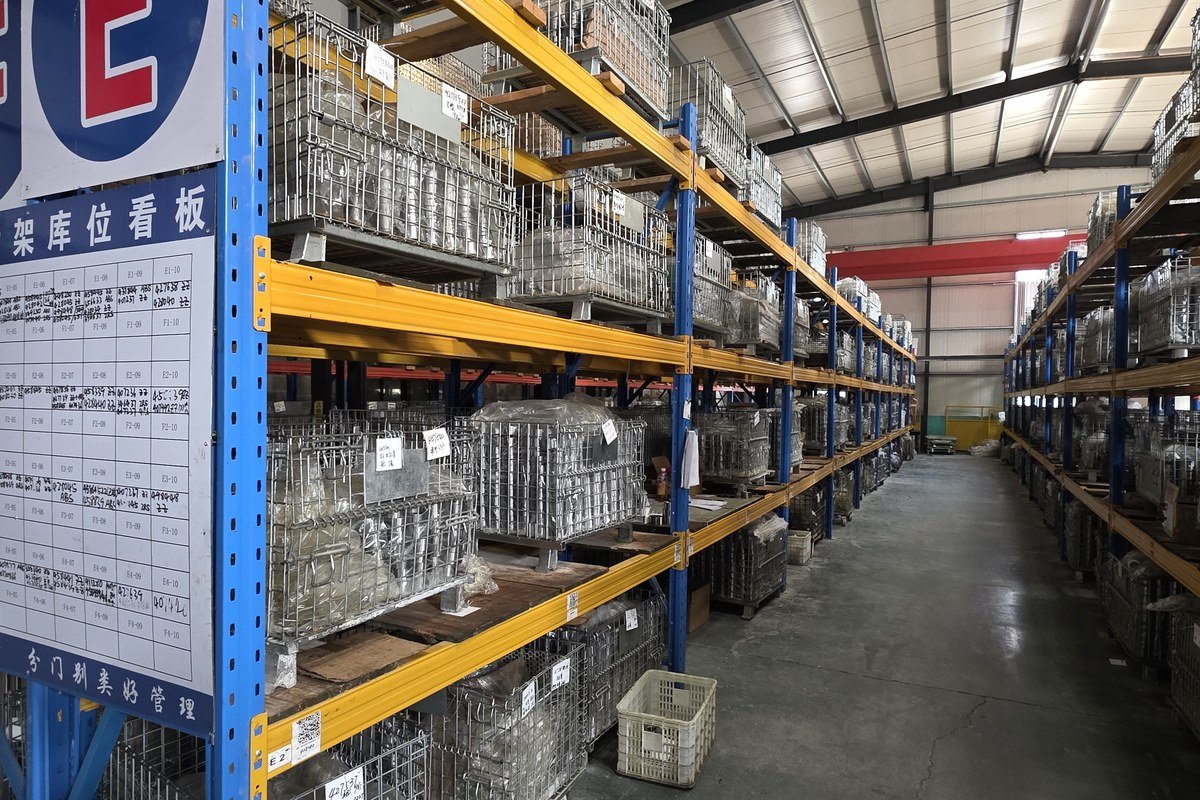
Incoming inspection for outer CV joints should cover identity against the drawing, spline and thread dimensions, boot and clamp fit, grease fill, sample hardness verification and packaging that survives container handling. The checks take minutes per batch and settle most quality disputes before they reach a customer.
Which documents and markings should match?
Compare the packing list, the part number marking and the drawing revision number, and confirm that the parts received match the approved sample. If your purchase order asks for material or hardness records, check that they cover the actual production batch. Brand marking matters too: HJDP is the own brand associated with jnhjdp.com, and any buyer-branded carton must match the approved artwork.
Which dimensional and visual checks are worth doing?
- Spline gauges, GO and NO-GO, on a sample from each carton.
- Thread gauge on the stem, plus a check of overall length and stem diameter.
- Housing outer diameter and boot groove position against the drawing.
- Hand articulation through the full angle, checking for smooth rotation and no notch.
- Boot material, seating and clamp crimp quality, plus grease weight on a sample basis.
- Absence of rust on splines, grooves and threads, and clean, dry packaging with no crushed cartons.
The same checks apply to every item on the order, including a joint such as the T11-XLB3AF2203030B outer CV joint.
What should you agree about packaging and private label?
Custom packaging and own-brand labeling are normally agreed before production: artwork, carton strength, inner packing and marking all need approval, and a print proof should be signed off before the run starts. Agreeing the marking scheme at that stage avoids a container of correct joints arriving in cartons that cannot be sold through your channel.
Frequently Asked Questions About Outer CV Joints
Is an outer CV joint the same as a CV axle?
No. A CV axle is the complete driveshaft assembly, usually with an inner joint, a shaft and an outer joint, and often with a intermediate bearing on unequal-length shafts. The outer CV joint is one component of that assembly. Some vehicles allow only the joint to be replaced, while others are serviced as a complete shaft.
Can I replace only the outer joint instead of the whole shaft?
It depends on the shaft design and on whether the splines and circlip groove are still serviceable. Where the joint is listed as a separate part and the shaft passes inspection, replacing the joint with a new boot and clamps is a normal repair. Confirm the option against the workshop manual and the drawing before ordering.
How do I tell CV joint noise from wheel bearing noise?
CV joint noise changes with drive torque and steering angle: it clicks on full lock and knocks under acceleration, and it usually quiets when coasting. Wheel bearing noise follows road speed and typically changes when the vehicle is loaded side to side in a curve. Both can exist at once, so test them separately.
Can HJDP supply outer CV joints under my own brand?
Yes. Jinan Huayuan Auto Bearing Co., Ltd. offers drawing and sample confirmation, custom packaging and own-brand labeling for HJDP and buyer brands through jnhjdp.com. Vehicle fitment, joint dimensions and marking details are confirmed against the drawing and an approved sample before production rather than taken from a catalog listing.