Wheel Bearing vs Wheel Hub Assembly: A Buyer’s Specification Guide
The terms wheel bearing, hub bearing, hub unit and wheel hub assembly are often mixed in catalogs. For a buyer, the practical question is not which label sounds correct, but which components, interfaces and fitment details are included in the supplied unit.
What is the difference between a wheel bearing and a wheel hub assembly?
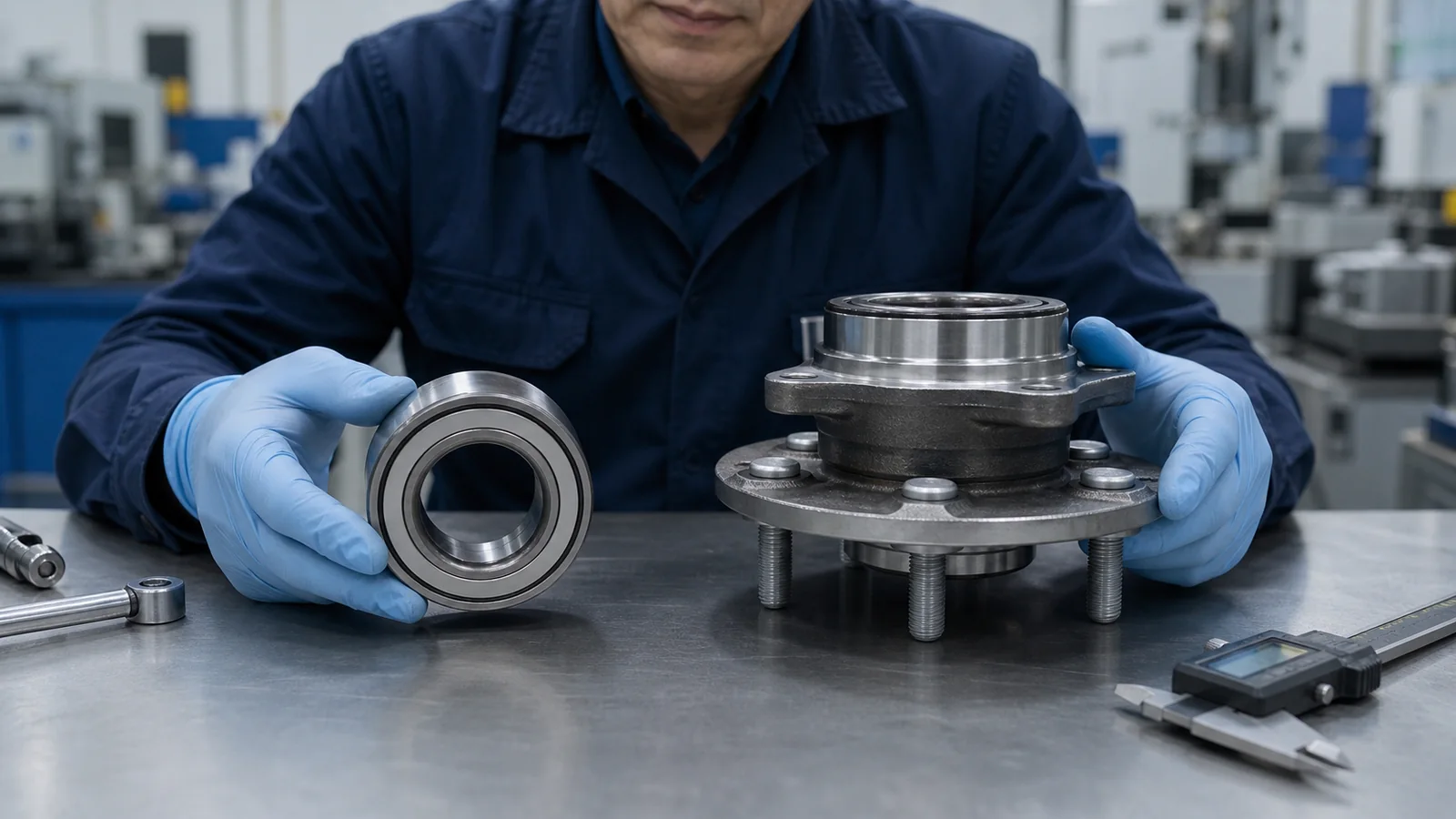
A wheel bearing is the rolling-element component that supports rotation at the wheel end. A wheel hub assembly is a more integrated replacement unit that can combine the bearing with one or more mounting flanges, wheel studs, a splined bore, seals and an ABS encoder or sensor connection. The terms overlap because later-generation hub bearings integrate functions that were separate in earlier designs, and aftermarket catalogs do not always use the same naming convention. Buyers should therefore specify the OE reference, vehicle and model year, front or rear axle, left or right side when applicable, driven or non-driven position, ABS configuration, flange and bolt details, spline count, key dimensions and required quantity. Those identifiers are more reliable than requesting a part from the words “wheel bearing” or “hub assembly” alone.
Wheel bearing and hub assembly comparison
A useful purchasing definition starts with the supplied interfaces. If the item is mainly the bearing element that must be pressed into a knuckle or hub, the catalog may call it a wheel bearing or Gen 1 hub bearing. If the supplied item includes a formed hub or mounting flange, it may be described as a hub unit, wheel hub bearing or wheel hub assembly. A fully integrated unit may also carry wheel studs, a splined center for a driven axle and ABS-related components.
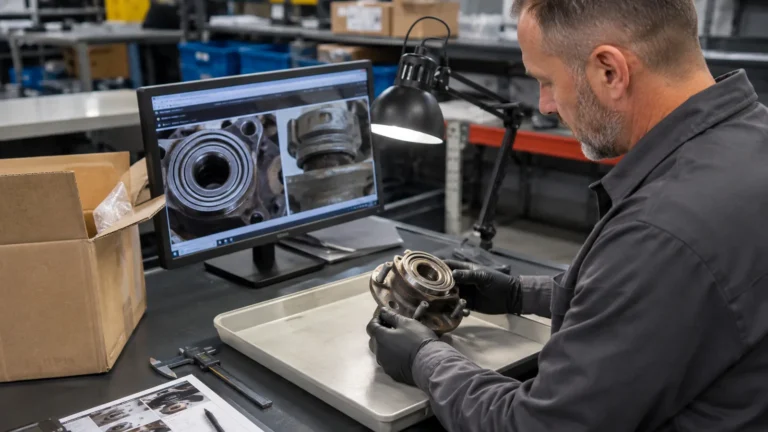
This distinction affects installation method, packaging weight, quotation comparison and the failure points a buyer must inspect. It also affects whether a photograph is enough to identify the item. Two assemblies can look similar at a distance while differing in the bore, flange offset, bolt pattern, sensor connector or magnetic encoder.
| Buying question | Wheel bearing / earlier unit | Integrated wheel hub assembly |
|---|---|---|
| What is normally supplied? | Bearing rings, rolling elements, seals and related retaining components; exact kit contents vary. | Bearing plus one or more hub or mounting functions; studs, spline and ABS features may be included. |
| How is it mounted? | May require pressing into the knuckle or hub and careful support of the correct ring. | Often bolts to the knuckle or attaches through an integrated flange; the vehicle procedure still governs installation. |
| What must the RFQ identify? | Bore, outside diameter, width, seal/encoder side and application reference. | OE number, vehicle/axle, flange and bolt data, spline, studs, ABS lead or encoder and overall offset. |
| Can the name confirm interchange? | No. Similar bearing names can cover different dimensions or encoder designs. | No. Similar housings can hide different sensor, spline, offset or mounting details. |
How do Gen 1, Gen 2 and Gen 3 hub bearings differ?
Generation labels describe increasing functional integration, but suppliers may apply the names differently. NTN describes Gen 2 products as incorporating mounting functions into the bearing rings, while Gen 3 units incorporate flanges for chassis attachment and wheel or brake-disc mounting. NTN also describes Gen 2.5 variations for particular inner-ring rotation and hub-spindle arrangements. These are design families, not a substitute for an application check.
Gen 1: compact bearing unit
A Gen 1 unit is commonly a sealed, double-row bearing without the full external mounting flanges of later assemblies. Replacement may involve a press operation, retaining ring and separate hub. The buyer should pay close attention to dimensions, the direction of any encoder ring and whether the application requires supporting a specific ring during installation.
Gen 2 and Gen 2.5: mounting functions added
A Gen 2 family adds a flange or other mounting function to the bearing. A Gen 2.5 arrangement can add a hub spindle or factory-set assembly features depending on the application. The presence of a flange does not by itself identify the vehicle: offset, hole spacing, bolt size, stud pattern and encoder design still need verification.
Gen 3: higher integration
A Gen 3 assembly generally integrates inner and outer mounting functions. Driven-wheel versions can include a splined bore, and modern units may integrate ABS or traction-control sensing features. Timken’s current Gen 3 description, for example, highlights integrated sensor capability and sealing as design characteristics. The exact included sensor, lead and connector remain part-number specific.
Buyer rule: use “Gen 1/2/3” to narrow the construction family, then confirm the OE reference and physical interfaces. Do not approve a substitute from the generation label alone.
Why do catalogs use overlapping terms?
Catalog terminology follows regional habits, supplier systems and how much of the wheel-end module is sold together. “Hub bearing” may refer to a bearing with a single flange, while “hub assembly” may refer to a bolt-on unit. Other catalogs use “wheel bearing and hub assembly” for the same style of part. Search engines therefore group informational phrases such as “wheel hub vs bearing,” “wheel bearing hub replacement” and “front hub assembly” even though a procurement team needs a more exact definition.
The overlap explains why copying a competitor title or matching a product photograph is not a safe catalog method. A useful product page should state the part number, axle position, vehicle application evidence, HJDP model, included ABS configuration and the interfaces a buyer can verify.
What should a wheel hub RFQ include?
Start with traceable identifiers, then add physical and commercial information. If an OE number is uncertain, mark it as unverified and attach a label photo, drawing or sample measurements. If the request covers many applications, use one line per configuration instead of placing several numbers in a single cell.
- OE or interchange reference: preserve punctuation and add the source catalog or label when available.
- Vehicle: make, model, model year and market; provide VIN or chassis detail when the application is ambiguous.
- Wheel position: front/rear axle and left/right side if the unit is handed.
- Drive configuration: driven or non-driven wheel, plus FWD/RWD/AWD/4WD where relevant.
- ABS arrangement: encoder ring, integrated sensor or separate lead, connector appearance and cable length when supplied.
- Mounting data: flange shape, bolt circle, mounting-hole count, wheel-stud count and thread details.
- Center interface: bore or spline count and any retaining-nut or roll-form feature visible in the reference.
- Dimensions: bearing bore, outer diameter, width, flange offset and other drawing dimensions available.
- Commercial details: quantity per part number, destination, target packaging and labeling.
- Confirmation status: identify which fields come from an OE catalog and which were measured from a sample.
For catalog browsing, use the HJDP Wheel Hub Assembly category. If the required construction is a bearing unit without the full integrated hub, compare the Wheel Hub Bearing range.
Common sourcing mistakes and how to prevent them
Approving a match from one reference number
An OE reference is the best starting point, but supersessions, regional catalogs and supplier cross-references can create multiple candidate records. Confirm vehicle, axle and sensor configuration before approving the quotation. The companion guide, How to Read a Wheel Hub OE Number and Build an RFQ List, provides a reusable spreadsheet structure.
Ignoring the ABS side or connector
A magnetic encoder can be integrated into a seal, while other assemblies use a sensor and lead. Orientation and connector details may not be clear in a front-view image. See ABS Encoder Wheel Hub Assembly Identification Guide before combining similar-looking items.
Requesting “front hub” without the drive configuration
The same vehicle family may use different front wheel-end components across drivetrain or model-year variants. Ask the buyer for the exact configuration instead of assuming that one front assembly covers every version.
Comparing quotations with different kit contents
Check whether bolts, clips, axle nuts, sensor leads or other hardware are included. A lower unit price is not directly comparable if one quotation is for a bare bearing and another is for a complete assembly or kit.
Using one generic product description across several constructions
A distributor catalog should not describe every wheel-end item as the same “premium hub bearing.” Separate construction fields make the range easier to search and easier to quote: bearing or assembly type, axle position, driven status, flange count, ABS arrangement, spline, studs and verified application. Product copy can then explain only the facts supported for that item. This approach also gives search engines and AI answer systems a clearer relationship between the category guide and the individual OE-number pages, without generating hundreds of near-identical paragraphs.
For a large assortment, nominate the category page and these guides as the main indexable cluster, then index individual product pages only when their identifier, application and specification data are complete. This reduces index bloat while preserving a searchable catalog for buyers who arrive with an exact number.
A practical decision tree for choosing the correct construction
Begin with the way the component is removed and installed in the target application. If the service procedure describes pressing a sealed double-row bearing into a knuckle or separate hub, the request is likely for a bearing unit rather than a complete bolt-on assembly. If the component bolts to the knuckle through an integrated mounting flange and carries the wheel studs, the requested item is more likely a hub assembly. This is only the first branch of the decision tree: the buyer must still confirm whether the wheel is driven, whether the center is splined, and whether the sensing target or sensor is included.
The second branch is the supplied interface. Ask which surfaces and fasteners connect the replacement part to the vehicle. A bearing may be retained by a snap ring and supported by a separate hub. A more integrated assembly can include a knuckle flange, wheel flange, studs and a center spline. Some kits add an axle nut, retaining ring or mounting bolts, while others supply only the core unit. Record each included item instead of treating the word “kit” as a fixed specification.
The third branch is sensing. A vehicle without wheel-speed sensing at that position may use a visually similar mechanical unit, while an ABS-equipped application can require a magnetic encoder, tone ring, integrated sensor, external lead or a target that works with a separate vehicle sensor. The sensor side, cable route and connector are configuration fields, not optional marketing details. If the evidence is incomplete, classify the quotation as a candidate and ask for additional photographs or application data.
How to compare supplier quotations on an equal basis
Unit price is meaningful only when the quoted construction, included hardware, validation evidence and commercial conditions are comparable. Create a quotation comparison sheet with one row per OE/application line and separate columns for the supplier model, construction family, flange count, studs, spline, ABS arrangement, included hardware, packaging, minimum order, lead time and validation status. This makes an apparent price difference easier to explain and prevents a bare bearing from being evaluated against a complete hub kit.
Ask the supplier to return the same line identifier used in the RFQ. If a requested OE number has been superseded or combined with another reference, the response should preserve the original number and state the proposed replacement separately. A quotation should also identify unresolved fields. A blank ABS column should not be interpreted as “without ABS,” and a generic vehicle description should not replace the exact model-year or chassis evidence supplied by the buyer.
- Compare the physical construction and all included hardware.
- Confirm the quoted application, axle, side and drive configuration.
- Separate verified facts from catalog cross-reference candidates.
- Record sample, drawing and photo revision used for approval.
- Compare packaging, labeling, inspection and traceability requirements.
- Return questions against the buyer’s original RFQ line ID.
Sample approval and receiving inspection
For a new application, sample approval should connect the part to a controlled evidence set. Photograph both faces, the mounting flange, wheel studs, center bore or spline, seal or encoder side, cable and connector when present, and the product label. Record the dimensions that can be measured without damaging the unit. Link the approved sample to the supplier model, OE and cross-reference list, application, drawing revision, packaging specification and approval date.
Receiving inspection should verify identity and condition against that approved record. Check labels, packaging, visible corrosion or impact damage, flange and stud condition, connector protection and the presence of agreed hardware. Dimensional checks should use the drawing and agreed inspection method; a few visually convenient measurements cannot prove complete interchangeability. If the received part differs from the approved sample or drawing, quarantine the affected line and resolve the revision before product pages or customer catalogs are updated.
This approval discipline also improves SEO content. Product pages can state verified construction, interfaces and kit contents instead of repeating generic claims. The guide page explains the buying method, the category page organizes the range, and each qualified product page answers an exact OE or application need. That hierarchy is more useful to buyers than publishing many near-identical pages with only a number changed.
Related HJDP resources
- Browse Wheel Hub Assembly products
- Browse Wheel Hub Bearing products
- Read the wheel bearing installation overview
- Learn about Jinan Huayuan Auto Bearing
- Request an OE fitment review and quote